

Last week in Tynwald, Mr Robertshaw observed: “I am becoming more and more uneasy now as these Regulations reach further and further into detail and complexity. I think actually we are seeing this afternoon the limit of the reach or the ability of emergency regulations to make sense. I think if this continues my degree of unease will grow significantly to the point that I will actually start saying no, and I will no longer support these sorts of regulations. They are getting too complex, we have to think again”. This may be a good point to reflect on the shape of the Emergency Powers Regulations.
Using numbers as a way of understanding laws can be eye catching, but should be approached with serious caution. Not all laws are equally important, and the length of a law is no guide to importance either. A purely numerical approach might take an Act introducing the election of MHKs as being as important as an Act removing the voting rights of the Attorney General in Tynwald. If we reach below the level of Acts to particular sections, a detailed Act amending say the Companies Acts may seem vastly more significant than a short act abolishing capital punishment for murder. With that caveat, some numbers as a way of understanding the EPRs!
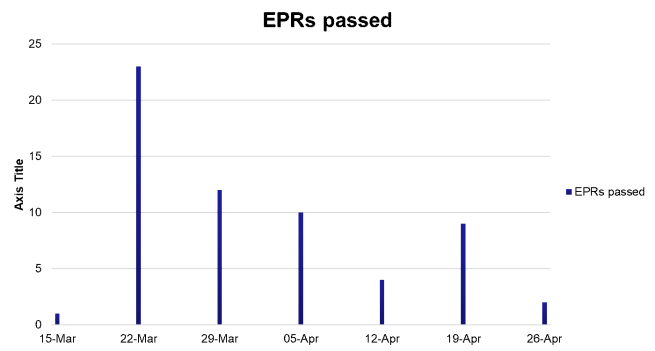
The number of Regulations created each week ramped up rapidly at the start of the crisis, and then fairly consistently drop.
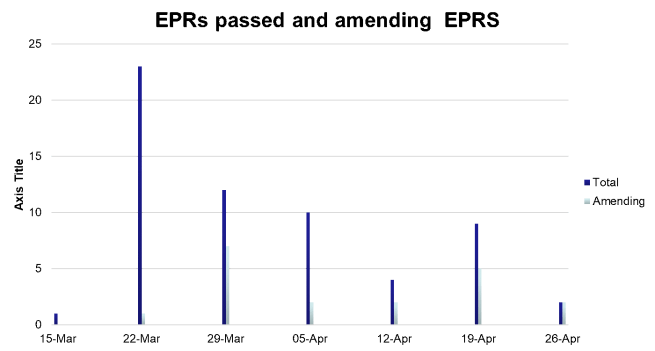
Regulations amending earlier Regulations begin to pick up after the peak of new Regulations has passed. Some of this is substantive change to policy, but a significant amount of it is fixing problems that had become apparent after the Regulations were drafted and came into effect – notably identified by members of Tynwald during approval of the Regulation.
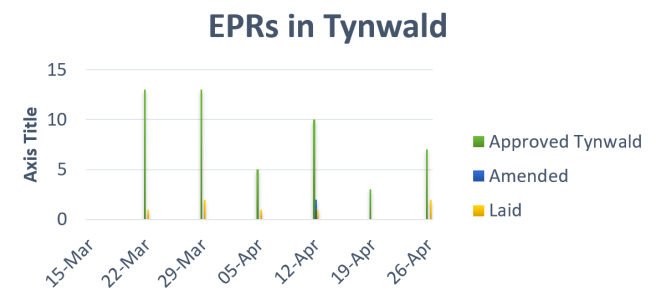
Unsurprisingly, given the rules for approval of EPRs, we see approval by Tynwald off-set by a week from the creation of the EPRs. The vast majority of EPRs were put to Tynwald for approval. A small number were allowed to lapse, and in one week (12 April) we have Tynwald exercising its powers to approve subject to amendments for two EPRs.
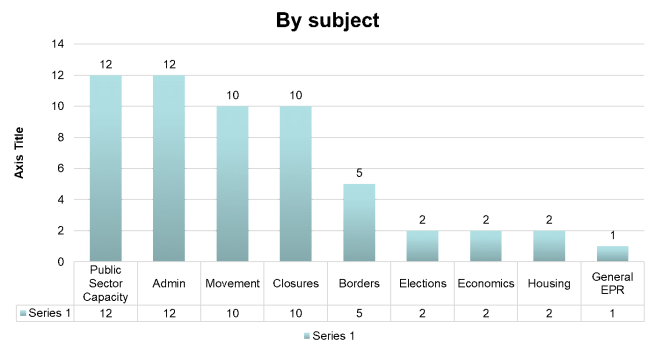
Finally, turning to subject matter, my categories are inevitably subjective, and I have treated each EPR as only falling into one category. I am likely to revise these subjects once the state of emergency has ceased; and, given what the Chief Minister has said about how EPRs are generated, mapping EPRs onto Departmental portfolios may also be useful. For the moment, it does give a sense of the centre of gravity of the EPR response.
 Peter Edge's Law Blog.
One thought on “The Emergency Powers Regulations in numbers, as of week commencing 26 April.”