
The results of the 2026 General Election to the House of Keys.

So, the results are in, and a new House of Keys is preparing to face the challenges that lie ahead. With such a small number of MHKs each election, you need to be quite careful about seeing information where there is just variation. Nonetheless, a few thoughts about the results of the 2026 election.

A more male House of Keys? Slightly.

The last election resulted in a record number of women MHKs, with 10 women sitting. This was on the back of 16 women standing, itself a record number of women standing. This election saw even more women standing – 26, being 31% of the total candidates rather than the 25% of 2021.

A higher proportion of women candidates has not translated into a higher proportion of women MHKs, with 8 elected. Of these 8, 4 were incumbents. So success for both women candidates, and women incumbents, very much tracks the success rate for candidates generally.

Nonetheless, despite this not being a departure from the century long norm that women who stand are successful at broadly the same rate as men, there are fewer women MHKs. In itself, should this be a cause for concern?

The global literature suggests that there is a critical mass, beyond which women in the legislature “becomes normal, widely accepted and irreversible” (Fraenkel, 2006). Thirty percent is often suggested as the point at which critical mass is reached. This was reached for the first time in 2021, and has been retained in 2026. In the Manx context, it may be that critical mass was earlier than 2021: there is some evidence, from the Women in Manx Politics project which I led, that the election of five women in 2016 caused a significant shift in the culture of the chamber.

A new House of Keys? Ish.

Of the 24 MHKs elected, 15 are new to the Keys, and 9 are incumbents who retained their seats (although may be changing where they sit physically in the House of Keys).

The House of Keys is considerably more volatile than the House of Commons. In that context, only 9 MHKs being re-elected is not unusual. In 2021 10 were re-elected, and in 2016, 8. It represents a considerably more stable House than in 1986 (the election with the fewest incumbents staying in the House), when only 4 incumbents were elected; but considerably less than 2001 (the election with the most incumbents staying in the House), when 18 incumbents retained their seats.

As noted earlier, this election had a record number of candidates come forward. Looking at success rates, the 1919-2021 data indicates a 78% success rate for incumbents, against a 46% success rate for candidates as a whole. In this election, reflecting the unusually large field, we have a 28.92% success rate for candidates as a whole; and a 56.25% success rate for incumbents. So incumbents retain a very substantial advantage, even where the success rate for both incumbents and newcomers has dropped.

A Keys of Independents? Definitely.

Again, an election dominated by Independent candidates has led to a Keys overwhelmingly composed of Independents. Only the Manx Labour Party enjoyed any success, retaining 2 seats (having fielded four candidates); while Liberal Vannin lost its only MHK (having fielded four candidates); and the two new parties who contested the election did not gain any (with Transform fielding 2, and The Change Movement 5). Party candidates represented 18% of the candidates, and secured 8.33% of the seats. This substantial underperformance compared with independents does not suggest strong party institutionalisation anytime soon.

The youngest MHK ever? I’m going yes, with one reservation.

Daniel Davison was elected for Glenfaba and Peel in an unusually close poll (with the top three candidates polling 1232, 1147, and 1073). At 18, he has been reported variously as the youngest every person to be elected to the House of Keys, and the youngest MHK in history. These are different claims, and I am more confident of one that the other.

There are many ways of understanding “elected” – for instance, MLCs are appointed through election by the House of Keys, but their role is often criticised on the basis of their being unelected. If we take the general meaning of “elected by the general public”, I think Davison is the youngest person to be elected as an MHK.

When elections to the House of Keys were introduced by the House of Keys Election Act 1866, candidacy was limited to property-holding males of full age (s.46). Before 1971 full age (also described as majority) was 21. So even though finding the ages of candidates and MHKs is not always straightforward, I am confident that no one younger than 21 was elected between 1866 and 1971. In 1971 the age of majority was changed to 18 by Part I of the Family Law Reform (Isle of Man) Act 1971. Since 1971 there have been some comparatively young MHKs (Peter Karran was hailed as the youngest ever when he was elected just before his 25th birthday in 1985, while Juan Watterson was 26 when elected in 2006), but no other 18 year olds.

Whether he will be the youngest ever MHK is a little less clear. Before 1866 MHKs were elected mainly by other MHKs, and there were definitely political families with multigenerational expectations of joining the Keys. Records of the unelected Keys are much less accessible than those of the modern Keys, but I think we can find at least one person, from a prominent Manx family, appointed at the age of 21.

John Christian Curwen was born in 1756, and according to AW Moore’s “Extracts from the Journals of the self-elected House of Keys”, entered the Keys in 1777, sitting as a member for 51 years. Christian Curwen was born on 17 July 1756. It is *possible* he was appointed to the Keys before he was 21, but his signature does not appear in any of the 1777 legislation, and so being appointed very soon after he turned 21 seems likely. If so, there may have been a norm of only appointing MHKs who had reached the age of majority, which pre-1971 was 21.

So, I cannot be categorically sure, without a substantial project to find the ages of everyone appointed to the Keys before 1866, but I think it very likely that Davison will also be the youngest person to serve as an MHK.

Standing for two seats did not result in an MHK elected to two seats.

Nigel Dunmore stood for both Ramsey and Garff. He polled 286 votes in Garff (against the lower MHK elected on 968), and 162 in Ramsey (against the lower MHK elected on 1395). So this may not have been an appealing tactic to his two electorates.

English law does not allow a candidate to stand in a General Election for the House of Commons in two constituencies. The Representation of the People Act 1983 sch.1 para 8.3 requires a candidate to state that that he or she “is not a candidate at an election for any other constituency the poll for which is to be held on the same day as that for the election to which the consent relates”. I cannot find any equivalent piece of Manx legislation relating to elections preventing this; nor discussion in election law or the Standing Orders of the House of Keys or Tynwald about what would happen if a candidate were successful in both seats.

It may be worth either stating how a doubly-successful candidate is to be treated (which may be quite complex), or ruling out candidates standing for two seats in the same General Election by drawing on the existing English model.

Small numbers of votes count.

This is Inevitable in a system with such small constituencies, but there were a number of close polls; albeit not record breaking. The closest result was in Douglas East, with Joney Faragher being elected on 682, and Dave Mackey not being elected on 632.

The constituencies for the Keys are intended to produce constituencies of similar sizes, so that a vote is of roughly equal power whatever constituency you are in. Differences in the turnout between constituencies, and differences in the number of candidates can, however, result in the votes needed to become an MHK varying considerably from constituency to constituency. This time, the candidate with the most votes who was not elected was Steve Crowther with 1251 in Arbory, Castletown and Malew. The MHK elected with the least votes was Joney Faragher with 682 in Douglas East.

So, what next?

Knowing who the 24 MHKs will be does not tell us much about who the next Manx Government will be led by. Appointing the Chief Minister will be one of the first acts of the new House of Keys when it meets in October. In the Manx system, with only a marginal role for parties, MHKs need to decide which of their colleagues to support to become Chief Minister.

There is no formal role for voters – unlike Parliamentary systems with strong parties, voters cannot know in advance how their vote could translate into a particular head of government; unlike the Kiribati system, voters are not asked to choose between candidates for head of government once the legislature has formed; and unlike some Presidential systems, electors do not vote for the head of government directly.
The candidates for the 2026 election to the House of Keys.

The nomination process has now been completed, and Notices of Poll have been issued for each of the 12 constitutencies.

None of the 12 constituencies are uncontested. Instead, with 83 candidates standing, this is a year in which the electorate have an unusually broad choice. At the last general election 65 candidates came foward, and in the one before that, 63. So a 28% rise in the number of candidates coming forward this time. Indeed, it is a record number of candidates, with the next highest being the 73 of 1991 – one of the two General Elections held under an alternative electoral system, both of which had an unusually high number of candidates come forward. We need to go back to 1976 to find the next highest number under the first past the post system: 71 candidates.

Of these candidates, 16 are incumbents – that is, candidates who were MHKs in the same seat before the Keys were dissolved in August, and who are seeking reelection. So, 66% of MHKs in the last Tynwald have decided to run for relection. This is not unusual in the Manx system – for instance this number was 79% in 2001, and 67% at the last election. Incumbents tend to be elected in greater numbers than new candidates across the world, and across other small democracies. Aggregating all Manx General Elections since 1919, we find a 78% success rate for incumbents, and 46% for candidates as a whole. Not every constituency has been offered a chance to reelect a sitting MHK however – neither of the former Glenfaba MHKs has come forward; and in 6 of the other constitutencies only one incumbent is standing. Although not an incumbent, Martyn Perkins is returning to contest the seat in Garff which he held until the last General Election.

Turning to gender, 26 women are standing, with at least one woman standing in every constituency. This is a record number of women candidates – the next highest being the 16 who came forward in 2021. In the 2021 election, women were 25% of the candidates, in this election 31%. Viewed across the entire period for which women have been eligible to be MHKs, success rates for women and men tend to be very much the same, once the decision has been made to stand. At 53%, a high proportion of the incumbents standing are women. Combining the incumbency effect with the increased number of women candidates, it is not unlikely we will see an increase on the number of women MHKs in 2026, even on the record number elected in 2021.

Finally, in relation to parties, five political parties were registered to support candidates in this election. The Green Party has not fielded any candidates. The Manx Labour Party, the only party to have contested every General Election since 1919, has fielded four. Liberal Vannin has fielded four. Transform Isle of Man has fielded two (both in the same constituency). The Change Movement has fielded five. Combined, these 15 party candidates represent 18% of the candidates, and a similar percentage of the incumbents standing. This is in line with the role of parties in 21st century General Elections, and indeed since the 1970s. Given that party endorsement does not translate to an unusually high level of electoral success, it is likely that the House of Keys will remain a chamber dominated by Independents.

Newly available in the UK National Archives: July 2026.

Looks like I missed a six monthly round up, so a year’s worth of newly released records in this post! The most interesting files have just been released.

Records being released are now a mix of records downloadable for free; and files now accessible in the National Archives. So in the roundup I will focus on downloadable records, and give a link to them.

Downloadable.

Possible independence was a cause for discussion in the wake of the Edwards Review of financial regulations in the Islands (on which, I suspect see the file on fiancial regulation in UK dependent territories 1991-1995, not online but can be consulted as HO 248/507). A 1998 “contextual note” begins planning for island responses to the Edwards review, seeing three possible scenarios – acceptance of the recommendations by the Islands, imposition of the recommendations on the Islands by the UK, or independence rather than accepting imposition. The note suggests that independence planning discussions had begun with the Treasury (islands as IFCs), the DTI (dubious companies). defence (MoD), fisheries (MAFF/DTI/FCO), air space (DETR), broadcasting (DCMS/Radio Communications Agency), immigration and nationality (HO Immigration and Nationality Directorate), and counter-terrorism and organised crime (HO Organised and International Crime Directorate). The complete document is available to download for free.

From the list of specialists who were to be consulted after the contextual note was written, we can expect a bumper crop of UK specialist reflections on Manx independence. The 1998 document was released on 1 June 2026, so assuming the same closure conditions for replies from other agencies, we should see them being released gradually over the next six months or so. One has already been released.

The Inland Revenue advised the Constitution Unit on the impact on the UK Exchequer of independence by the Isle of Man or one or more Channel Islands. This is an interesting document, comntaining as it does a list of advantages and disadvantages, from a financial point of view, to the UK from such a change. For instance, a reduction of inward investment from a newly independent island to the UK was identified as a risk. There is also a brief consideration of possible disadvantages to the islands. The complete document is available to download for free.

On the related issue of taxation and international relations, there is an entire thread of faxes on the Manx response to the 1998 OECD request for comments on their report on Harmful Tax Competition. Comments were produced by HM Treasury, generally approving although suggesting the draft was “a little bit too rude to be most effective”. The complete document is available to download for free.

Released but not downloadable.

There are also:

  • a 2005 report on the reciprocal National Insurance relationship. Not available online, but can be consulted as PIN34/2146.
  • a 1995 correspondence on Council of Europe agreements applicable to the Isle of Man. Not available online, but can be consulted as FCO 33/13752.
  • a 1997 correspondence on draft Manx legislation dealing with money laundering offences. Not available online, but can be consulted as HO 634/172.
  • Information, from 1924-1940, on the Isle of Man and Channel Islands yield, rate of tax etc.. This was closed for 85 years, so may have information on individuals. Not available online, but can be consulted as IR 64/54.
  • The usual release of Manx prisoner of war records from World War Two: John Karran, and Douglas Gill; and aviation incident reports from wartime air bases (AIR 81/23905).
  • Two reports on international cooperation. The 1998-2001 file is not available online, but can be consulted as HO 634/206 and HO 634/205..
  • “Outport records: Isle of Man”, goods warehoused for duties in Yarmouth 1820-1921 (not available online, but can be consulted as CUST 104/311), and in QUeens 1960-1976 (can be consulted as CUST 104/312).

Baroness Finlay’s Amendment that Never Was.

In February 2026, Baroness Finlay of Llandaff tabled an amendment to the Crime and Policing Bill then going through the Lords which referred to the Crown Dependencies. In particular it would have restricted liability for assisting suicide in Scotland or the Crown Dependencies. It would have excluded actions under assisted dying laws in those jurisdictions from being capable of amounting to assisting suicide; and in addition have created a defence where a person “(a) reasonably believed they were acting in accordance with relevant legislation in those jurisdictions and (b) took all reasonable precautions and exercised all due diligence to avoid the commission of the offence”.

Baroness Finlay did not move the tabled amendment, on the basis that “I was contacted by the Chief Minister of the Isle of Man, who felt that it was premature: they had not been consulted, their Bill has not received Royal Assent, and they felt that a considerable number of parliamentary colleagues would be greatly concerned if this was to pass as an amendment without formal consultation”.

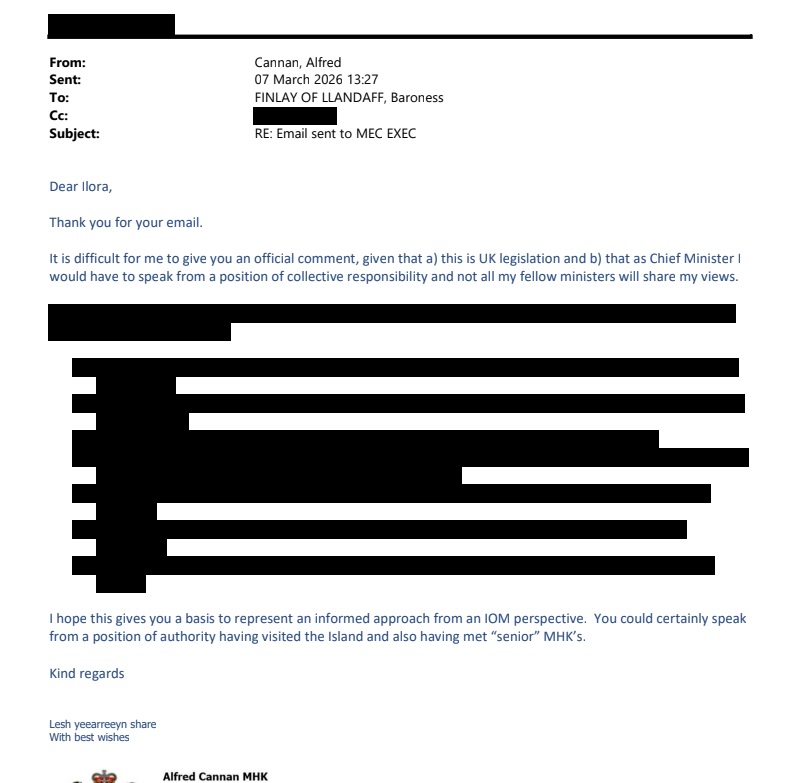
Correspondence between Baroness Finlay and the Chief Minister has been released under a Freedom of Information Request. It is worth embedding the image of the key email.

The Chief Minister gives two reasons why it is difficult to give an official comment, before sharing 15 lines of redacted text. The second is his position as one member of the Council of Ministers, who do not share the same view on assisted dying in the Isle of Man; leading to a concern that the Chief Minister was being accused of having “personally intervened in the process inside a Westminster piece of legislation”. The first is that “this is UK legislation”. What does he mean?

The UK Parliament retains the legal authority to legislate for the Isle of Man by Act of Parliament. The modern constitutional position is that only in exceptional circumstances should this be exercised without the consent of Manx authorities.  So in some instances it is not only permissible, but expected, that Manx views on UK legislation will be expressed. This is, however, UK legislation which is intended to extend to, or provide for the later extension to, the Isle of Man.

The Finlay amendment, despite the reference to the Crown Dependencies, would not have changed Manx law. It is worth unpacking this a little.

In some cases, criminal liability can attach to a UK resident for actions committed outside of the jurisdiction. Generally, however, criminal liability does not attach for acts committed outside the jurisdiction, although the courts can be flexible in how they interpret where an act is committed – for instance, a letter sent to a person in Germany which constituted a demand with menaces resulted in prosecution of the English poster, on the basis that the demand was made as soon as the letter was posted. The location of the offence was grounded in where the criminal act began (England, with the posting of the letter), as opposed to only where the final act occurs (Germany, with the reading of the letter).

The Suicide Act 1961 created specific offences of aiding and abetting suicide. In Purdy the House of Lords considered whether these offences applied to deaths which were intended to occur outside of the jurisdiction, in this case Switzerland. There were significant differences of opinion in the House of Lords (perhaps most clearly between Lord Phillips and Lord Hope), but the majority considered it was not necessary to resolve the issue if it was in doubt – that is, if it was not impossible that the offence would be committed if the death occurred abroad, then the arguments for clarity put forward by Purdy would apply.

As a result of Purdy, the CPS published detailed guidance on prosecutorial policy in related to encouraging or assisting suicide.  This includes the specific statement that:

“This policy applies when the act that constitutes the encouragement or assistance is committed in England and Wales; any suicide or attempted suicide as a result of that encouragement or assistance may take place anywhere in the world, including in England and Wales.”

If it was not impossible that an English resident could be prosecuted for aiding and abetting a suicide which lawfully occurred in Switzerland, it was not impossible that they could be prosecuted for aiding and abetting a suicide which lawfully occurred in the Isle of Man. It was this rule of English law – enforced in the English courts for acts which occurred in England – that would have been changed by the amendment, rather than any rule of Manx law enforceable in Manx courts.

In that sense, this was UK legislation for the UK.

Preparing for the Manx General Election 2026 – candidates and voters.

As a final output from the Women in Manx Politics project, in April 2026 we ran two events on the Isle of Man – one aimed at young voters voting in their first Manx General Election; and another aimed at those considering standing for election to the House of Keys in this General Election.

Due to technical problems, we weren’t able to record these live as planned; but we have now produced videos with the content we covered on the night.

For young voters:

For those considering standing for the House of Keys:

These are the last planned activities emerging from the Women in Manx Politics project. So a good moment to express our thanks to everyone who made the project possible – notably Culture Vannin, Oxford Brookes University, University College of the Isle of Man, and everyone who shared their time and insights with us during the project.

It was a really interested multiyear project, and I was blessed with two excellent colleagues in Catriona Mackie and Alex Powell. We all brought something different to the project, and the project was without doubt stronger for that. So personal thanks to Catriona and Alex.

Three ideas for a PhD project.

One of the striking things about a UK PhD in an area like law or history is how we look to a candidate to have the fundamental idea for what they want to spend four years becoming a world expert in at the start of their doing so. My doctoral idea changed significantly through the process – most notably having the timescale reduced from “mad” to merely “very challenging” – but the fundamental idea was largely the same. Colleagues supervising students working as teams in labs they supervise find this a big thing to ask of someone at the start of their research life.

So, in case you are at the stage of thinking about doctoral work in law or history, here are three topics which I think are live intellectually, interesting, ambitious, but doable in the confines of a doctoral project. I would be very pleased to supervise a suitable student in any of them but, as they say, other supervisors are available and I will not take umbrage if one of these gives you the start of an idea best pursued elsewhere!

Borders and the Crown Dependencies since Brexit and the Coronavirus Pandemic.

The Isle of Man, Jersey, and Guernsey share both islandness, and a semi-autonomous relationship with the UK. Brexit shifted the wider frame in which this relationship operated, putting a new emphasis on the Common Travel Area. More powerfully, a common response to the global Coronavirus pandemic by all three jurisdictions was to close their borders – with a rigour, and penalties, not seen elsewhere in the British Islands. In the Isle of Man for instance, details of border control were regularly debated throughout the pandemic, with border control against travellers from the UK being seen as self-evidently a concern for Tynwald. Post-pandemic, border control has been given new prominence as part of policing the Islands. How have island attitudes to their borders changed over time? How far have the Islands moved into regulatory space formerly seen as part of the “external” matters in which the UK operated for the islands? What similarities and differences do we see across the three jurisdictions? What accounts for these patterns? What are the policy challenges and opportunities insular border-mindedness pose?

Calls to public attitudes in small democracies.

One of the recognised features of small democracies is the concentration of political power in a small number of individuals, even when the number of elected officials per head is much larger than in larger democracies. Another is the intimacy of small democracies, with unmediated relationships between politicians and individual constituents the norm rather than the exception. This raises some interesting questions around calls for public consultation, particularly when unusually extensive (such as with the Manx and Jersey assisted dying legislation). What role does formal public consultation have in small democracies? How is it carried out? How far, if at all, are those outside of the small democracy excluded from the consultation? How do formal referenda – whether hard or soft – and citizens assembles fit into this landscape? Given their special characteristics, how can small democracies most effectively make use of public consultations?

The Irish influence on Manx Independence and Autonomy in the 20th century.

As an unintegrated possession of the UK crown, most obviously since the Revestment of 1765, the Isle of Man has been the potential locus of a tension between national identity and loyalty to the state. Revestment itself was seen by some as part of a broader rebalancing of the British Empire, one which could be resisted by the (distant) rebels of North America, but not by the Manx. From the late 18th century on links were drawn with experience in Ireland, both by the state, and by those opposed to it. As might be expected, 1916 merits sustained attention: UK troops were deployed at the 1916 Tynwald, and Manx nationalists of Mec Vannin obscurely, but fascinatingly, were guests marching to commemorate the Easter Rising fifty years later. How far were Manx attitudes to their constitutional position shaped by the radically changing position of Ireland throughout the 20th century? How far were UK approaches to Manx autonomy shaped by the UK experience of Ireland?   

Is refusing Royal Assent to the Assisted Dying Bill a constitutional crisis?

The short answer is no. But this is because of the basis for the refusal, and exactly what has been done by the UK government, so it is worth giving the long answer.

Why does an Act of Tynwald need Royal Assent, and who gives it?

Historically, every Act of Tynwald needed the support of Tynwald (in some centuries, a fairly amorphous concept), and the assent of the King, later Lord, of Mann. With the vesting of the rights of the Lord of Mann in the UK Crown, this came to be exercised by the sovereign of the UK – whether by virtue of their title as Lord of Mann or as UK sovereign is a matter that need not delay us. In practice, since 1981 many Acts of Tynwald receive Royal Assent from the Lieutenant-Governor, rather than directly from the UK Crown.

In the UK, Royal Assent to an Act of Parliament is formally by Charles III as a “personal prerogative”, but in constitutional  practice he will always do so. In the UK context, there has been controversy over whether the Crown could refuse assent when required to by the UK Government – rather than their own judgment – but the consensus is probably that expressed by Paul Evans in 2019:

“in all foreseeable circumstances short of a revolution (or counter-revolution perhaps) there is no executive veto in the British constitution over legislation after it has been agreed by parliament”.

The Manx position is very different. There is no internal executive veto. The Council of Ministers has no authority to direct the Lieutenant-Governor, or the Crown, to give or withhold consent to an Act of Tynwald. Instead, there is an extremely long history of Bills passed by Tynwald being refused Royal Assent by the Crown acting on the advice of their United Kingdom ministers.

When can UK ministers withhold Royal Assent?

As with many constitutional issues, there is a difference between the legal rule, and the constitutional rule. The legal rule is that the Crown may withhold Royal Assent upon any ground, and the UK Government may advise the Crown to do so on any grounds. The constitutional rule, however, is rather narrower. As with many issues touching on Manx autonomy, the further back you go, the more willing the English/British/UK authorities were to intervene in Manx affairs.

There are numerous examples from the 19th century of a prospective Act of Tynwald being refused Royal Assent simply because the UK government thought it should not become law. This might be because the Bill was seen as badly drafted (such as the Petty Sessions Bill 1864), or because it introduced rules different from English law. My favourite example is the 1849 Bill to reduce the scope of capital punishment, which was rejected because “it [was] an important departure from the law of England”.

With the changing understanding of the relationship between the Isle of Man and the UK, and in particular of the autonomy of a democratic Tynwald, this and other grounds have fallen away. Today, the “strong presumption” (Barclay v Secretary of State for Justice [2014] UKSC 54 para.16) and almost invariable practice is that a Bill passed by Tynwald should receive Royal Assent – the Manx Attorney General advises the (UK) Ministry of Justice they have no objection to the Bill being passed into law, the Ministry of Justice then advises the Lieutenant-Governor that they may use their powers to grant Royal Assent. Two grounds for exceptional intervention seem to have survived – “fundamental constitutional principles” and compliance with international law.

The “fundamental constitutional principle” ground risks being interpreted very broadly. In 1855 a Bill to provide for the speedy capture of sheep stealers was refused Assent “in consequence of their Lordships having been advised that its leading principle was contrary to the tenets of British jurisprudence”.  Today, it is likely to be interpreted narrowly. An extremely rare example, from the Channel Islands, concerned constitutional reform in Sark.  In 2008 Royal Assent for a measure to create a new democratic legislature for Sark was refused on the basis that it was “inconsistent with basic democratic principles, some of which were set out in the European Convention on Human Rights”. When a revised law was resubmitted by Sark, the Lord Chancellor judged it to be acceptable and recommended it for Royal Assent, which it duly received. As with other aspects of the ultimate responsibility of the UK Crown for good government in the Isle of Man, it is likely only to refer to extreme situations such as “a fundamental breakdown in public order or of the rule of law, endemic corruption in the government or the judiciary or other extreme circumstance”

The other ground, and the one upon which I read Royal Assent being refused here, is that the legislation would put the UK in violation of its international legal obligations. The Isle of Man, although increasingly active on the international legal stage in the 21st century, is not a sovereign state. International obligations applicable to the territory of the Isle of Man are obligations of the UK. So, for instance, when Tyrer was judicially birched in the Isle of Man this was by Manx officials executing a sentence passed by a Manx court under a Manx statute – but the violation of international law was by the UK.

When would withholding Royal Assent have been a constitutional crisis?

As I say, in law, the Crown could withhold Assent for any reason. If Royal Assent had been withheld simply because the UK Government did not share the view of Tynwald as to what an assisted dying law should consist of, however, that would have been such a substantial reversal of the growth of Manx autonomy as to trigger a constitutional crisis. Given that the UK has been wrestling with assisted dying legislation at the same time as Royal Assent was being considered, it was reasonable to worry that this was the basis for the drawn out process of giving Royal Assent, signalling an approach to Manx legislation which was “paternalistic and unnecessary” .

From the limited data currently in the public domain, as indicated by the Chief Minister in March, that has not happened here. Instead, Royal Assent has been withheld under the international obligations ground. The Cabinet Office press release stresses this basis for refusal of assent:

“The Ministry of Justice duly consulted with the Isle of Man Government, seeking clarity on the proposed arrangements for the independent monitoring of assisted deaths, safeguards against coercion, and ensuring that individuals have the capacity to make informed decisions regarding assisted dying.

The consultation culminated in the Isle of Man Government providing comprehensive assurances outlining a number of commitments intended to address the issues raised. While these commitments would, if fully implemented, mitigate the legal risk significantly, they do not form part of the Bill.

It is therefore the UK Government’s view that these matters must be addressed directly on the face of the Bill to comply with the European Convention on Human Rights.

It is on this basis that the Ministry of Justice is unable to recommend the Bill for Royal Assent at this time”.

Royal Assent, then, has been withheld on the basis of the need to meet the international legal obligations of the UK under the European Convention on Human Rights. From earlier discussions shared by the Minister for Health and Social Care, a particular concern is to ensure that the obligations under the ECHR as interpreted in Mortier v Belgium are met. These same obligations were considered by the UK DHSC in relation to the English Bill to allow assisted dying, which discussed the safeguards in the English Bill at length, concluding that the English Bill met ECHR obligations.

Although this sort of issue is normally dealt with before a Bill is considered for Royal Assent, it is not a constitutional innovation, nor the basis for a constitutional crisis, for a Bill passed by Tynwald to be refused Royal Assent because it is incompatible with the international legal obligations of the UK. So long as the UK is responsible for Manx violations of international law, this ground for refusing Royal Assent seems inevitable. To quote Lady Hale from Barclay (para. 48):

“It is the clear responsibility of the United Kingdom government in international law to ensure that the Islands comply with such international obligations as apply to them. Just as the United Kingdom Parliament has the constitutional right to legislate for the Islands, even without their consent, on such matters, so must the United Kingdom executive have the constitutional power to ensure that proposed Island legislation is also compliant. As was pointed out in evidence to the Kilbrandon Commission, to hold otherwise would be to assign responsibility to the United Kingdom without the power to put that responsibility into effect”.

Bonus constitutional crisis averted: A disallowance power?

The actual correspondence from the Ministry of Justice is not available, but it is referred to in the Cabinet Office press release which announced the withholding of Assent. There it was said:

“This should not be interpreted as disallowing Royal Assent; nor does it prejudge the policy merits of assisted dying. It reflects solely the need to ensure that the legislation once enacted contains the necessary protections required under the European Convention on Human Rights”.

My best guess is that the reference to “disallowing” here is to make the objection to the legislation as it currently stands, rather than all assisted dying legislation, clear. As with Sark in 2008, a Bill which addresses the concerns of the Ministry of Justice would receive Assent. Unfortunately, “disallowance” has a very specific technical meaning which it would be unfortunate to see become a live part of the Manx constitutional landscape.

As a general rule of Imperial constitutional law, the Crown was able to disallow the legislation of dominion legislatures, other than the Imperial Parliament. Because Acts of Tynwald after 1765 required the assent of the British Crown, refusal of Royal Assent was occasionally referred to, inaccurately, as disallowance. Disallowance proper, by which is meant the negation of an Act of the national legislature by a later Order in Council deriving authority from the prerogative, rather than an Act of Parliament, is very different. When Royal Assent is refused, a key part of the legislative process has not been completed – there is no national law. A disallowance power, on the other hand, is exercised to negate a piece of national law which has been passed – as we find, for instance, in the Australian Constitution s.59.

I am aware of only one example of a disallowance power being exercised in relation to the Isle of Man, and it is both elderly – dating to 1900 – and ambiguous. The Companies Act 1900 had passed all stages of legislation “and the Order in Council [had] actually been made approving it, and … [was] … lying in the [Home Office]” when objections were first raised. These were sufficiently persuasive to render the Act undesirable, and the question arose as to whether it could be annulled. K. Digby noted: “We can find no precedents of a revocation of an Order in Council with reference to Isle of Man legislation but there are abundant cases of alteration and variation of other Orders in Council”. The Manx and English Law Officers agreed that the Act could properly be dealt with, since it had not been promulgated and so was not law, by the Order granting assent being repealed by another Order. Even this single precedent leaves open the question of whether an Act of Tynwald could be disallowed after it had become law which, given the changes in the law relating to promulgation, now means after Royal Assent has been granted.

If disallowance is being used in the broad sense, it is not describing anything objectionable. If it is being used in this more technical sense – suggesting that reassurance was needed that an Order in Council, as opposed to an Act of Parliament, would not in this case be used to repeal an Act of Tynwald – then it is much more problematic.

So what next with the Assisted Dying Bill?

The proposer, Alex Allinson, has already begun work to bring forward amendments to the Bill to address the points raised by the Ministry of Justice. There is one, calendar driven, problem here.

Refusal of Royal Assent is not unheard of, and so the Manx legislative process specifically accommodates changes of Bills to make “such amendments … as the House [of Keys] may consider desirable in respect of such suggestions” (House of Keys Standing Orders, 4.16). The amended Bill then needs to be considered by the Legislative Council, as normal. The General Election to the House of Keys this September means there is a time constraint on getting this done. When the House of Keys is dissolved – on the 13th of August 2026 – all Bills before the House lapse (House of Keys Standing Orders 4.26(3)). If a Bill awaiting Royal Assent has been passed by the House of Keys, and the Legislative Council, and signed in Tynwald, it may receive Royal Assent after the dissolution of the House. If it has not, it will lapse, and must be reintroduced to the House of Keys as if it were a new Bill (House of Keys Standing Orders 2.26(5)). If a Bill has passed the Branches, it would be normal to sign it in the last sitting of Tynwald Court before the General Election, so that if Royal Assent is given, it will become law without further action by Tynwald.

Should I stand for the House of Keys? Free public event, Wednesday 22nd April 2026.

With the General Election to the House of Keys in September 2026 approaching, people across the Isle of Man will be considering whether to stand for election to one of the 24 seats. Manx politics is very different from that of the UK and US. Elections, and the Keys, are dominated by Independent candidates who are not associated with a political party.

This distinctive feature can work in favour of candidates standing for the Keys for the first time. Unlike in larger neighbours, there is no process of party approval. If a legally qualified candidate wishes to stand, and can secure enough signatures from fellow citizens, they will be on the ballot. Our work on Women in Manx Politics showed that while some candidates began their planning an entire General Election in advance, others decided within months of the General Election that they were going to stand. 

Deciding to stand for the Keys is a big decision. Our interviews with MHKs, and those who had decided not to stand, found that they drew upon a very disparate range of sources of support in making this decision. Family, naturally; friends, commonly; but in sharp contrast to the UK, members of political parties were not significant. In the absence of the support of political parties, how do potential candidates find out what they need to know to inform this crucial decision?

One way is to come along to our event on “Should I stand for the House of Keys?” at 6pm on 22 April 2026. This will be available live, either by joining us in person at the Studio Theatre at Ballakameen High School; or online via Zoom. We will be covering key issues like:

  • What do MHKs do?
  • Myths about getting to be an MHK.
  • Deciding to run for the Keys.
  • Some tips on how to run for the Keys.

For those not able to attend on the day, the presentation will be posted online on the YouTube channel of the Centre for Law, Criminology and Social Justice Research at Oxford Brookes University.

You are welcome to join us in person on the day. If you would like to attend online, please contact pwedge@brookes.ac.uk in advance to receive the Zoom link to the event. 

Why you  should vote in the 2026 General Election to the House of Keys – particularly if you are a young voter.

This is going to be a lively year for Crown Dependency politics. In Jersey, the General Election of 7 June 2026 will elect the 49 members of the States Assembly, including 9 island-wide Senators abolished for the 2022 general election. In the Isle of Man, the General Election of 24 September 2026 will elect the 24 Members of the House of Keys. In this blog, I am going to put some of the global discussion about voting into the Manx context to argue that you should vote in September.

Why everyone should vote.

Globally, there are significant concerns about voter turn out for national elections. Particular parties, or political perspectives, campaign to bring out “their vote”, but we also find non-partisan campaigns which want to encourage people however they intend to vote.

Some of their arguments are about benefits to the political structure from good voter turn out – for instance increased legitimacy for those elected. Focussing on the interests of the individual voter, there are three important arguments that certainly influence me.

  • Shape the future. Voting gives you a say on issues important to you that impact on your life “from roads to recycling, to education and climate change, to housing and employment”
  • Protect your interests. If you don’t vote, other people get to choose who represents you.
  • Hold elected politicians accountable. Elected politicians serve a term, and can be rejected by the electorate if they are not happy with how they used it. They know this.

Within the Manx context, I want to bring out just how important an individual vote can be.

Most of us absorb a lot of political commentary, and drama, from the UK and the US. Manx constituencies are much smaller than those of the UK or the US. In the Keys, the optimum size for a two-member constitutency is 7k total population. In the House of Commons, the optimum size is 73k electors for a single member constituency. In the US, in the federal House of Representatives, the average size for a single member constituency is 800k total population. So, looking at this in terms of a voters power to get a person into the legislature, the Manx voter is 20 times as powerful as the UK voter; and 200 times as powerful as the US voter.

This means a very small number of votes can make the difference. In the General Election of 2016, Graham Cregeen beat Phil Gawne for Arbory by 19 votes, while Chris Robertshaw beat Jon Joughin for Douglas East by 7 votes.

While the size of Manx constitutencies can make a vote very important in determining who sits in the House of Keys, the absence of a developed party political system can make the contribution of an individual MHK of pivotal importance. Voting records are public domain data, and quantifiable. What they don’t capture is the importance of influence and interaction in a 24 member chamber. MHKs do listen to each other, and exercise individual judgement. So an MHK may only have one vote to cast, but perhaps their influence means two other MHKs cast a vote differently from how they would have done otherwise. So the vote examples I am going to give are, I think, the quantifiable and provable tip of an iceberg!

The Keys is the centre of Manx political life, and has a very wide remit, far beyond any of the devolved assemblies in the UK. I am going to focus on two functions – creating and staffing government, in particular the Council of Ministers; and creating primary legislation in the form of Acts of Tynwald. In both these functions, we can identify events where the 19 voters in Arbory, or the 7 voters in Douglas East, had an obvious impact. Starting with executive government:

  • In the election for Chief Minister in 2016, the Keys voted first, and Howard Quayle secured 12 votes. This plurality included Graham Cregeen, but not Chris Robertshaw – Robertshaw voted for the next closest (Cannan, on 9). If someone other than Cregeen had been elected, and they had voted for Cannan too, we would have had an 11 Quayle, 10 Cannan vote from the Keys. The Legislative Council – in the last time they would be able to vote for the Chief Minister – block voted for the candidate who had carried half the Keys. Would they have been willing to do so if Quayle did not have a majority, and was only one vote ahead of the next candidate?
  • Staying with Graham Cregeen, who remember was in the Keys because of a 19 vote lead over Phil Gawne, he served as Minister for Justice and Home Affairs from 2020-2021 – a post he could not have held had he not been in Tynwald and, realistically, not been an MHK.

Similarly, we can give concrete examples of the importance of our two closely elected MHKs in relation to primary legislation passed by Tynwald.

  • On 9 February 2021, Chris Robertshaw was in the 13/11 majority to pass an amendment to clause 7 of the Competition Bill 2020. The clause sought to make it clear that competition law applied to public sector bodies, as well as the private sector. An amendment was proposed to make it clearer that the law applied to everyone, rather than just those parts of the public sector covered by the Freedom of Information legislation. The amendment was adopted by the Keys, and became the Competition Act 2021 s.7.
  • On 2 February 2021, Graham Cregeen was in the 12/11 majority to accept amendments to the Climate Change Bill 2020. As a result, clause 32 was amended. Clause 32 covered powers of entry under the Act, or under regulations made by the Department under the Act. The clause did not require reasonable suspicion of an offence, and the proposed amendment would have required “reasonable grounds for suspecting that an offence has been committed”. The amendment was adopted by the Keys, and became Climate Change Act 2021 s.32(2).

Why young people should vote.

Within the Manx context in particular, it is worth noting that the Isle of Man is very much in the minority in enfranchising 16 and 17 year olds (continuing an honorable tradition for such a young democracy in innovation, being the first to enfranchise women in 1881). All of the arguments .above apply to younger voters, but there is another to consider.

Across the world, older people are much more likely to vote than younger people. Not only are they more likely to turn out, older people as a group may hold different political views than younger people as a group. A robust poll in the UK in January 2026 found that the Green Party was the most popular with 18-24s, Labour with 25-49s, and Reform with 50+. Without getting into policies, and quickly getting partisan; if young people vote at a significantly lower rate than older people, we would expect to see views represented by the Green Party underrepresented, and views represented by Reform overrepresented. So voting by younger voters can help to represent the younger demographics views.

So make sure you can vote, and vote!

The 21st century House of Keys really matters. Since the late 20th century the Legislative Council, although an important part of Tynwald, has been without doubt the subordinate chamber of Tynwald. Around the same time running the Manx government shifted from the Lieutenant-Governor to Manx politicians able to command majority support in Tynwald – and latterly, just the House of Keys. From even earlier, Tynwald had become far more important in Manx life than the UK Parliament. So who is elected into the House of Keys in the General Election really matters for the Isle of Man.

In large democracies with dominant political parties, the feeling that one voters vote is not going to matter is understandable. Large constituencies mean you need to be part of a much broader trend to make a difference in who is elected to represent you; politics dominated by parties mean that your individual decision may not make much of a difference over the next five years. In the Isle of Man, things are very different. If 4 people who voted for Chris Robertshaw had instead voted for Jon Joughin, Douglas East would have had a different MHK. That different MHK would have been one of only 24 people, the vast majority of whom sat as independents, who sat and voted in the Keys; and whose views and discussions shaped national policy.

To be able to vote, you need to make sure you can. There is an excellent elections site, updated for the General Election 2026, maintained by the Crown and Elections Unit in Cabinet Office. Well worth checking out!