
The Tynwald webpage on Women Members of the Legislature notes that Mrs Marion Shimmin, the first woman to be elected to the Keys, “was elected unopposed”, although her Manx Roll of Honour entry and Culture Vannin’s interesting biographical note from her family simply refer to her having been “duly elected”. There is very little reference to unopposed elections to the Keys elsewhere on the Tynwald site. Without some context on unopposed elections to the Keys, some readers might associate her exceptional status as first woman MHK with her unopposed election. So how unusual was it to be elected unopposed – and so without a poll – to the House of Keys?
My focus is on General Elections, and I am going to consider these across three periods, the separation driven by the unusual nature of the 1986 and 1991 General Elections, where the voting system within constituencies was briefly changed to a form of single transferable vote. So we have the 12 General Elections from 1919 to 1981, which were dealt with under the first past the post system used today (albeit for a variable number of constituencies and with changes in the number of MHKs elected in some constituencies); the two General Elections of 1986 and 1991, which were dealt with under a single transferable vote system; and then the six General Elections from 1996 to 2021, again dealt with under the first past the post system (again, with variations in the number of constituencies and the number of MHKs in some constituencies).
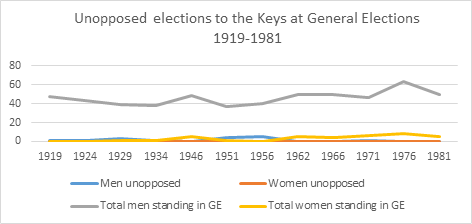
Up until the end of the 1981 General Election, only one seat in the Keys had been filled by a woman unopposed. Over the same period, 16 seats in the Keys had been filled by a man unopposed. Given 552 men stood for the Keys in General Elections during this period, as opposed to 36 women – that is, 15.3 times as many men than women – that Mrs Marion Shimmin was elected unopposed is not in itself unusual.
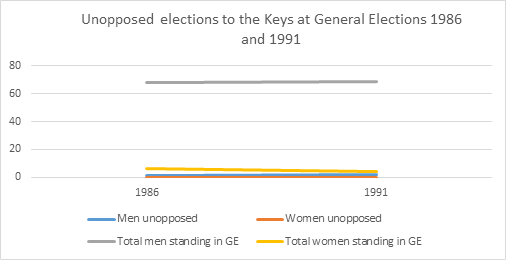
The two single transferable vote elections show the continued pattern of unopposed elections being unusual, but not unknown, and men being the beneficiaries. Three seats were taken by men unopposed, none by women; there were a total of 137 men standing, as opposed to 10 women. With so few women standing in just two elections under this system, it is difficult to say much more.
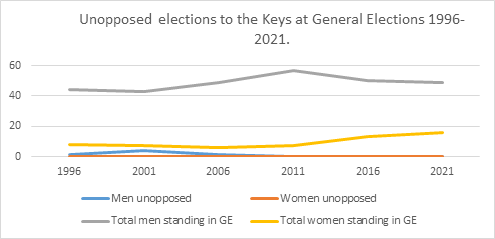
Turning to the most recent set of General Elections, we see six men elected unopposed, and no women. Looking at the period as a whole, we see 292 men standing, and 57 women. With those proportions, it would not have been striking had one of the six people elected unopposed been a woman; but with such small numbers, it is equally not striking that all were men.
Additionally, it is worth noting a feature across the periods since 1919. The decline in the number of seats taken unopposed has occurred alongside an increase in the proportion of candidates who are women. In particular, the three General Elections from 2011 – which had no unopposed candidates – were contested by 36 women: the same number as the twelve General Elections from 1919-1981. At periods when unopposed elections were less uncommon, women candidates for the Keys were more uncommon: so it is unsurprising that only one woman was elected unopposed at a Manx General Election.
To conclude, I think the fact that Mrs Marion Shimmin was elected unopposed to the Keys is not especially worthy of highlighting without the context I have outlined here. More worthy of highlighting is the Keys career of Joseph David Qualtrough. Entering the Keys at a by-election in 1919, he was elected as the member for Castletown at every General Election until his death in 1960. At six of these seven elections he was elected unopposed, and in the only contest (in 1946) he secured a comfortable majority. New Manx Worthies notes, in the third-to-last paragraph of a two and half page entry, that six of his elections were unopposed. The same publication’s entry for Marion Shimmin, on the other hand, begins “Marion Shimmin (nee Fallows) was returned, unopposed, in 1933”.
This blog is authored by Peter Edge, as part of a series on Women in Manx Politics, a larger project funded by Culture Vannin. Click on the icon to go to the project page.
 Peter Edge's Law Blog.