The Emergency Powers Regulations in numbers, as of week commencing 26 April.

Last week in Tynwald, Mr Robertshaw observed: “I am becoming more and more uneasy now as these Regulations reach further and further into detail and complexity. I think actually we are seeing this afternoon the limit of the reach or the ability of emergency regulations to make sense. I think if this continues my degree of unease will grow significantly to the point that I will actually start saying no, and I will no longer support these sorts of regulations. They are getting too complex, we have to think again”. This may be a good point to reflect on the shape of the Emergency Powers Regulations.

Using numbers as a way of understanding laws can be eye catching, but should be approached with serious caution. Not all laws are equally important, and the length of a law is no guide to importance either. A purely numerical approach might take an Act introducing the election of MHKs as being as important as an Act removing the voting rights of the Attorney General in Tynwald. If we reach below the level of Acts to particular sections, a detailed Act amending say the Companies Acts may seem vastly more significant than a short act abolishing capital punishment for murder. With that caveat, some numbers as a way of understanding the EPRs!

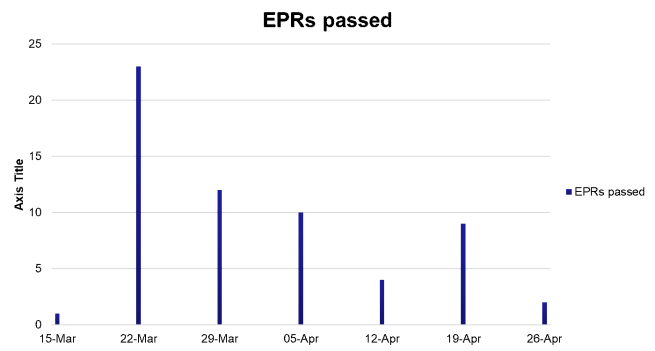
fig 1

The number of Regulations created each week ramped up rapidly at the start of the crisis, and then fairly consistently drop.

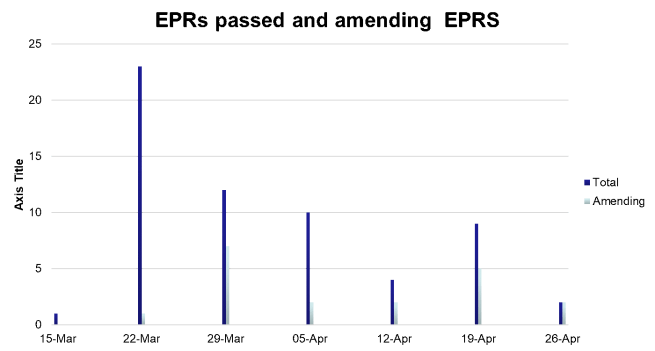
fig 2


Regulations amending earlier Regulations begin to pick up after the peak of new Regulations has passed. Some of this is substantive change to policy, but a significant amount of it is fixing problems that had become apparent after the Regulations were drafted and came into effect – notably identified by members of Tynwald during approval of the Regulation.

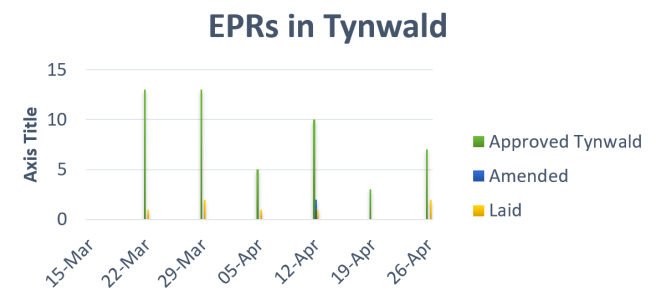
fig 3

Unsurprisingly, given the rules for approval of EPRs, we see approval by Tynwald off-set by a week from the creation of the EPRs. The vast majority of EPRs were put to Tynwald for approval. A small number were allowed to lapse, and in one week (12 April) we have Tynwald exercising its powers to approve subject to amendments for two EPRs.

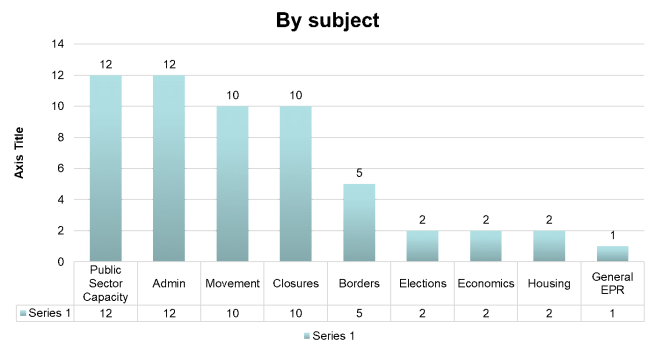
Finally, turning to subject matter, my categories are inevitably subjective, and I have treated each EPR as only falling into one category. I am likely to revise these subjects once the state of emergency has ceased; and, given what the Chief Minister has said about how EPRs are generated, mapping EPRs onto Departmental portfolios may also be useful. For the moment, it does give a sense of the centre of gravity of the EPR response.

fig 4

Emergency Power Regulations, 29 April to 1 May.

Two Regulations amending the Closure of Businesses Regime were created in rapid succession.

The Closure of Businesses and Other Premises (no.3) Regulations adds recycling facilities to civic amenity sites as premises that may remain open for restricted purposes (reg.3(3)(a), amending Sch.1), discussed further below; and makes it clear that the premises identified for provision of temporary accommodation in the early Regulation noted here are permitted to open for that purpose (reg.3(3)(b)).  The more significant changes are to the rules concerning continuation of operation of businesses, added to the new detail added by Closure of Businesses and Other Premises (Amendment no.2) Regulations, discussed here.  The duty on employers to ensure that premises are regularly cleaned is amended to “regularly and frequently cleaned” (reg. 3(2)(a) amending reg.5(3)(b)). The power of an employer to require the presence at the business premises of employees, limited by the no.2 Amendments is clarified to include a power to require presence at “such other premises as the employee would ordinarily be expected to attend” (reg.3(2)(b) amending reg.5(4)(a)). This covers the case of a business whose employees deliver services outside of their own premises – for instance an electrical goods repair service, or provider of temporary office workers.

The Closure of Businesses and Other Premises (no.4) Regulations makes two amendments to Part 1 of the Schedule, that is businesses which must close. Original entry 20 simply closed “golf courses”; this has been amended to close clubhouses serving golf courses, except that if the clubhouse includes a point where members must report prior to playing golf “that part of the clubhouse may remain open for that purpose only” (reg. 3(2)(a), amending Sch.1). Original entry 21 similarly closed “any premises that provide recreational fishing activities”. The amendment reduces the scope of that restriction to fishing from any unmoored vessel, or from premises charging a fee other than a fishing license fee (reg.3(2)(b), amending Sch.1). This amendment continues the trend of blurring an initially clear distinction between Part 1 of the Schedule (“Businesses and Premises that must close”), Part 2 (“Businesses and premises that may remain open for Restricted purposes”), and Part 3 (“Businesses that may remain in operation”).

The question of recycling facilities appears in both of these amending Regulations. The no 3 Regulations added “other facilities for the collection of recyclable” to the permission to open for civic amenity sites (reg.3(3)(a)), amending Sch.1). The no 4 Regulations correct the no.3 Regulations by adding “products” after the word “recyclable” (reg 3(3)) – correcting a purely typographical error, as the guidance to the no.3 Regulations refer explicitly to “recyclable products”.

The Manx legal response to the 1919 pandemic.

Parallels are often drawn between the 2020 coronavirus pandemic and the “Spanish Flu” pandemic of 1918-1920. The Isle of Man was affected by this earlier pandemic, with the Isle of Man Examiner reporting from the latter part of 1918 to the end of March 1919 a total of 84 deaths (“Influenza Mortality”, Isle of Man Examiner 29 March 1919), against a population of around 55,000 at the turn of the century.

The legal response to this threat was not under a general Emergency Powers Act (no such Act existed), or Imperial statutes or emergency Acts of Tynwald such as those which had played such a role in the wartime regime, but rather a very specific provision which allowed the creation of Regulations with a view to preventing, mitigating, and guarding against the spreading of epidemic disease.  (Local Government Consolidation Act 1916 s.195). These powers were seen as broad enough to allow more substantial restrictions on individuals than English law did, and in particular to be able to encompass controls of gatherings of people, including private parties (Isle of Man Times 25 January 1919) – a speculation which as we will see bore legal fruit a little later. Unusually for such significant powers in this era, these were not exercised by the Lieutenant-Governor, but by the Local Government Board, a Board of Tynwald (see the discussion of this by the Vicar General in Tynwald April 15th 1919). The Board was able to make regulations which took effect immediately, and would be proclaimed by the Lieutenant-Governor, but if not confirmed by Tynwald would cease to have effect.

The Isle of Man responded to the early wave of the pandemic with school closures, restrictions on cinemas and theatres, and cleaning requirements for cinemas, theatres, and public conveyances (Proclamation of 29th October 1918).; but on the 11th of  January 1919 the government updated this regulation, adding a duty to disinfect daily for “all factories, workshops and shops” (Proclamation of the Lieutenant-Governor of 11 January 1919). These formal regulations, violation of which could be punished by a fine, were – in a precursor of 2020 – supplemented by guidance. At the same time as publicising these regulations, the Government Secretary added that “The general public is required to cooperate with the authorities in preventing the spread of the epidemic” (B.E. Sargeaunt, 11 January 1919):

“The following instructions should be carefully observed by members of the general public –

  1. Avoid crowded places, especially dances, parties, and similar forms of amuseument.
  2. Keep doors and windows open, and sleep in well-ventilated bedrooms.
  3. Brush teeth frequently, and use antiseptic gargles.
  4. If headache, shivering, or joint pains are felt, go to bed immediately, and consult a doctor.
  5. Strict isolation should be enforced in every affected case”.

These restrictions were shortly amended, to clarify that the ban included night schools, to reduce the permitted opening hours for cinemas and theatres, and to extend these limited hours to “all dances, theatres, or other public entertainment in any public hall, boarding-house, or any other place where a charge is made for admission, or a subscription is paid” (reproduced in “The Influenza Epidemic”, Isle of Man Times 25 January 1919). Peel continued to pose particular concerns, however, and on the 22nd of February a further Regulation limited to Peel prohibited all performances in cinemas and theatres; closed all churches, chapels, and schools; and prohibited gatherings – even in private houses – of more than twelve people (Peel District Influenza Epidemic Regulation, 22 February 1919, approved by Tynwald 15 April 1919). The restriction on places of worship was removed on the 7th of March (Peel Destrict Influenza Epidemic Regulation, 7 March 1919), the remaining restrictions expiring as planned later in the month.

The 1916 Act saw regular use through a long lifetime. Regulations to deal with influenza were completely routine during the 1920s and 1930s, albeit much less intrusive than the 1919 set, and rarely subject to scrutiny or query in Tynwald. Mr Crellin, moving approval of one set in 1933, constituted the entire discussion of the motion: “This is rather important, and it won’t take a minute. I beg to move this resolution. The regulations are the usual regulations issued when there is an influenza epidemic in the Island” (Tynwald Court, 27 January 1933). They were not replaced by the Emergency Powers Act 1936 – for instance influenza regulations being issued in January 1937.  Regulations under this provision of the Act were made 23 times between 1918 and 1973, principally concerning influenza but also on occasion measles, psittacosis, and scarlet fever.

It may be tempting to see the powers under the 1916 Act as the precursor to the Emergency Powers Act 1936. It is better, however, to see them as the precursors to the Public Health Act 1990, which repealed and replaced the 1916 powers. The Public Health Act 1990 was the legal basis for the first emergency regulations in the current crisis, the Health Protection (Coronavirus) Regulations 2020, created on the 26th of February, and laid before Tynwald on the 24th of March, but as it was not approved by Tynwald at that point, ceasing to have effect on that day (Public Health Act 1990 s.51Q(3)-(5)). Since the 24th of March, Regulations under the Emergency Powers Act 1936 have instead been the primary tool for dealing with the pandemic.

Comparison of the legal structures used to respond to the 1919 and 2020 pandemics raise some interesting lines of inquiry. The 1919 response, in a context where Tynwald was incomparably weaker in relation to the Lieutenant-Governor than today, was by a Board of Tynwald, not the Lieutenant-Governor. Changes in executive government in the Isle of Man have been so profound, however, that this may not be a useful comparison. Perhaps more illuminating will be the possibilities the 1919 experience shows for regulating public behaviour under specific measures aimed at addressing epidemics, rather than emergency powers drafted to deal with a range of possible crises. In this light, the decision made between the 26th of February and the 24th of March 2020 to step away from the powers in the Public Health Act, and instead rely on the Emergency Powers Act even on issues directly related to reducing the spread of the disease, may be particularly significant. The geographical granularity of the 1919 response, with strict special rules for Peel during the broader crisis, does not feel like it would travel well into the 21st century context.

Emergency Powers Regulations 25th of April.

Two Regulations were made on the 25th of April, one of broad significance to the general public, and the other very specific.

With Friday’s change in emphasis between the restrictions on movement regulations, and the restrictions on events and gatherings, the power of the police to issue fixed penalty notices for the latter is of practical importance. The Fixed Penalty (Amendment) Regulations address a problem I identified in my note on the amendment to the Events and Gatherings Regulations, that the fixed penalty regime appeared to apply only to the offence in Regulation 8(1), and not the new offence in Regulation 8(2). This Regulation applies the fixed penalty notice regime to the Regulation 8(2) offence.

The Provision of Temporary Accommodation Regulations allow the Department of Health and Social Care to secure temporary accommodation for persons who do not have a right to occupy any premises (reg.4,5).  If the DHSC concludes that a person has no right to occupy any premises, that person is eligible to be housed: the default is therefore that a person is not eligible under the scheme (reg.6(3)). The person does not need to be a Manx resident, but obviously needs to be present in the Isle of Man (draft license, part A). A person who provides false or misleading information to the DHSC when it is determining whether a person has a right to occupy a property commits an offence punishable by up to 3 months custody and/or a £10,000 fine (reg.6(2)). A person who accepts an offer as a temporary resident must pay a charge for the accommodation, but this may be deducted from a state benefit (reg.8). Accommodation may only be offered on terms set out in a form letter in the Regulations (reg.7): meaning that the law only allows temporary accommodation to be offered in either the Sefton Express Hotel or Athol House Hotel; and that a weekly charge of £192.25 per week including three meals a day be charged. In its current form, therefore, this Regulation is very specific indeed.

Emergency Power Regulation 23 April – Supplemental.

A further Regulation signed, and taking effect, yesterday did not appear online until after I had written the earlier explainer: so 23 April Supplemental!

The Prohibitions on Movement (Amendment no.3) Regulations amend the principal Regulations restricting individual freedom of movement. It will be recalled that a general prohibition on movement under the Prohibitions on Movement Regulations noted here,  have a list of exceptions allowing people without symptoms to leave their home, detailed under reg.5. The Amendment revises these on a number of specific, but significant points: (1) leaving the house for shopping does not need to be for purchase of “basic necessities” (amending reg.5(1)(b)), and a visit to take waste to a civic amenity site is now also permitted (adding new reg.5(1)(ba)); (2) leaving the house for exercise no longer needs to be for “one form of exercise per day”, but instead is permitted in order to undertake “exercise or leisure activity” (amending reg.5(1)(c)), leisure activity excluding sporting activities with people outside the household, and activity in an unmoored vessel  (amending reg.3), and requiring that the activity is undertaken, as far as reasonably practicable, with a 2m separation from people who are not a member of that household (amending reg.3(3)); (3) the existing ground of caring for an adult who would otherwise suffer avoidable harm is now supplemented by providing assistance for an immediate family member not in the household, providing that there is no entry to their property (adding new reg.5(1)(fa)); (4) the existing ground of attending a funeral is now supplemented by visiting a grave (amending reg.5(1)(g)). The Regulation is not exclusively about easing the restrictions however, with a new, clarifying, rule that members of different houses may not share private transport or a taxi (new reg.3(7) ).

Emergency Power Regulations passed on the evening of 23rd April 2020.

Three Regulations were signed into law late on the evening of the 23rd of April, coming into effect immediately, although their content was not published until the next day. Given two of them create new criminal offences, and the third blurs the reach of an existing offence, it might be best if no prosecutions were brought in relation to conduct in the period between the law being created, and it becoming publicly available to citizens as per the general requirement under the European Convention on Human Rights that restrictions on rights be prescribed by law.

The Events and Gatherings (Amendment no.2) Regulations modify the gatherings rules in significant ways. A constable is now empowered to stop a person and ask them questions in order to determine whether they or a member of their household “has taken part, or is taking part, in a gathering and if so, the purpose of the gathering” (reg.3(2), creating new reg.7(4)). If the question asked is reasonable, the person must answer it (new reg.7(5), but see my query below). A constable may require a person or members of the persons household to leave any premises if the constable reasonably believes that remaining at the premises creates a higher risk than leaving the premises of coming within 2m of someone who is not a member of the household, and such a contact would not be permitted under a regulation made under the Emergency Powers Act (new reg.7(6)).

It is unclear how far these new powers and duties are backed by criminal law. The power to ask and require an answer, and the power to require a person to leave premises, are applicable whether or not a direction has been made under the reg.4 or 5 of the original Regulations (new reg.7(3)), suggesting that “direction” in this Regulation means the direction under these sections, rather than the new requirements from a constable. The liability for failing to meet the duty to answer questions by a constable, and for failing to leave a premises, is not specified at any point in the Regulation, and is not clear to me.

The offence under these Regulations has been amended, but, some rephrasing apart, only by adding a new offence of intentionally taking part in a gathering which was not permitted under Emergency Power Regulations, or as part of required attendance at court (new reg.8(2) and (3)). This in turn creates a problem. This new Regulation was passed after the introduction of a fixed penalty notice option for regulation 8. Unfortunately the schedule to the fixed penalty notice regulation has now become ambiguous: the schedule refers to “Regulation 8: failure without reasonable excuse to comply with a direction given under the Regulations”; while other Regulations which create multiple criminal offences in the same section are broken down by sub-section and description for each offence. It is not clear to me that the new offence of intentionally gathering is subject to the fixed penalty regime.

The other Regulation of broad effect passed is the Closure of Businesses and Other Premises (Amendment no.2) Regulations. The broadest changes concern the operation of businesses allowed to continue to operate (under both Part 2 and Part 3 of the Schedule). In relation to safety, the Regulations previously required food businesses to operate in a way consistent with IOMG Guidance (reg.5(4) as amended), but otherwise left the details of how businesses should meet their duty to ensure the business adopted such measures as are reasonably practicable to reduce the risk of infection unspecified (reg.5(3)). The new Regulations specify that this duty includes ensuring so far as practicable that persons can remain at least 2m apart, that premises are regularly cleaned, and that facilities are available for regular handwashing or sanitising (reg.3(2), creating new reg.5(3)(a)-(c)). In relation to the rights of employees, businesses permitted to remain open may only require employees to work on their premises where their “attendance is necessary for the proper performance of” their job (new reg.5(4)(a)); and must ensure that “no more persons are present at any one time than is necessary for the effective operation of the business” (new ref.5(4)(b)).

This Regulation also makes more specific changes to particular types of business. To carry on my illustrative theme from previous notes, places of worship may now be open to install and maintain broadcasting equipment, as well as actually carrying out such a broadcast (reg.5(3), amending Schedule Part 2). Graveyards and cemeteries may be open for “any purpose” without any special restrictions. Construction has also been significantly changed, with any construction, gardening, or landscaping business similarly being allowed to operate for “any purpose” without any special restrictions (reg.5(3), amending Schedule Part 2). Allowing a business to operate for any purpose without any special restriction may have fitted better into in Part 3 (businesses that may remain in operation) rather than Part 2 (businesses and premises that may remain open for restricted purposes).

The criminal offence associated with these Regulations has been given a new twist. As I noted earlier, the offence aimed at persons running a business contrary to the Regulations is not covered by the fixed penalty notice scheme; and carries quite a substantial penalty. In relation to a business which is accused of operating outside the permitted conditions (whether specific to their type of business, or the general duty detailed above), a new clause has blurred the difference between law and guidance: “regard may be given, when determining whether the person is guilty of the offence, as to whether the person operated the business in a way that was inconsistent with any guidance published on http://www.gov.im in relation to the operation of that business” (new reg.7(4)). I have already expressed concern that this approach in relation to specific businesses risks losing democratic oversight for substantial criminal liability under the Regulations. This new provision takes the same approach across any sector upon which IOMG chooses to post guidance, potentially mutable guidance, on their website.

Finally, the Electronic Transmission of Information – Enterprises Regulations allow electronic filing of a range of documents in the Companies Registry (reg.5), and for deferral of payment of fees until one month after the end of the Coronavirus Proclamation period (the latter will in practice require a continuation Regulation) (reg. 9). This electronic filing can include signed documents, in which case an image of the document with relevant signatures (which may themselves be added cumulatively to electronic versions of the document) may be submitted (reg.6(1),(2)). Witnessing of signatures may also be carried out electronically, so long as the signature is added to the document while the witness and signatory can observe each other over a video link (reg.6(3)). The Department of Enterprise and the Registrar retain a residual discretion to accept as signed a document that does not satisfy these requirements (reg.6(4)). Everyone who signs or witnesses a document under these provisions is required to keep documents for two years, and produce them upon request by the Department or Registrar (reg.7). These provisions are backed by the usual possibility of custody or a substantial fine, which applies not only to falsely recording or representing compliance with the provisions, but also a failure to keep the required documents for two years (reg.8(2)). The latter is phrased very broadly – there is no explicit requirement that the failure be dishonest, reckless, or negligent.


Emergency Powers Regulations made between 17th and 22nd of April 2020.

This note covers the three Regulations made between the 17th and 22nd of April.

The Prohibitions on Movement Amendment (no.2) Regulations amends the prohibition on movement regime, principally based on this Regulation,  to create a new exception to the limits on movement to allow a person without coronavirus symptoms (1) to move to a new residence where reasonably necessary, or (2)  temporarily move to other accommodation in order to comply with Emergency Power Regulations, and measures such as self-isolation advised “by a Department or appropriate professional body in connection with the Coronavirus pandemic” (new reg.5(1)(l)). A move is reasonably necessary if for reasons of health (that of the person moving or another member of their household), or finances (new reg. 5(5A)). The Regulation also expands one part of the definition of jobs which involve key public services, and so where movement is permitted in order to carry them out. The original referred to “advocates engaged in ongoing proceedings in the courts” (Sch, reg.3(1)(b)). This has been expanded to include trainee advocates and paralegals; attending prison or a police station in relation to proceedings; preparation of key legal documents such as wills, powers of attorney, and disposition of real property (new Sch, reg.3(1)(b)(i)-(iii)).

Another Regulation also deals with legal business, in considerable detail. The Courts etc Regulations use the new powers under the amendment to the Emergency Powers Act to make a substantial number of modifications to how courts and tribunals operate. These include a number of changes to criminal procedure, which required the consent of the Deemsters. This consent is referred to in the explanatory notes, and as no form is required for giving or recording consent, this would seem sufficient. The Regulation expands on existing rules in the Criminal Justice and Police Courts Act 2007 to allow any person to take part in criminal proceedings through a live audio or video link (reg.6, amending s.30). If the courtroom is not properly equipped, a court may sit for all or some of these proceedings in a place where link facilities are available (reg.8, amending s.32). A witness giving, or required to give, evidence on oath by link may be liable for perjury (reg.9, creating new s.32(A)), but the court is not able to deal with a contempt of court by a person participating by link, not giving evidence  (reg.6, amending s.30(19)). These changes can be applied to criminal proceedings which have already begun (reg. 13, disapplying s.39(1)). There are substantial exclusions to the power to carry out criminal proceedings by link. The most significant is that a court may not allow a juror to take part through a link (reg.6, amending s.30(3)); or require a link to be used for the hearing in an appeal except against sentence only (Sch, art.2(2)). There are more significant limits on audio links, particularly limiting participation by the defendant by audio link (Sch.art.3(2), 4(2)). The Regulations also provide for granting of bail by a custody officer (reg.18, creating new Police Powers and Procedures Act 1998 s.50A), and enforcing of bail conditions (reg.16 and 19 amending s.20 and s.52). Finally, the Regulation provides for the use of live video links and live audio links by tribunals (such as the Advocates Disciplinary Tribunal), so long as it is in the interests of justice to use the link (reg.20).

Finally, a very specific Regulation deals with a very narrow prohibition, but one with obvious application given the current makeup of the House of Keys. The Emergency Assistance by Members of the Keys Regulation temporarily disapply the Representation of the People Act 1995 s.6(6). The 1995 legislation provides that an MHK loses their seat if they “accept an office of profit under the Government of the Island, or the government of any country or territory outside the Island” (s.6(6)). There is an existing exception for an MHK who during “a national emergency” (defined in the Act as relating to war or international disturbance) joins the armed forces (s.6(7)(b)), but not for service during an emergency more broadly, or for other types of emergency. There is a very useful review of “office of profit”, focussed on the Australian Constitution but of broader range, here. A key point is that an office which normally carries a salary remains an office of profit even if the person does not accept that salary.  An MHK may now accept an office of profit, for instance by volunteering for a role which would normally carries a salary,  relating to the health service, fire and rescue services, or ambulance services (reg.5(1)).

The Fixed Penalty Regulations.

Last week’s amendment to the Emergency Powers Act added the power to create fixed penalty notice offences. The Fixed Penalty Regulations implement this.

A fixed penalty notice is a notice “offering the person to whom it is given the opportunity of discharging any liability to conviction for the offence to which the notice relates by payment of a fixed penalty” (reg.3). A constable who reasonably believes that a fixed penalty offence has been committed may give a fixed penalty notice to an adult (reg.6). The recipient then has 21 days to decide whether to pay the penalty, in which case no formal criminal prosecution may be brought (reg.7). If paid within 14 days, the penalty is £150; thereafter £250 (reg.9). A constable is not required to give a person the opportunity to pay a fixed penalty notice: the constable who considers the offence may be sufficiently serious to merit a heavier punishment is not required to give them the option of settling things with payment of a fixed penalty. A recipient who wishes to put before a court the case for their being innocent of an offence is not  prevented from doing so – rejecting a fixed penalty notice is not an appeal, rather, it is reopening the normal prosecution route, with the normal maximum penalties if convicted (thus ensuring these penalties comply with the Emergency Powers Act 1936 s.4(3C) as amended). Finally, accepting a fixed penalty notice is not an admission of guilt, and does not constitute a criminal conviction.

It will be recalled that a substantial number of Emergency Powers Regulations have created criminal offences punishable by a fine of up to £10,000 and/or a prison sentence of up to three months. These Regulations do not apply the fixed penalty regime to all of these offences – so for offences under the Infrastructure Support Regulations, for instance, a constable may not issue a fixed penalty notice; and a person who commits an offence may not exclude formal proceedings by paying a small fixed penalty. Instead, the Schedule to the Regulation specifies offences under four Regulations. Fixed penalty notices are available for: all criminal offences under the Potentially Infectious Persons Regulations; the only criminal offence under the Events and Gatherings Regulations; and the only criminal offence under the Prohibition on Movement Regulations.  Not all offences under the Closure of Business Premises and Other Premises Regulations are covered: contravening those Regulations by a person operating a business is not covered by the fixed-penalty system (the reg.7(1) offence), but obstructing without reasonable excuse a person carrying out a function under the Regulations is (the reg.7(2) offence).

Emergency Power Regulations made from the latter part of 9th April to 15th April.

Four Regulations were created from the latter part of the 9th of April to through to the 15th of April. Additionally, an earlier noted Regulation has been approved by Tynwald with an amendment.

The Entry Restrictions (Amendment no.2) Regulations were noted earlier. As with the Entry Restrictions which they sought to amend, they were the subject of considerable debate in Tynwald on the 14th of April. The proposed reg. 6A(3)(c) would not allow the issue of an exemption to a returning resident if they had stayed after the 27th of March at a dwelling owned by themselves, or a close family member. This restriction was removed; although the controversial requirement that every exemption for returning residents include a condition that they are liable “to pay all the costs incurred and associated with his or her re-entry” was not.

Also created on the 9th of April, and amended during approval by Tynwald, were the Information Sharing Regulations.  The purpose of the Regulation is to allow the Council of Ministers to direct that information protected by data protection legislation be shared between Departments, or a third party required to disclose information, in order to facilitate “any regulations made under the Emergency Powers Act 1936 which relate to coronavirus” (reg.5). The direction from CoMin may include safeguards, and the Regulation notes that these may be intended to prevent abuse, unlawful access, or further disclosure; and must (not may) “provide for the return, deletion, destruction, or other recovery of date from the person with whom it is shared” (reg.5(4)(b)(ii)). Reg 3(1), defining terms used in the Regulation was amended. Working from the audio transcript of Tynwald, the effect of this amendment was to make it clear that information sharing could involve local authorities: although the breadth of the power to make directions under reg.5(1)(b) looks to have included local authorities in any case.

The Events and Gatherings (Amendment) Regulations add to the original regulations, noted here, a statutory definition of gathering as “any meeting or assembly of two or more persons who are not members of the same household” (reg.3 as amended). This is a useful clarification. It makes it clear, however, that this Regulation does not apply to assembly outside the household of members of the same household. These are governed by the Prohibition on Movement Regulations, noted here, which include justifications for gatherings such as attending a funeral.

The Suspension of Regular Service Licenses Regulations state that section 25 of the Road Traffic Act 2001 “does not apply” to Bus Vannin (reg.4). Section 25 creates a criminal offence where a person uses “a public passenger vehicle for the provision of a regular service unless he is a holder of a license”. The statutory regime for licensing of a regular service is quite detailed, and may require an application for a license to state fares, class of vehicles to be used, operating base for the vehicles used, and the route and timetables of the service (s.26). This Regulation allows Bus Vannin to make changes to regular services without the involvement of a licensing body.

Finally, a Regulation which may turn out to be influential in a variety of contexts. The Planning Committee Regulations adds a new definition of “meeting”, perhaps one we will see again, to the normal statutory document regulating the constitution of the Planning Committee. Meeting is defined as including “a meeting which is conducted in such a way that those who are not present together at the same place may by electronic means participate in it” (reg.5(2), amending original reg.3). Similarly potentially influential in the future, the new Regs remove the original requirement that proceedings “must be held in public” and replace them with “must ordinarily be held in public unless this is not reasonably practicable, when they may be held in private” (reg.5(4), amending original reg.17(2)). This Regulation also adds a power to defer consideration of an application (reg.5(3), amending original reg.15).

The Emergency Powers Act 1936 as amended on the 14th of April 2020.

The Emergency Powers (Amendment) Act 2020 has now received Royal Assent, and has made a number of changes to the Emergency Powers Act 1936, which is the key legislation being used by IOMG for rapid law-making during the current crisis. I have noted the 1936 legislation as the crisis began, the Bill as originally intended to be put before Tynwald, and the Bill which was actually put before Tynwald. For ease of reference, this note is a restatement of the 1936 Act, now including the amendments.

A state of emergency proclamation has been made under the Emergency Powers Act 1936, an Act of Tynwald. On the 16th of March the Governor in Council (that is, the Governor acting on the advice and with the concurrence of the Council of Ministers) exercised his powers under s.3 on the basis that “there is a pandemic of Coronavirus … it appears that there is a threat of that disease affecting the Island and causing serious damage to human health on, and the economic well-being of the Island”. This proclamation of emergency may not be in force for more than one month, although it may be renewed before the end of that period (s.3(2)). Showing the age of the legislation, the proclamation has to “forthwith be sent by prepaid post to each member of Tynwald” (s.3(4)).

The finding upon which the Governor exercised his power falls within the damage to human welfare head of the statutory definition of emergency (s.2A). The threat of serious damage to human health is a reference to loss of human life (s.2A(2)(a)), and human illness (s.2A(2)(b)). Economic well-being is less clearly a ground for invoking emergency powers, but may be intended to refer to the risk of homelessness (s.2A(2)(c)), damage to property (ibid, (d)), disruption of supply of money, food, water, energy or fuel (ibid, (e)), disruption of communications or transport (ibid, (f) and (g)), or disruption of services relating to health (ibid, (h)).

The Emergency Proclamation allows the Governor in Council to “make regulations for securing the essentials of life to the community and for the protection of the economic position of the community”. They may confer “on any persons in the employ of the public service of the Isle of Man such powers and duties as the Governor in Council may deem necessary for the preservation of peace, for securing and regulating the supply and distribution of food, water, fuel, light and other necessities for maintaining the means of transport, communications and the supply of services and for any other purposes essential to the public safety and the life of the community” (s.4(1)).

The regulations can create criminal offences, triable by a court of summary jurisdiction, with a maximum penalty of a £10,000 fine (s.4(3)(a) as amended), imprisonment for three months, and forfeiture of “any goods or money in respect of which the offence has been committed” (s.4(3)). Regulations can also create offences punished by fixed penalty notices (often referred to as “on the spot fines”) not exceeding £250 (s.4(3)(b) as amended), but in such case the person fined must be provided with the option to refuse the fine, and proceed to a trial for the offence under the Regulations (s.4(3C) as amended). Any regulation altering existing criminal procedure requires the consent of the Deemsters (s.4(3A)(a) as amended), and no regulation may impose a fine or imprisonment without trial (s.4(3A)(b) as amended). This is tremendously wide ranging, the only explicit limit on the regulations being a prohibition on criminalising taking part in a lock-out or strike, or peacefully persuading others to do so (s.4(1)).

Regulations made under the Emergency Powers Act have legal force only during the period of emergency.  During a period of emergency, the Governor in Council may make continuation Regulations which must be affirmatively approved by Tynwald. Affirmative approval means that these continuation Regulations have effect when drafted, but must be placed before Tynwald as soon as practicable, and if not approved at the next sitting (s.4A(3) as amended), cease to have effect (Legislation Act 2015 s.31). Continuation regulations may provide for the continuation, with or without modification, of any Regulations previously made under the Emergency Powers Act, for up to six months from the end of the period of emergency (s.4A(4)). These continuation Regulations are treated as secondary legislation for the purposes of the Human Rights Act 2001.

There is an element of democratic control. The regulations must be laid before Tynwald within seven days of being made, and shall cease to have effect seven days after being made unless approved by Tynwald (s.4(2)). Ceasing to have effect does not mean that the regulations were invalid – so for instance a fine imposed under the regulations will remain in effect (s.4(4)). As noted above, the proclamation of emergency must be renewed on a monthly basis. Regulations made in any earlier month must be approved by Tynwald at the first sitting in that proclamation period, or cease to have effect (s.4(1A) as amended).

The Emergency Powers Act now places on a statutory basis the postponement of local elections made by Regulations issued under the Act (s.6 as amended).

The 1936 legislation is very similar to the English Emergency Powers Act 1920, both procedurally and in terms of the range of regulations, but the 1920 legislation prohibited regulations amounting to compulsory military service or industrial conscription. The 1920 legislation was used 12 times between 1921 and 1973, in each case to deal with industrial disputes. The 2011 report of the Council of Ministers identifies a number of other emergency powers vested in the Governor, but it is striking that a number of them are based on national emergencies due to a state of war “or international disturbance”. Using these powers in relation to Covid-19 may require a purposive interpretation of “international disturbance” which is not obvious from the legislation. The 2020 Amendment Act is not a systematic updating of the Island’s emergency powers legislation, as a report of the Council of Ministers recommended in 2011, but rather a rapid response to problems which emerged when dealing with the current crisis. During the passage of the Amendment Act, it was made clear that such a systematic updating was planned for a later date.