

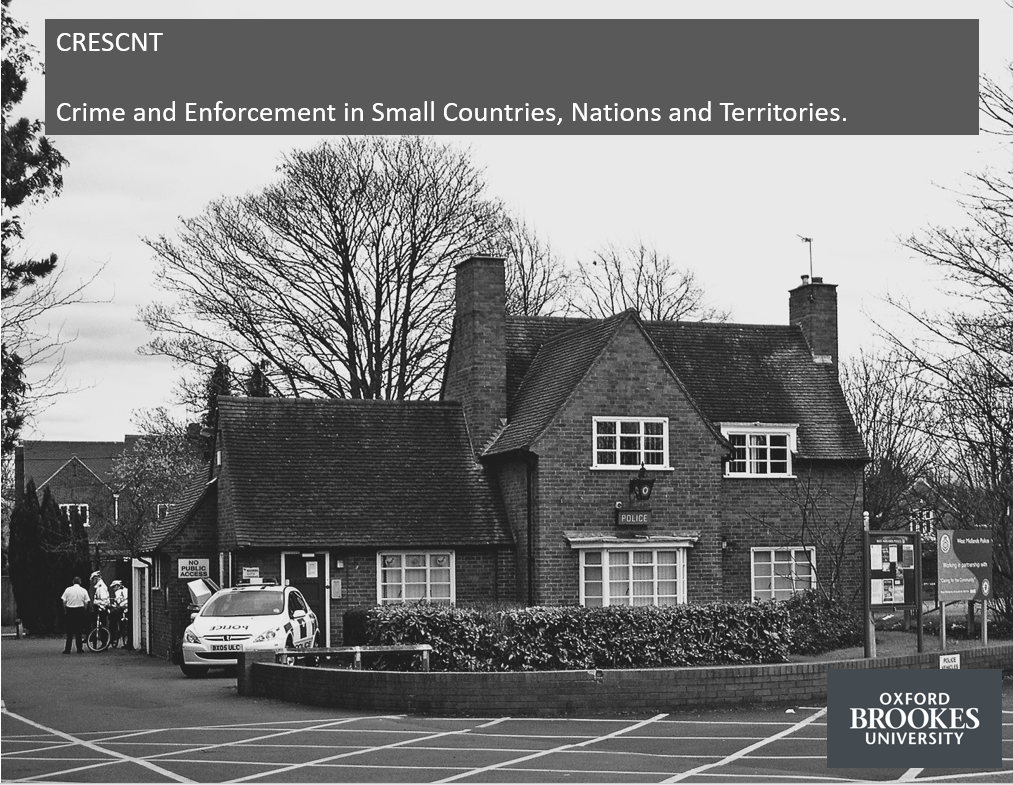
About CRESCNT.
Small democracies face special challenges in relation to criminal justice – common challenges which flow from their smallness, and are not simply national challenges. The CRESCNT Network, hosted by Oxford Brookes University, aims to bring together criminal justice practitioners, those whose lives are touched by the criminal justice system, civil society organisations, and academics. As a Network, we will share knowledge and insights into the common challenges faces by small democracies. We will work together to develop proposals to support research in this neglected area, research ultimately intended to provide small democracies with solutions to, the challenges they face.
What do you mean by “small democracies”?
Our primary focus is on sovereign, and non-sovereign, democracies with a, broadly speaking, “common law” legal inheritance, and a population below 150,000. So we are particularly interested in participants from:
The Crown Dependencies: The Isle of Man, Jersey, Guernsey (and Alderney and Sark).
The UK Overseas Territories: Akrotiti and Dhekelia, Anguilla, Bermuda, British Antarctic Territory, British Indian Ocean Territory, British Virgin Islands, Cayman Islands, Falkland Islands, Gibraltar, Montserrat, Pitcairn Islands, Saint Helena and associated territories, South Georgia and associated territories, and the Turks and Caicos Islands.
The independent small democracies of: Antigua and Barbuda, Dominica, Grenada, Kiribati, Saint Kitts and Nevis, Saint Vincent, Seychelles, Tonga and Tuvalu.
What do you mean by “criminal justice”?
We take a whole systems approach to criminal justice, this includes the operation of the criminal justice system:
- before any trial, so including investigation, decisions to prosecute, and preparation of cases.
- during a trial, so including the operations of a court, findings of fact, determination of liability, and determination of senence.
- after a trial, so including the operation of non-custodial sentences, prisons, and exile.
What do you mean by “special challenges”?
Broader studies of small democracies have shown a number of shared features which we see as impacting on the efficient and just working of a criminal justice system. For instance:
- Intimacy. How does a criminal justice system deal with a context where everyone knows everyone else? For instance, how does this impact on jury selection? How do police, prosecutors, and defence lawyers manage ongoing relationships alongside individual cases?
- Capacity. How does a criminal justice system deal with a context where, regardless of wealth per capita, the small democracy has strictly limited resources? For instance, how does it deal with small groups of prisoners with special needs – such as elderly prisoners serving very long sentences, or young offenders? How does it cover specialist investigations which may only rarely occur, but require unusual expertise?
- Insularity. How does a criminal justice deal with a context where the small democracy is distinct – in almost all cases with exclusively maritime borders – but closely intertwined with its region? For instance, how does it deal with witnesses who leave the jurisdiction and do not wish to cooperate with a trial? How does it deal with offenders who are normally resident in a neighbouring jurisdiction?
Who are you interested in hearing from?
CRESCNT will be a network bringing together people from around the world actively engaged with the challenges of ensuring a just and efficient criminal justice system for their jurisdiction. It is open to:
- Officials involved in criminal justice such as police officers, court officers, probation officers and youth workers.
- Lawyers involved in criminal justice such as prosecutors, defence counsel, and judicial officers.
- Media workers involved in reporting criminal justice.
- Members of civil society organisations with a focus on criminal justice, or a specialist aspect of it such as the treatment of children and young people, the working of criminal justice in relation to women, or the rights of victims.
- Academics working on criminal justice in small democracies in general, or in a particular small democracy.
If you are interested in CRESCNT, but not sure your work and interests fit with the Network, you can contact Professor Peter Edge here: pwedge@brookes.ac.uk
Joining CRESCNT.
If you are interested in joining the CRESCNT Network, you can do so by this form.


 Peter Edge's Law Blog.