The Assisted Dying Bill 2023.

The Assisted Dying Bill, the current version of which is here, passed its Second Reading in the House of Keys on 31 October. Following a debate on the 7 November, it was referred to a five person Committee which will report back to the Keys in February 2024, before debate on the clauses of the Bill by the Keys. What does the Bill currently look like?

The provisions of the Bill: Criminal Law.

Under the Bill, a person may request and lawfully be provided with assistance in dying if they are terminally ill; have capacity; have a “clear and settled intention” to end their own life; have made a section 6 declaration (discussed below; for readability I am not not referring to it as a clause 6 declaration) to that effect; are over 18; and have “been ordinarily resident in the Island for not less than one year” (cl.4). Terminal illness is defined as “an inevitably progressive condition which cannot be reversed by treatment”, which is “reasonably expected” to cause death in six months (cl.5(1)). Unbearable suffering is not currently either a qualification for assisted dying, nor a requirement.

The main effect of the Bill would be to exempt those who provide assistance in accordance with the Bill from criminal liability, including specifically abetting suicide (cl.10). As well as being exempt from criminal punishment, the Bill will amend the criminal code to protect such a person from “forfeiture”: It will be interesting to see during the progress of the Bill what the latter is intended to cover – one possibility is that it is meant to protect the inheritance rights of a friend or relative who has assisted the person in discussions around dying. While excluding some activity from the reach of current criminal law, it would at the same time create new criminal offences: forgery of a declaration made under section 6 by a person purporting to seek assistance in dying (cl.14(1)); carrying up to life imprisonment if with the intention to cause the death of another under cl.14(3)); wilfully concealing or destroying a declaration made under section 6 (cl.14(2)); and knowing or recklessly providing a medical or other professional opinion in respect of a person seeking to make a section 6 declaration “which is false or misleading in a material particular” (cl.14(2)).

The obvious mischief addressed by the new offences is the misuse of the assisting dying structures to cause a death which would not qualify for assisted dying – for instance causing the assisted dying of a person who had not made a valid declaration. As this would not be “in accordance” with the Act, such a person would not in any case qualify for the protection from homicide liability under cl.10 – so a person who forged a section 6 declaration and succeeded in causing the death of their victim could be prosecuted for murder under the Criminal Code. Potentially interesting is the position of a medical profession who innocently acts in accordance with a forged section 6 declaration – are they acting in accordance with the Act, so as to be protected from criminal liability? It is also worth noting that the special offences, unlike the existing homicide offences, apply to those seeking to impede the exercise of a person’s rights under the Act by concealing or destroying a declaration, or by intentionally or recklessly providing misleading medical advice. A medical professional who advises a patient that their life expectancy is greater than six months, and so precludes them making use of the assisted dying provisions, and does so reckless as to it being false, commits an offence liable to up to five years imprisonment.

The provisions of the Bill: Assisted dying as healthcare.

The Bill also, however, frames assisted dying as healthcare, with specific powers given to the Department of Health and Social Care (cl.12) and a duty on the Department to monitor and report on the operation of the resulting Act annually (cl.13). It is envisaged that the Bill will result in an increase in public expenditure (see Explanatory Memorandum 16), although as a Private Bill work has not yet begun on how the Bill would be implemented (response to question by Mr Moorhouse, HK 31 October 2023), . Medical practitioners are involved at a number of points:

(1) There is an absolute bar on healthcare professionals initiating consideration of this form of health care when acting as a health care professional (so not, for instance, a doctor discussing their options with a relative who is not under their care). Clause 9 prohibits such a health care professional initiating any discussion which is in substance about assisted dying, or making any suggestion that the person seek assistance to end their life under the assisted dying legislation (cl.9(1)). but does not prohibit them from engaging in a discussion initiated by the person (cl.9(2)). Initiating such a discussion is not an offence, but may constitute professional misconduct (cl.9(4)). Health Care professional carries the definition under the Health Care Professionals Act 2014, and so encompasses registered medical practitioners, chiropractors, osteopaths, registered nurses or midwives, or “a relevant professional who is a registered professional” (section 3). The latter is linked to UK secondary legislation, and while excluding social workers in England, by my reading is capable (if registered) of including “arts therapists; biomedical scientists; chiropodists and podiatrists; clinical scientists; dietitians; hearing aid dispensers; occupational therapists; operating department practitioners; orthoptists; paramedics; physiotherapists; practitioner psychologists; prosthetists and orthotists; radiographers; and … speech and language therapists”. The range of individuals prohibited from initiating discussions about assisted dying is more capacious than at first appears.

(2) The section 6 declaration must be countersigned by the medical practitioner from whom assistance has been requested (“the attending doctor”) and another, independent, medical practitioner (“the independent doctor”) (cl.6(1)(b)). They must both be satisfied, after independently examining the person and their medical records, that the person is terminally ill, has capacity to make the decision to end their own life, and “has a clear and settled intention to end their own life which has been reached voluntarily, on an informed basis and without coercion or duress” (cl.6(6)). They may bring in a registered psychiatrist to provide advice on capacity, although it remains their independent medical decision to countersign or not (cl.6(7-9)). There is no provision for them to bring in a professional to advise on coercion or duress, and it will be interesting to see how medical professionals are supported in identifying coercion or duress. Mr Allinson, in proposing the Bill, sees identifying coercion as something for doctors to do, supported, “through better awareness, training and education” (Mr Allinson, HK 31 October 2023); while Mr Wannenburgh demanded “a great deal of work to mitigate coercion” (HK 31 October 2023), and it was a significant concern of others (for instance Mrs Corlett, 31 October 2023). The current Bill would allow doctors to bring in an expert professional to advise them on capacity, a central aspect of medical practice, but not coercion, one where their professional expertise is less clear. The countersigning doctors must be satisfied that the person has been fully informed of palliative, hospice and other care (cl.6(10)). There is, deliberately, no involvement of judicial officers in this process, and no appeal process: it is a matter for the patient and their doctors.

(3) The attending doctor may prescribe medicine to enable the person to end their own life, such medicine not being delivered until at least 14 days after the section 6 declaration; or 7 days if death is reasonably expected within one month (cl.7(1), (4)). The patient may revoke their section 6 declaration at any time, and so this constitutes a cooling off period (cl.6(12)). The person may then self-administer the medicine, including by making use of a machine which they have received assistance in setting up, or request a medical professional to administer the medicine to them (cl.7(5)-(7)). Whether self-administered, or administered at request, “the assisting health professional must remain with the person until the person has died”, but not necessarily in the same room (cl.7(8), (9)). The assisting health professional may be the attending doctor, but can also be another registered medical practitioner, registered nurse, or registered pharmacist who has been authorised by the attending doctor (cl.7(2)(b), cl.7(13)).

Assisted dying in a small democracy.

Many jurisdictions are wrestling, or have wrestled with, assisted dying, including other small democracies such as Jersey. I would like to bring out three issues of particular importance to the Isle of Man as a small democracy

Firstly, the prospect of making “the Isle of Man a center for death tourism”, as one respondent to the public consultation that preceded this Bill put it (I have retained the original spelling). By this is meant people seeking assisted dying coming from one of the adjoining, much larger, jurisdictions to take advantage of the Manx assisted dying regime. There is some attempt to limit this. A patient must have been ordinarily resident for not less than a year before making their declaration; and at that time they must be reasonably expected to die within six months of the declaration. “Ordinarily resident” is adopted from the Manx abortion legislation, which limits abortion services to women who are ordinarily resident, except for in case of emergency (Abortion Reform Act 2019 s.4), and is used in other legislation, most notably that around work permits. In Department of Tourism and Leisure v Maule [2007] Staff of Government the Staff of Government interpreted the term in that context. The judgment stresses that there is no single, overarching, definition of the term applicable for all legislation (para. 29-32). It may well be that a starting point will be a section of the judgement of Lord Scarman in Shah v Benet LBC, cited with muted approval in Maule:

” Unless, therefore, it can be shown that the statutory framework or the legal context in which the words are used requires a different meaning, I unhesitatingly subscribe to the view that ‘ordinarily resident’ refers to a man’s abode in a particular place or country which he has adopted voluntarily and for settled purposes as part of the regular order of his life for the time being, whether of short or long duration.

And there must be a degree of settled purpose. The purpose may be one or there may be several. It may be specific or general. All the law requires is that there is a settled purpose. This is not to say that the propositus [the applicant] intends to stay where he is indefinitely; indeed his purpose, while settled, may be for a limited period. Education, business or profession, employment, health, family or merely love of the place spring to mind as common reasons for a choice of regular abode. And there may well be many others. All that is necessary is that the purpose of living where one does has a sufficient degree of continuity to be properly described as settled.”

Although not cited by the Staff of Government, Lord Scarman suggested another requirement: “The residence must be voluntarily adopted. Enforced presence by reason of kidnapping or imprisonment, or a Robinson Crusoe existence on a desert island with no opportunity of escape, may be so overwhelming a factor as to negative the will to be where one is.”.

A definitive definition of “ordinarily resident” will depend upon a Manx court interpreting legislation flowing from the Bill, but if we take Shah as a starting point, moving to the Isle of Man with the intention in due course of taking advantage of the assisted dying scheme may well constitute becoming “ordinarily resident”. As the UK’s All -Party Parliamentary Group for Terminal Illness explain in its critique of a six month limit for terminal illness in relation to benefit entitlement, “In 1990, many terminally ill people were unlikely to survive for six months after receiving a terminal diagnosis – today, advances in treatment and diagnosis mean that many more people are living with terminal illness for longer”. There is no restriction on a person otherwise entitled to become a resident in the Isle of Man becoming resident knowing that “they have a progressive disease that can be reasonably expected to cause their death“, with the intention in due course, and after one year, of making use of the assisted dying regime when within six months of death (a concern raised by, inter alia, Mr Ashford, HK 31 October 2023). If the Bill becomes law, it will be interesting to see if residents who have become resident after a terminal diagnosis form a significant proportion of those using the scheme – what Ms Lord-Brennan referred to as “death residency” (HK 31 October 2023).

Secondly, capacity to deliver assisted dying as health care. As noted above, health care professions, most especially doctors but also registered nurses and pharmacists, can have essential roles in providing assisted dying. Under clause 8: “A person shall not be under any duty (whether by contract or arising from any statutory or other legal requirement) to participate in anything authorised by this Act to which that person has a conscientious objection” (cl.8). The wording is interesting – “in anything authorised by this Act” rather than the equivalent in the Manx Abortion Act which refers to participation in “any treatment or counselling authorised by the Act” (Abortion Reform Act 2019 s.8(1)). A very early survey carried out by the Medical Society indicates – very roughly – that 20% of Manx doctors woulde be prepared to support their patients through an assisted dying request (Mr Allinson, HK 31 October 2023).

The Manx wording would seem to go beyond prescription and administration of lethal drugs and cover, for instance, acting as a witness to a section 6 declaration. My reading is that this would mean that an administrator working in a residential home, for instance, could refuse an order to act as a witness by their manager; even if they routinely act as a witness for resident’s wills and other legal documents. The UK abortion clause on the other hand, which like the Manx Abortion Act emphasises participation in treatment, has been interpreted narrowly by the UK Supreme Court to exclude administrative, managerial, and ancillary tasks associated with the provision of an abortion service.

One specific issue may be worth addressing in the text of the Bill. In Manx abortion law, a conscientiously objecting medical professional is required to “without delay inform the woman who requests abortion services that she has a right to see another relevant professional or pharmacist (as the case requires); and … ensure she has sufficient information to enable her to exercise [this] right” (Abortion Reform Act 2019 s.8(5)). A draft assisted dying Bill in the UK in 2004 similarly dealt with referrals by conscientious objectors expressly, with a duty to take appropriate steps to refer a patient “without delay to an attending physician who does not have such a conscientious objection”. Mr Hooper takes an alternative approach to the same issue, which gives more weight to conscientious objection, proposing an opt-in register of those who do not have a conscientious objection, which “would make it clear to the public who they can discuss assisted dying with”. Addressing the position of a patient seeking lawful assisted dying who contacts a medical profession unwilling to support this is worth doing, especially given the high proportion of Manx doctors who may have conscientious objections.

More fundamentally, in a small democracy a recurring challenge is low levels of absolute capacity, regardless of the capacity per capita. Some other jurisdictions have found a real tension between individual conscientious objection to some forms of health care, and retaining capacity for patients seeking these forms of health care – this has been particularly extensively studied in relation to abortion in Italy, where an average of 70% of gynaecologists exercise their right to conscientiously object to providing abortion (for an open access introduction, see here), and may have underpinned a question about the impact of the Bill’s progress on recruitment and retention (Mr Moorhouse, HK 31 Otober 2023) . If at some point a very significant number of Manx doctors exercised their rights under clause 8, so as to constitute a barrier to the timely operation of the assisted dying scheme, could recruitment to future posts distinguish between candidates who did not anticipate using clause 8 and those who did?

The Bill does not address this directly, but there is nothing in this Bill – as there is nothing in the examples I have given already – which protects a person applying for employment. Like the protection of whistleblowers, there is protection for an employee, but not for a person seeking to become an employee. The strongest argument for such protection is likely to be discrimination on the grounds of religion or belief, but a health service that needed to appoint a doctor willing to be involved in assisted dying is likely to be able to argue under the Equality Act that it is an occupational requirement for that particular post that the doctor not have philosophical or religious objections that would lead them to take up the conscientious objection protection. To put it another way, a blanket rejection of applicants for medical posts who would exercise their legal rights under clause 8 on philosophical or religious grounds would be likely to fall foul of the Equality Act; but such a rejection for a post intended to address a shortfall in provision of assisted dying services would not.

Finally, as with many but not all professions practised in the Isle of Man, medical professionals operate within a legal context set in the Isle of Man, but a professional context based primarily in the UK. Mr Thomas raised the tensions between the two in a substantial contribution to the debate (HK 31 October 2023). This, together with the death residency point discussed earlier, led a number of MHKs to suggest that the Isle of Man should coordinate innovation in this area with larger jurisdictions in the Atlantic Archipeligo.

The role of Tynwald.

One concern raised during debate was that the Bill leaves a significant set of issues to secondary legislation, rather than incorporated into the provision of the Bill itself (Mr Callister, HK 31 October 2023). Mr Ashford argued for issues to be dealt with in the primary legislation in order to ensure scrutiny of the detail, and in particular changes to that detail, at the same level as the Bill itself (HK 31 October 2023).

There are a number of mechanisms by which Tynwald is to be kept engaged with the operation of this legislation. Although the DHSC has the power to change defined terms, this is subject to the affirmative procedure of Tynwald (cl.3(2)). The DHSC may by regulations specify the medicines to be used to assist dying, and how they are to be prescribed and transported, subject to approval by Tynwald (cl.7(10-12)). The regulations specifying the qualifications of the independent doctor countersigning a section 6 declaration may be specified by the Department, subject to approval by Tynwald (cl.6(13)). Codes of Practice issued under cl.12 would not need to be approved by Tynwald, however, but only be laid before Tynwald. These Codes could cover “the assessment of whether a person has a clear and settled intention to end their own life”, including assessing capacity, taking account of psychological disorders, and “information made available on treatment and end of life care options available to them and of the consequences of deciding to end their own life”; but also “such other matters relating to the operation of this Act as the Department considers appropriate” (cl.12(1)). Before issuing such Codes the Department is required to consult such persons as it considers appropriate (cl.12(2)). Given the relatively close monitoring of most of the assisted dying scheme by Tynwald, it may be worth considering revising the clause 12 procedure to give Tynwald a more active role in considering Codes of Practice.

As noted above, the Department is required to “monitor the operation of the Act, including compliance with its provisions and any regulations or code of practice made under it”, publish an annual report on the operation of the Act, and submit a copy of the report to Tynwald (cl.13). One way to increase Tynwald’s control of the assisting dying scheme would be to specify some elements which this report is required to address. From the discussion above, for instance, it may be worth requiring a report on the length of residency for those who have made use of assisted dying; the number of Section 6 declarations rejected on the grounds of capacity and, separately, coercion; the proportion of medical professionals who have exercised, or made it clear they would exercise, their right to conscientious objection; and the capacity of the Manx health care system to implement the scheme in a timely fashion.


The Isle of Man Constitution Bill 2023.

This Bill has now been published, and is available here. It is a very short bill, whose purpose is to remove the vote of the Lord Bishop of Sodor and Man from both the Legislative Council and Tynwald, while leaving the Lord Bishop with a seat in both bodies.

The key provision is clause 3, which provides (in full): “3 Bishop not to vote in Tynwald or the Council. (1) The Bishop shall cease to have the right to vote either in Tynwald or in the Council, but shall continue to be a member of both bodies with the same right to speak in both bodies as before this Act.(2) The presence of the Bishop at a sitting of Tynwald or of the Council shall not reckon towards the constitution of a quorum of either body”.

Against this admirable conciseness, there are two issues which it might be useful to consider in the Bill.

Firstly, the Bill mentions the “same right to speak”, but does not expressly address the right to bring motions and otherwise contribute to the work of the Council and Tynwald. The Bill is, no doubt consciously, based on the 1971 measure which removed the vote of the Attorney General while allowing them to remain in the Council and in Tynwald. That legislation uses the same term, albeit within a more cumbersome sentence: “the same rights to speak therein as heretofore” (s.1(1)). The Standing Orders of the Legislative Council, (but not of Tynwald), refer to the absence of the Attorney General’s vote, but do not indicate any restriction on their ability to bring motions, including bringing Bills in the Legislative Council. As a matter of practice, we can find the Attorney General moving legislation after 1971, for instance the third reading of the Jury Bill. So, if interpreted this Bill as the 1971 Act removing the Attorney General’s vote has been interpreted, the Bill seems set to allow the Lord Bishop not only to participate in, but initiate, discussions in both the Council and Tynwald Court, and to nominate witnesses before the Council. It may be useful to refer explicitly to this.

Secondly, the Bill does not consider the possibility of a Lord Bishop without a vote being elected by the Keys as a voting MLC. There does not appear to be an internal rule of the Church of England prohibiting the Lord Bishop from taking up such a public office; and Anglican clergy have run for, and taken up, elected office; for instance the Reverend Alan Billings, who is currently the South Yorkshire Police and Crime Commissioner. So it may be worth explicitly considering this scenario. Not doing so could face the President with some difficult issues to resolve, for instance how to apply the legislative prayer section of Standing Orders when a Lord Bishop could be sitting in a different capacity and – although I anticipate this being resolved quickly – whether the Lord Bishop could move a motion, and then the elected MLC who is the same person could then second it.

One possibility is that a Lord Bishop who is also a voting MLC sits only as a voting MLC – that is, the seat set aside for the Lord Bishop is temporarily in abeyance. Another is that the Lord Bishop continues to sit as Lord Bishop, but with a vote, a change to the role which exists only so long as the Lord Bishop’s term as a voting MLC runs. There is little practical difference between these two options. A third possibility would allow an alternative ecclesiastical officer to take the seat of the Lord Bishop. The arguments for retaining the Bishop’s voice do not seem to apply with such strength to adding to a Council which already has the Lord Bishop speaking and voting in it. A final possibility would be to avoid the problem by barring the Lord Bishop from consideration as an elected MLC – a move counter to the general removal of ecclesiastical disabilities for those seeking to join a national legislature.

From these four, the first appears to me the most attractive. It would, however, require some consideration at the level of Standing Orders as to whether the Lord Bishops new role is a continuation of their ex officio one, for instance in relation to membership of Committees of the Council.

The Vagrancy Act 1896.

Historically, Manx criminal law dealt harshly with vagrants and vagabonds. By the earliest customary law they were liable to presentment and expulsion from the Isle (Vagabonds [1505] QP; see also Customary Laws 1422 s.97) . Later, those unable to show that they were “blind, maimed or decrepit” were forced into service by the Servant’s Jury (Deemster Parr’s Abstract para. 45.01). With the demise of the Servants Jury, this became defunct. Additionally, it appears that the customary law recognised an offence of being of a notorious demeanour in the neighbourhood (Cormish [1673] L.S.), and from a very early date drunkards were liable to punishment as in misdemeanour (Parr’s Abstract 45.01) In 1896 a number of vagrancy misdemeanours were created. The 1896 Act was based on an English statute of 1824 (the Vagrancy Act 1824), as was the amending legislation the Vagrancy Act 1906 s.2 (based on the Vagrancy Act 1898).

English law continued to change after the early 20th century however. The Vagrancy Act 1935, for instance, provided that a person ought to be apprehended under the rough sleeping provision only when they had lodging available but refused it. The Police, Crime, Sentencing Courts Act 2021 provides for the 1824 Act – the equivalent of the Manx 1896 Act – to be repealed in full: including the provision making begging an offence (s.3) and that which creates a range of offences including persons who sleep in an outdoor setting, or an unoccupied building (s.4). The relevant section has yet to be brought into effect, as the Home Office wishes to have replacement legislation in place first. The delay in bringing this provision into force has been queried in the House of Commons.

So, while a specific vagrancy law is on the way out in England, it is still in effect. Reflecting the changes made to English law in the twentieth century, even this moribund Act is less severe than the 1896 Manx Act. Begging in a public place and sleeping rough, despite the reference in the extant text of the 1824 Act to up to one month imprisonment, are no longer offences which can carry a prison term:  “the court shall not have power to sentence him to imprisonment” (Criminal Justice Act 1982 s.70). Additionally, most of the specific ways of offending under the 1824 Act have been repealed (for more details  see here). In the Manx legislation, the ways to be a vagrant remain wide ranging, and much closer to the 1824 Act as passed: fortune telling (subject to the protection of the Fraudulent Mediums Act 1952), being a prostitute in a public place and behaving in a riotous or indecent manner; rough sleeping without a visible means of subsistence “and not giving a good account of himself”; exposing an obscene picture, print, or other indecent exhibition in a public place; “wandering abroad and endeavouring, by the exposure of wounds and deformities, to obtain or gather alms”, betting in a public place; being armed with an offensive weapon; being found in a building or garden “for any unlawful purpose”; and – my personal favourite – “Being a suspected person or reputed thief, and frequenting any river, or dock, or any quay, wharf, or warehouse near or adjoining thereto, or any street, highway, or avenue leading thereto, or any place of public resort, or any avenue leading thereto, or any street, or any highway, or any place adjacent to a street or highway for any unlawful act.” (Vagrancy Act 1896 s.2).

The emphasis on this legislation – in contrast to more recent criminal legislation –  is less on what the defendant does, and more on what they are;  on “being a vagrant” as shown by the activities in section 2. Section 2 concludes with a sharp emphasis on this: “Provided always, that in proving an intent with respect to any of the said offences, it shall not be necessary to show that the person accused or suspected of being guilty of any such offences, was guilty of any particular act tending to show his purpose or intent; but he may be convicted if, from the circumstances of the case, and from his known character as proved to the court, it appears to the court that his intent was to commit an unlawful act, as the case may be”.

Prosecution may be at the suit of constables, “or of any person aggrieved” (s.4); and “any person may apprehend without warrant anyone offending against this Act” (s.5). Punishment on the face of the statute is a period of imprisonment of up to 3 months, and the court may order forfeiture of any instrument or article which “constitutes, or forms part of such offence” (s.3). Despite the reference only to imprisonment, in Manx law a court of summary jurisdiction has the option, where an Act gives the power only to sentence to imprisonment, to instead impose a fine of up to £5000 (Summary Jurisdiction Act 1989 s.25(3)).

It is striking how in England many of the 1824 provisions have been whittled away even before the Act is finally repealed – not necessarily by making a particular activity lawful, but instead by regulating it in specific legislation. In England, the provisions dealing with exposing an indecent print in a public place were removed by the Indecent Displays (Control) Act 1981, which created its own offences (https://www.legislation.gov.uk/ukpga/1981/42/section/1). The Manx version of this offence can be found in the Sexual Offences and Obscene Publications Act 2021 s.97 and will, when it comes into effect, use the same strategy by removing harms regulated under the 2021 Act from the Vagrancy Act.  It may be worth reviewing the remaining provisions of the Vagrancy Act in this light.

Free online paper: “Women in Manx Politics – Preliminary Findings”.

At 6pm on Wednesday 17 May 2023, Dr Catrona Mackie will be giving a #UCMTalks paper on behalf of the project team introducing some of the preliminary findings of the project.

The Women in Manx Politics project combines historical, legal, and interview data to understand the experience of women in Manx politics, principally in the House of Keys, from 1919 to the present. Our preliminary findings suggest that this experience can only be understood in the context of the Isle of Man as a small democracy, and in particular as one in which party institutionalisation has never taken place. The understanding of women in public life has changed considerably since 1919, as we demonstrate through public domain discussion of the ongoing battle to allow women to serve in Manx juries (only finally resolved in 1980), and interviews with Manx women MHKs from the late twentieth century on. This has contributed to, and been driven by, increased numbers of women in the House of Keys. There remain distinctive features of the Manx political scene which are crucial to understanding the experiences of women MHKs, four of which we cover in this paper: the nature of campaigning in the Isle of Man; the architecture of Tynwald, the “always on” culture of Manx politics; and the collective dimension of substantial numbers of women in the Keys. 

Attending this online paper is free, but you do need to register. You can register via this link.

Do sitting MHKs have a greater chance of being elected than their challengers?

In small democracies without strongly established political parties, one of the significant challenges facing candidates for elected office is how to raise a significant profile with the electorate. One way to develop a high profile for public office is to be seeking re-election having just held the office: one manifestation of a complex phenomenon discussed globally as “the incumbency effect”. How far does this play out in the Manx context? Do sitting MHKs have a greater chance of being elected than their opponents?

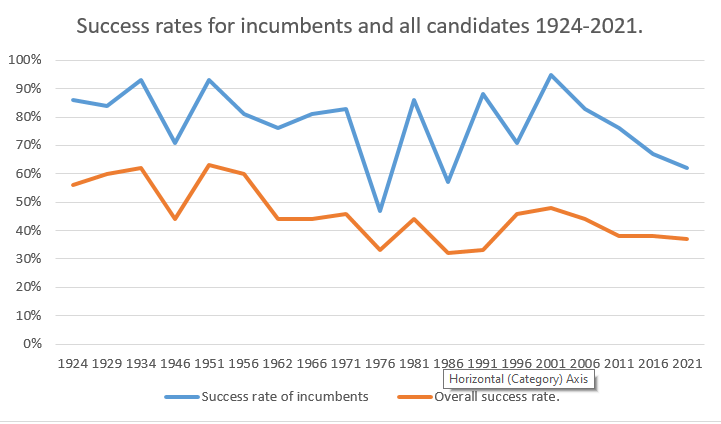
The short answer is yes, to an important degree, demonstrated in every General Election for a hundred years.

Although there is a sustained difference between the two success rates, it has fluctuated over the years. The smallest difference was in 1976, when there was a significant rejection of incumbents: 17 MHKs of 24 sought to retain their seats, and 9 were rejected by the electorate. Even that year incumbents were re-elected at a 47% rate, while 33% of candidates generally were elected. The twenty-first century started with a singularly stable House of Keys: the 95% success rate for incumbents was with a very high number of incumbents standing. 18 of 24 Keys retained their seats, with only one who sought to be elected being rejected by the electorate. From that exceptionally high level, however, the success rate of incumbents has decreased in every 21st century General Election, while the success rate of candidates generally has dropped much less dramatically.

Nonetheless, despite these fluctuations, there is a consistent pattern of sitting MHKs having a better chance of being elected than their non-sitting peers. If we average the success rates across all the General Elections, we find 78% for incumbents, and 46% for candidates as a whole. This difference is not dissimilar from the 20 percentage point advantage estimated for UK elections, and the 18 percentage point advantage described for Irish elections. Studies of larger democracies, however, tend to identify incumbency as party retention of a seat, not individual retention of a seat. The “personal incumbency advantage” may be low in party systems, but will often constitute the entire incumbency advantage in the Manx system.

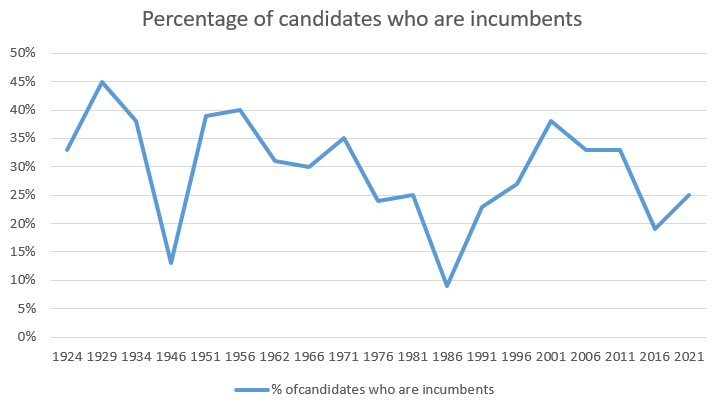
This differential success rate operates in a context where significant numbers of incumbents stand for re-election. It is useful to depict this in both absolute numbers (so how many incumbents stood), and percentage terms (so what percentage of candidates were incumbents).

A consistently high proportion of candidates are incumbents. Two General Elections stand out as having a much lower proportion than normal. In 1946, only 13% of candidates were incumbents. The previous General Election had been held in 1934, and most of the Keys had served for eight years, including six years of global war. Incumbents may have chosen not to stand because they did not wish to continue this form of public service even longer, or because of their assessment of the electorate’s desire for change.  The proportion in 1986 was even lower, with only 9% of the candidates under the new electoral system being incumbents, and their success rate being comparatively close to non-incumbents (57% vs 32%). Incumbents may have considered that changes to the electoral system made it more difficult to assess their chances of success, or to manage their campaigns. There is a – less pronounced – drop in the percentage of candidates who are incumbents in other General Elections where there have been changes in the electoral system (for instance 2016).

One point to bring out is how often the electorate have been offered the option to have a House of Keys composed of a majority of incumbents, and the times that has actually materialised. A majority of Keys seats were contested by an incumbent (interpreting the term widely when there has been a change of the number of seats or the voting system, discussed more fully below) in every General Election except 1946 (when only 7 incumbents of the long House of Keys which had been elected in the pre-war election of 1934 contested the election), 1986 (when in a radically different electoral system only 7 incumbents contested the election), and 2016 (when in the first elections to 12 two member constituents, 12 incumbents stood). Half or more of the Keys consisted of incumbents following every General Election except 1946, 1976, 1986 (the first election under a very different electoral system), 1996 (the first election after the return to first past the post), and 2016 (the first election under the 12 2 seat constituency system).  

That sounds like a very significant number of seats held by incumbents across the century. We can, however, easily compare the proportion of new MPs in the UK Parliament and new MHKs in Tynwald for  1979-2019. Mapping the UK General Election onto the closest Manx General Election we find:

When contrasted with the larger, party institutionalised, neighbouring system, it is striking how much more volatile membership of the House of Keys is compared with the House of Commons. Only in 2011 (Keys) and 2010 (Commons) do we find a similar proportion of new members to the House: 33% in the Keys compared to 35% in the Commons. This was an exceptional point however – overwhelmingly, a higher percentage of the Keys are sitting for the first time as opposed to the Commons. In the period 1976-2021, in 5 of the 10 comparator points, more than half of the Keys were sitting for the first time; the highest percentage of new MPs sitting was 37% in 1997, followed by 35% in 2010 – in both cases, reflecting a change of the majority party in the Commons. Widening the scope slightly, the record number of new MPs elected in the 1945 election, 51%, would be completely unexceptional on the Manx scene since 1924.

The remedies judgement in the Ranson case.

The judgement of the EET in the Ranson case is now available. The Tribunal has awarded Dr Ranson a total of £3,198,754 damages, plus 70% of her costs at the liability stage (it should be noted that normally parties in Tribunals do not receive any costs). This breaks down into a number of different elements (summarised at para 346-347).

Injury to feelings. There was a detailed discussion as to what the maximum amount that could be awarded was, and how to apply English cases to the Manx situation. The EET took the approach that “The award should be compensatory with no element of punishing the wrongdoer. Feelings of indignation ought not to inflate the award yet neither should the award be too low because that would diminish respect for the policy …. The award must ensure that such misconduct is seen to be wrong. Additionally, the award should bear some broad general similarity to those awarded in personal injury cases” (para.130). The EET considered that “During the Liability Hearing process ( including disclosure of
documents), besides in her evidence on oath, there was also an attempt by Miss Magson to cover-up her misconduct. This was bound to inflame justified injured feelings” (para. 132).. She was awarded £40,000 for injury to feelings,

Aggravated damages. These are damages which may be awarded “when the Respondent has acted in a high-handed, malicious, insulting or oppressive manner” (para.137). The Tribunal considered this to be beyond argument, and no contrary view as put forward by the DHSC. The Tribunal explicitly found that that the wrong was committed in a “demeaning and spiteful way”, motivated by “animosity and spiteful misconduct”, with subsequent misconduct in the way the DHSC opposed Dr Ranson’s action (para.140) She was awarded £20,000 of aggravated damages.

Personal injury. These are damages to reflect personal injury suffered because of the wrong committed by the other party. The Tribunal noted that there were no known Manx High Court authorities on personal injury awards following whistleblowing, and drew on the English approach. The Tribunal did not completely accept Dr Ranson’s case as to the personal injury suffered, and was not happy with the level of disclosure by Dr Ranson as to her previous medical history, “particularly after her many complaints about non-disclosure by the DHSC relating to the Liability Hearing” (para.161). It was, however, much more critical of the medical expert called by the DHSC (para.174). The two parties had proposed either £56,000 or £30,000 damages. She was awarded £40,000 of damages for personal injury.

Medical expenses. These are expenses reasonably necessary to ensure the best chance of recovery. The Tribunal accepted most of the treatments Dr Ranson’s medical expert suggested, and awarded her £6000 for medical expenses.

Exemplary damagaes. These can be awarded where conduct is “oppressive, arbitrary or unconstitutional” (para.176), and are awarded not to compensate the complainant, but to show that the governmental misconduct had to be punished. It was agreed that the DHSC was a public body against which such damages could be made. The Tribunal found that the rulings in the Liability Decision “amply justified Miss Magson’s misconduct (and to a lesser extent that of others) as being oppressive and arbitrary” (para.181), justified on the basis of unreasonable conduct and false evidence (para.187). The two parties had proposed either £100,000 or around £4,000. She was awarded £10,000 for exemplary damages. The Tribunal saw “The very fact of making the award at all demonstrates that the Tribunal considered punishment was warranted for the oppressive, arbitrary or unconstitutional behaviour – amounting to gross misconduct” (para.185). This was to be punished through the award of costs (discussed below), and adding a substantial exemplary damages head “plus a very large costs burden which is also awarded (this being, in effect, a punishment) would impact not just the DHSC but, in reality, Manx taxpayers and, in all probability, persons on hospital waiting-lists.” (para. 186).

Compensatory award. This is the amount awarded to compensate for financial losses caused by the wrong – in particular, loss of salary. As the Tribunal notes “this is not an exact science. Fortunately, there is abundant legal precedent about how to approach something which is, inevitably, unpredictable.” (para 213). I will gloss over the abundant legal principles and approach. The analysis of Dr Ranson’s future career prospects is also – in contrast to the other heads – very personal (as illustrated by the list of questions about Dr Ranson the Tribunal felt it needed to address, para.323). The Tribunal awarded £185,670.64 for past loss (i.e. loss before the date of the judgment), and £1,464,118.08 for future loss of earnings (a higher number is given earlier in the judgment, and then reduced by 25% to reflect “non-exhaustive uncertainties” (para. 334). Additionally, future pension loss was calculated at £749, 718.15, plus £8062.60 for the Manx state pension.

.Interest on some elements of these awards totalled a further £ 8,994.95 (para. 345).

It is striking to find aggravated and, especially, exemplary damages, awarded against the DHSC in this case. The concerns over the way in which the defence of the action was conducted are returned to in the, exceptional, award of costs for the Liability Decision. The Tribunal notes that “In effect, when an order for costs is made, it is because of gross misconduct” (p348). The Tribunal considered that the proceedings were conducted unreasonably, and “involved a false allegation (and indeed, more than one)” (para. 351). This is discussed at length from para. 352-

In particular, at para 363-4 the Tribunal said: “It is however inexcusable for a Chief Executive such as Miss Magson to mislead both the Tribunal and Dr Ranson. The case on liability was fought tooth and nail by the DHSC on a false basis to the substantial detriment of Dr Ranson and at the expense of taxpayers on the Isle of Man … Miss Magson knew that the denials of liability in the Response contained assertions and allegations that were untrue. She knew or should have known and understood that the way she had drafted the Response was unsustainable. She knew or should have known that her pleaded arguments could never survive scrutiny once the documents which needed to be revealed were in fact disclosed”.

The Tribunal did not award full costs to Dr Ranson for the Liability Decision, on the basis that “Even if the DHSC case had contained bona fide but ultimately unsuccessful cornerstones, Dr Ranson would have had to incur quite considerable costs which, as a norm, would not be recoverable at all.” (para. 366) – reducing recovery to 70% of the legal costs once assessed or agreed.

It did not, however, make the same order in relation to the costs of the Disclosure Proceedings. As part of explaining this decision making, the Tribunal discuss the EXPOL report seeking to resolve whether there were concocted documents. To quote at length:

From almost as soon the EXPOL report became available, the Tribunal was informed
that Dr Ranson did not agree with the conclusions. Thereafter, it was apparent from
her evidence in this Tribunal in January 2023 that she did not agree with the outcome,
at least to some extent. Inter alia, she did not consider EXPOL to be independent.
However, her witness statement never set out any reasoned attack on the
conclusions. It did not point out why she stood by her allegations that all or some of
the documents were concocted. She gave no evidence to expand on her rejection of
any of the conclusions.

  1. Because of the influence on potential issues of Exemplary Damages and costs, the
    Tribunal had anticipated that, because the conclusions of the EXPOL report were
    controversial or disputed, there would have been a request on Dr Ranson’s behalf for
    a Witness Order (or Orders) for cross-examination of EXPOL officers at the Remedy
    Hearing. That did not happen.
  2. The appeal process last year regarding documentation issues was heard by the learned
    First Deemster. He rejected the appeal but in his judgment, he had cautioned against
    the Tribunal taking on too much of an investigatory role. It was therefore not
    considered to be the role of the Tribunal of its own initiative to require attendance of
    the personnel behind the EXPOL Report, even though the Tribunal had expected this
    to happen.
  3. In the event, Dr Ranson’s team did not seek to call anybody involved with preparation
    of the EXPOL report. However, in his Closing Submissions, Mr Segal alleged quite
    detailed and serious shortcomings about the conclusions of no improper concoction.
    Mr Segal still maintained that some of the documents were concocted – to the extent
    that he encouraged this Tribunal to refer the allegations of concocted documents to
    the Isle of Man Constabulary for further investigation.
  4. While the Tribunal had hoped and expected to have the issue of the alleged
    concoctions tested and resolved, this was not possible. Without questioning the
    appropriate witnesses, as Mr Segal had the chance to do by seeking witness orders
    against the authors of the EXPOL report, it would be quite wrong for this Tribunal to
    come to any conclusions one way or the other – let alone to refer the matter to the
    Isle of Man Constabulary. There remains nothing to stop Dr Ranson referring the
    matter to the Constabulary herself.

The award of the Tribunal in relation to exemplary damages, and costs, although a relatively small part of the overall award, are sobering. The DHSC has been found by the Tribunal to have acted in a high-handed, malicious, insulting or oppressive manner; in a way which was “oppressive, arbitrary or unconstitutional”; and in a way which involved gross misconduct.

Women jurors in the Isle of Man.

In 1920, Tynwald did not take the opportunity to open jury service up to Manx women, although contemporary English legislation did so at the same time as addressing women’s suffrage. This was a deliberate decision by Tynwald, revisited repeatedly until, at the very late date of 1980, women were able to sit in juries in Manx courts. 

In 1920 the Sex Disqualification Removal Bill was debated in Tynwald. Based on 1919 UK legislation, the Sex Disqualification (Removal) Act 1919, one clause would have allowed women to serve on Manx juries. The Bill began in the Legislative Council, as was common for significant Bills of the time, and was passed with little discussion. The Bill then moved to the House of Keys, where questions were raised as to whether there was any demand for Manx women to sit on juries, whether women defendants were treated unfairly by all male juries,  and whether the English law reform had been a success. An amendment removing juries from the ambit of the Bill was passed without a vote, and accepted by the Legislative Council.

In 1949 a Bill to allow women to serve on Manx juries, based again on the 1919 UK legislation, failed in the Legislative Council; and a motion in Tynwald in 1959 to add women to the roster for jury service failed to secure a majority in either the Keys or the Council.

It remained a live issue however, driven by the Women’s Institute from 1963, and a Bill whose sole purpose was to include women was introduced to the Keys by the government in 1965. The proposer of the Bill, however, stressed that the Women’s Institute focussed on legal change to permit women to serve, while the Bill introduced “is rather different, for it brings women onto equal terms to men and it makes jury service compellable”.  Two different amendments were proposed which would allow women to choose whether to be compellable for jury service – one an “opt-in”, the other an “opt-out”. The “opt-in” commanded more Keys support, and in an amended form that reflected this, passed the Keys by a margin of 20 votes to 1. It was described in the Isle of Man Examiner as giving “women … the best of both worlds … this gracious compromise”. 

The Bill, which now had compellable jury service for men and voluntary jury service for women, proceeded to the Legislative Council. The Attorney General expressed the view that the principle of voluntary service was entirely wrong, and had been reinforced on this by consultations with the UK Home Office. Other voices rejected the voluntary jury service for women only approach, and the Bill failed without a division. 

The issue was returned to in 1978, led by Mrs Hanson MHK. She was one of two women MHKs at the time, and a significant fault line developed between her approach, and that of the other woman MHK, Mrs Quayle. Mrs Hanson argued for women to be subject to compellable jury service obligations on the same basis as men; Mrs Quayle returned to the earlier theme of Manx debates, and indeed debates elsewhere in the common law world, and supported an opt-in for women who were willing to serve as jurors. The majority of the Keys followed the approach of Mrs Hanson, albeit with “a mother’s clause”.

The Jury Act 1980 as originally passed provided that “every person” registered as entitled to vote, between the ages of 18 and 65, and having been ordinarily resident in the British Islands for any period of five years since attaining the age of 13 was qualified to serve on all Manx juries as a civic duty. This was later amended to extend the maximum age to 75, and to start the period of normal residence from 18. The Deemster could excuse a prospective juror as they saw fit, but a specific clause treated some women differently from other prospective jurors. Section 12(4) provided that “an application by a woman that she is the mother of a child under sixteen years of age and has the care of that child shall be good and sufficient reason for that woman to be excused”. Authority to excuse a prospective juror was later transferred to the Chief Registrar, who may excuse a prospective juror for any good reason, and “personally undertaking the full-time care of a child under the age of 16”, or a person with a disability, or being themselves 71 years or older, shall be “a good and sufficient reason” (Jury Act 1980 s.12 as amended). The modern version of the section, unlike the one originally passed, is not limited to mothers, and is open to both men and women.The first woman to be called to a Manx jury was Mrs Ann Dugdale, “Grandmother of nine” (Isle of Man Examiner, 4/9/1981 at p1). She was called to join an otherwise male inquest jury, called by the Coroner, Henry Callow, in relation to a fatal road traffic accident involving a holidaymaker. Described by the press as a “cheerful grandmother”, she was joined, before the jury sat, by two other women jurors (Joceline Kelly and Ruth Kelly). The Coroner expressed pleasure at seeing women jurors, and seeing women take a full place in their civic duties. Mrs Dugdale recognised it was a historic moment, and took the view that “I’m all in favour of women in juries, and it’s not before time. We’re far more intelligent than men anyway”.

1919 and all that: Women MHKs but male only MLCs.

[This is a cross-post from the Women in Manx Politics blog]

1919 was a hugely important year for the internal Manx constitution – that is, the rules which define and allocate legal power within the Isle of Man, as opposed to between the Isle of Man and non-Manx bodies. This blog explores one facet of 1919, changes to the membership of Tynwald. In particular, two changes to the Manx constitution in 1919 seem in tension with each other – the opening up of membership in the House of Keys to women by the House of Keys Election Act 1919 s.15; and the creation of indirectly elected and appointed members of the Legislative Council, such new members being limited to men, under the Isle of Man Constitution Amendment Act 1919 s.12.

Although these provisions were passed in the same year, they have a very different background.

The Constitution Act can be traced to a 1907 petition of the House of Keys seeking a range of constitutional reforms, which led to an important report by the UK Government. In 1913, the Lieutenant-Governor informed the Keys that he intended to introduce a Constitution Bill into the Keys in the first instance (HK 2 December 1913). The Bill introduced at the Lieutenant-Governor’s request was a comprehensive document addressing a range of reforms proposed by the government report. The introducing MHK, Mr Crennell, noted that a better way to proceed would be to divide it into separate Bills, and Part I of the original Bill, which dealt with the composition of the Council, was read for the first time in January 1914 (HK 6 January 1914). He was given leave to introduce the other parts as separate Bills (HK 20 January 1914).

The discussion of this truncated Bill in the Keys was protracted (HK 20 January 1914; HK 17 February 1914; HK 3 March 1914), but focussed on two issues: which ex offio members of the Legislative Council to lose, and whether the “elected” members should be elected by the Keys, or by direct election. Of interest is the proposal that the Keys should elect MLCs, but that they should elect two persons representing farming, and two the towns and villages – reminiscent of later developments in the Irish Free State (HK 17 February 1914); or that MHKs for different sheadings should be the electors for an MLC representing their sheading – reminiscent of later developments in Pakistan. There was limited discussion of what became section 12, but entirely focussed on whether clergy should (as with elections to the Keys) be excluded (HK 25 February 1914). The limit of the clause to “male” was not a topic for discussion at all.

The 1914 Bill was passed by the Keys, and then proceeded to the Legislative Council where it failed on second reading (LC 17 April 1914). The Attorney General moved for rejection of the Bill, on the basis that an entire constitutional reform scheme had been put forward, and that the entire scheme needed to be considered in order to create “a new system of a fairly balanced character”. The Keys protested at this rejection (HK 21 April 1914, LC 15 May 1914), and later in the year the UK government intervened, advising the Lieutenant-Governor to proceed with seven Bills introduced separately (HK 26 May 1914). All seven Bills were read for the first time in Legislative Council in the summer of 1914 (LC 12 June 1914), but the commencement of the Great War lead to the Bills not being proceeded with (LC 25 May 1915).

The Constitution Bills were returned to in 1919, with the Keys petitioning the UK Prime Minister in relation to the reforms flowing from the 1907 petition (HK 7 January 1919).  The Constitution Bill dealing with the composition of Legislative Council was introduced into the Legislative Council in April 1919 (LC 29 April 1919). As Deemster Moore noted, this was a Bill which had first come before the Legislative Council in June 1914, when he had been one of only two members of the Council to support it. There was brief discussion of gender in relation to what became s.12 in the Legislative Council. The Vicar General queried whether the limitation of MLCs to males had been before the Keys, and thought that they had changed their view on the topic. The Vicar General, speaking I think on behalf of the Archdeacon who had “strong views about women being elected to positions of this kind”, suggested that the word “male” (and so the exclusion of women MLCs) “ought to go out”, but later concluded that “it would be desirable to leave it to themselves [the Keys] to alter their own views”. The Attorney General was content with the limit: “We might advance slowly – festina lente. In England the elective principle came before the universal suffrage”. The Bill was passed by Legislative Council with the “male” limit intact.

In the Keys, it is clear that the 1919 Bill was simply seen as a continuation of the 1914 Bill (HK 3 June 1919). The introducing MHK, Mr Quine, noted (slightly inaccurately) that it was identical to the Bill passed by the Keys – and rejected by the Council – in 1914. The only significant difference was a provision excluding clergymen from the Council, which the Legislative Council had removed. What became section 12 passed with very little discussion, and none on gender. The Bill passed in the Keys in June 1919, and received Royal Assent.

So the Act which ended up excluding women from the new seats in the Legislative Council was, fundamentally, a Bill which the Keys discussed at length in January-March 1914. The substantive decisions were taken in early 1914, and not revisited in 1919. The possibility of women MLCs was not raised in 1914 and – apart from a query raised but not pursued by ecclesiastical members of the Council – not discussed in 1919.

Generally, the House of Keys Act can also be traced back to before the Great War, and the efforts of Mr Crennell to introduce adult suffrage into the elections of the Keys (HK 19 November 1912, HK 18 February 1913, HK November 1916). The Bill was passed by the House of Keys  in 1918 (HK 30 April 1918), but when it passed to the Legislative Council they voted to postpone consideration of the Bill because of new legislation in England. This decision was made in November 1918 (LC 5 November 1918), and this must be a reference to the Parliament (Qualification of Women) Act 1918, which received Royal Assent on 21 November 1918. Section 1 of this UK Act provided “A woman shall not be disqualified by sex or marriage for being elected to or sitting or voting as a Member of the Commons House of Parliament”. After a nudge from the Keys (HK 28 January 1919), the Legislative Council returned to the Bill in February 1919.

In discussing the Bill, the Attorney General raised the issue of whether the Legislative Council should follow the House of Keys, or “follow the lead of England and make women eligible for membership of the other House” (LC 18 February 1919). A new clause was agreed in Council that provided “A woman shall not be disqualified by sex or marriage for being elected to or sitting or voting as a member of the House of Keys”. The closeness to the 1918 Act of Parliament shows which way the Legislative Council answered the Attorney-General’s question. The Council also proposed changes to the qualification requirements of women voters, again drawing more strongly on English models than the Keys version.

The Key’s consideration of the proposed amendments principally  focussed on the rights of women voters, but there was some discussion of the new clause giving women the right to stand for the Keys (HK 11 March 1919). Mr Teare felt the new clause should be rejected: “The Council, in a further amendment, have provided that women shall be eligible to sit in the House of Keys at 21 years of age; they are to have the privilege of legislating, but not of voting, or that of owning their own goods, if they are married … She can contract debts, but she is not legally liable to pay them. It seems remarkable that ladies are to have the privilege of sitting in the House, and yet not have the right to pay election expenses. or to engage in contracts which are necessary to secure election. The reasons why this amendment has been introduced are not strong or conclusive, and the mere adaptation of the English measure is quite contrary to the spirit of the Adult Suffrage Bill introduced by my predecessor.” Mr Southward objected to women as young as 18 being elected, but stressed: “Not that I object to ladies sitting in the House of Keys; they may possible add a charm to our meeting which hitherto it has not possessed, and they might possibly reduce the long speeches which we sometimes have to listen to”. Others felt this was an issue for the electorate. Mr J Qualtrough noted, in this context, “They will not only be an addition but an extra quality to the composition of the House in the coming time, and I hope when we get Council reform it will be possible for a lady to sit even there”. This is the only comment in 1913-1919 about the difference.

Clause 15 as sent down by the Legislative Council was passed by the Keys. The Bill was made subject of a conference with the Legislative Council, which resulted in the Council “withdrawing their amendments on the subject of the qualification of women” – women MHKs, having already been accepted by the Keys, was not a topic (LC 8 April 1919).

To summarise this legislative history. The 1919 exclusion of women MLCs was debated in 1914, and not revisited in 1919. The 1919 inclusion of women as MHKs was introduced very late in the legislative process, by the Legislative Council rather than the Keys, influenced strongly by the UKs passing of the  Parliament (Qualification of Women) Act 1918. The two measures are thus separated by the Great War, and the changes brought about by that collective experience.

This legislative history is singularly short of discussion of principles that might underpin the right of women to sit as members of Tynwald, and which might therefore be used to justify the distinction between women MHKs and women MLCs. My sense from the debates is that the position of women in Tynwald was, if considered at all, seen as peripheral to the constitutional reforms in both measures. The Constitution Act was primarily about introducing some sort of democratic element into the previously purely ex officio Legislative Council, the House of Keys Act was primarily about changing voting qualifications to introduce universal suffrage. The change to the Keys, introduced at the last minute in the legislative process, was driven by the Legislative Council’s favouring of a recent UK model; and accepted by the Keys with limited opposition but little enthusiasm. No such model existed for MLCs, and the principles of the Constitution Act were in any case not reopened in 1919.

The above may be read as an argument that the difference between women MHKs and women MLCs was almost an accident. Given the same legislators were considering both sets of legislation in 1919, and that the difference survived until 1961, this would be too simplistic. I think two principles, beyond the pragmatism I suggest in the previous paragraph, may underpin the willingness of the  Tynwald of 1919 to accept this difference.

Firstly, the 1919 reforms to the Council were the result of decades of constitutional pressure, and while seen as a hugely significant constitutional reform, were not seen as an end point by reform minded MHKs. Securing elected membership on the Council may have been seen as a sufficient first step, with the possibility of opening the Legislative Council up to women as a separate task. As the Attorney General said, “We might advance slowly”. Against this, the origin of the right of women to sit in the Keys originating in the Council may suggest that the Keys of 1919 were not committed to women’s right to join Tynwald.

Secondly, the reformed Legislative Council was in many ways seen as closer to the UK House of Lords than was the case in later decades. As I have discussed elsewhere, for decades there was an assumption that the right person to be appointed by the Keys to the Council was an MHK or former MHK. Given the overwhelmingly male makeup of the Keys, and the impossibility of any woman MHK having a long period of service starting before 1919, a woman “elder statesman” may have struck members of Tynwald in 1919 as a contradiction in terms. I do not want to put too much weight on a single word from a single MHK, but it will be recalled that the only MHK to see a link between women MHKs and women MLCs, Mr John Qualtrough said “I hope when we get Council reform it will be possible for a lady to sit even there”. He was speaking in March 1919, and the Council reform Bill was discussed in June 1919. Mr Qualtrough may have been anticipating a six month delay, rather than more than 40 years. But “even” is interesting to me, and may suggest that barriers to women MLCs might be seen as greater than for women MHKs.

These, and assumptions about the place of women in public life we see much more clearly discussed in relation to the place of women in Manx juries, may have underpinned the outcome of 1919. Having gone through the debates, however, my view is that the different times of the two provisions formulation – 1913 and 1919 – were at least as important.

Death tax planning offshore: Euthanasia repurposed?

A guest blog by Advocate Paul Beckett M.A., M.St. (Oxon.), Visiting Research Fellow, School of Law, Oxford Brookes University.

On 1 December 2022 the Isle of Man Government opened a public consultation on “assisted dying”, discreetly avoiding any reference to assisted suicide.One of the most divisive issues of our times, assisted suicide is defended and opposed with equal vehemence, and moral, ethical and legal arguments all fuel the debate over the right to ‘self-determination’. Euthanasia and assisted suicide, killed by medical professionals or killed by one’s own hand, lead to very much the same result: death.

Many countries have legalised euthanasia or assisted suicide.What sets the present Isle of Man consultation apart is not its thoughtful balancing of the emotional and clinical issues on which it seeks public comment, but something which is not stated, because it is self evident. This debate concerns euthanasia in a low tax jurisdiction.

Where there is death, there is a phalanx of tax planners eager to advise. For both onshore and offshore tax residents, there are heavyweight fiscal arguments to consider.Putting the ethical issues to one side, is there are danger that euthanasia could be hijacked – repurposed to serve the needs of death tax planning?

Leaving a low tax area, intending to be euthanised.

Picture a scene in which someone has relocated from their home country, in this case the United Kingdom, which is their domicile of origin, to the Isle of Man, their new domicile of choice. They are tax resident in the Isle of Man. Then imagine that because euthanasia is not yet available in the Isle of Man, this person will travel to Switzerland in order to end their life.

By leaving the Isle of Man for Switzerland with the sole intention of carrying out an assisted suicide, the Isle of Man – to which they are clearly not returning – is no longer their domicile of choice. For Switzerland to become their new domicile of choice, they would need to meet Swiss tax residence requirements. An individual is deemed to be a tax-resident under Swiss domestic tax law, if:

  • the individual has the intention to permanently establish his/her usual abode in Switzerland, which is usually where the individual has his/her centre of vital interest, and is registered with the municipal authorities, or if
  • the individual stays in Switzerland with the intention to exercise gainful activities for a consecutive period (ignoring short absences) of at least 30 days, or if
  • the individual stays in Switzerland with no intention to exercise gainful activities for a consecutive period (ignoring short absences) of at least 90 days.

But they are merely visiting in order to die, and none of these criteria is met. In this limbo, their default domicile for taxation purposes becomes once again their domicile of origin; the United Kingdom. The impact on a lifetime’s careful savings could be considerable, not to mention the consequences for family left behind.


Moving to a low tax area, intending to be euthanised.

Now assume that euthanasia has become legal in the Isle of Man. The Isle of Man Government consultation explains the aim of the proposed legislation to be:

• to enable mentally competent adults who are terminally ill to be provided with assistance to end their life at their request.
• A person is deemed to be terminally ill if a registered medical practitioner has diagnosed them as having a progressive disease, which can reasonably be expected to cause their death.
• The person must be 18 years of age or over and is a permanent resident on the Isle of Man.

“A permanent resident on the Isle of Man” – would this not, as in Switzerland, be an impediment to someone wishing to be euthanised who attempts to abandon their domicile of origin in the United Kingdom or (having earlier abandoned their United Kingdom domicile of origin) their domicile of choice elsewhere, by relocating to the Isle of Man? Would they also be in limbo, unable to establish that the Isle of Man had become their “permanent residence” and hence their domicile of choice in which they were tax resident. Would they remain domiciled in (or would their domicile revert to) the United Kingdom?

Not necessarily. There is no definition of residence for tax purposes in the Isle of Man.[1] The Isle of Man treats those individuals having a view or intent of establishing residence as tax resident from the date of their arrival. The Assessor of Income Tax will look at evidence showing that the presence in the Isle of Man is not for a temporary purpose.

Intending to live in the Isle of Man for the rest of one’s life is hardly a temporary purpose. And in any case, one’s appointment with death may be booked after residence has commenced. There is no compulsion to reveal advice received or their innermost thoughts and intentions. The Assessor of Income Tax can hardly ask a new resident how long they plan to remain among the living.

Death tax planning – euthanasia repurposed.

The result? In the hands of international wealth and tax planners, euthanasia will have been repurposed. The Isle of Man, as a low tax jurisdiction with ill-defined tax residency rules, may become the destination of choice for a steady stream of tax-advised, terminally ill individuals. The Isle of Man is gentle and welcoming, and there are far worse places in which to spend one’s final days. But what will be the social impact on the island and on the island’s reputation abroad of what amounts to death tourism?