GC 2021/0096 has added Sinovac, Sinopharm Beijing and Covaxin to the list of qualifying vaccinations under reg.5A(2). This is the regulation which creates an exemption to some rules governing entering the Isle of Man for those who have “completed the full course of a qualifying vaccination”.
Given the increased emphasis on booster shots as a response to the Omicron variant, it may be that at some point we will see a redefinition of “a full course of vaccination” to reflect this. The structure of reg.5A does not envisage this being done by GC, and indeed the emphasis on “a qualifying vaccination” may make recognition of combinations of vaccines difficult. If a change was needed, I would expect any formal change to be by a PHR.
The PHR (Amendment) (no.19) came into effect before approval by Tynwald: at 04.00 on 30 November 2021 (having been signed at 22.15 the night before). Assuming they are approved, the principal Regulations will now expire on the 31st of March 2022, as opposed to the 20th of January 2022 (amending reg.4).
As would be expected the changes are responding to the potential dangers posed by the Omicron variant.
Border control.
The vaccination exemption to border control (under reg.5A) and natural immunity exemption (under reg.5C) are now both subject to qualification in (new) regs. 11A and 11B, which as a result apply to both vaccinated and unvaccinated travellers.
Reg.11A applies to persons arriving from outside the Common Travel Area, who must self-isolate, and take a PCR within 48 hours of arrival. Reg.11B apples to persons arriving from within the Common Travel Area. On arrival they must agree in writing to self-administer a lateral flow test within 12 hours, and to share the results of the test with the Chief Secretary.
The amendment also slightly changes the definition of Category B persons (amending reg.14(1)(a)).
Face coverings.
A new set of regulations now impose requirements to wear face coverings.
Reg.6A requires a person travelling “on a vehicle used to provide a public transport service” to wear a face covering. A public transport service means the use, for transporting one or more members of the public, of a vessel, motorised vehicle, tram, train, public transport vehicle, aircraft, and “any other conveyance” whether or not for hire (reg.6A(6)). It does not include such a vehicle when being used for private purposes and not at the time transporting a member of the public (reg.6A(7)). This might suggest that “travelling” includes “driving”, so putting PHR face covering duties on bus drivers for instance, but it is phrased as “for the avoidance of doubt” so is ambiguous. Operators of public transport services must provide information about the new requirements on their vehicles (reg.6A(5)).
This duty to wear a face covering is subject to two exceptions – “exemptions” and “reasonable excuses”.
An important exemption is age: a traveller who is a child under 12 is exempt. The other exemptions are based on the nature of the vehicle. Exemptions apply where the vehicle is: a ferry where the part open to passengers is entirely outdoors; a vehicle which does not land, take off, or dock on the Island; a cruise ship; has an allocated cabin where the person is alone or only with members of their household or a carer; or – similarly – is carrying a vehicle within itself where the traveller will remain for the entire journey. The distinction between the cabin and the vehicle-within-a-vehicle rule is that the cabin using traveller is required to wear a mask outside the cabin, but may leave it; while the vehicle-within-a-vehicle traveller must stay within the vehicle. It seems an odd distinction to draw, but follows from the different drafting of reg.6A(3)(d) and reg. 6A(3)(e).
There is a list of reasonable excuses in reg.6A(4). The guidance note to this PHR state that it is not intended to be an exhaustive list. Determining whether a list in a statute is intended to be exhaustive is notoriously difficult, so it might have been useful to state this in a legally binding form in the PHR itself. Reasonable excuses specified include some characteristics of the traveller, but also particular circumstances and activities. They are: the traveller is unable to wear a face covering because of a physical or mental illness, impairment or disability; where the traveller has to remove a face covering to communicate with a person who has difficulty communicating (so covering communicating with a lip reader); where the traveller “has to remove the face covering in order to avoid harm or injury, or the risk of harm or injury, to [themself] or others”; where the traveller “is travelling to avoid injury, or to escape a risk of harm, and does not have a face covering”; where the traveller has to take medication, or eat or drink (if allowed on the vehicle and reasonably necessary); or where asked to remove it by a police officer or the operator of the public transport service.
Reg 6B, on the other hand, requires a person to “wear a face covering in a relevant place”. The Council of Ministers are empowered to issue GCs defining “relevant place” (reg. 6B(4)) – essential as the term is not defined in either the principal PHR, or the amending PHR. Shifting this definition down to GC rather than PHR suggests anticipating a need for rapid flexibility in defining where face coverings must be worn. For the moment GC 2021/0094 has defined relevant place as “health and social care premises”, which “shall include but are not limited to any indoor premises where health or social care services are provided to the public, including a hospital, GP surgery, dental practice, opticians or optometrist practice, pharmacy, residential home, care home, vaccination hub or other premises at which vaccinations are administered, or testing centre for the purpose of administering tests for Coronavirus”.
This is not required for children under 12, or where the person has a reasonable excuse (reg.6B(2)). There then follows a list of reasonable excuses almost identical to those discussed above in relation to travel. There are however two additional grounds here: “where [the person] is undertaking an activity and wearing a face covering during that activity may be considered to be a risk to [the person’s] health”, and “where [the person] is seated in premises where food or drink is sold, or otherwise provided, for consumption on the premises”. Note that the latter is very specific – you must be seated to be allowed to remove your mask. So visitors to Nobles, if the coffee shop is open, may remove their masks when seated for their coffee, but not before.
The inclusion of residential home and care homes is striking, as this part of the Regs do not include a cabin exemption which allows a person to remove a mask when “allocated a cabin, berth or other similar accommodation on the vehicle, at any time where P is in that accommodation — (i) alone; (ii) only with members of P’s household or a member of the household’s carer”. If the intention is not to require care home residents to wear a mask at all times, something like this might usefully be added; although it may be that we will find “reasonable excuse” read as encompassing care home residents alone. The Chief Secretary has the power to issue guidance relevant to both of these Regulations, and a person to whom the guidance applies “must have regard to that guidance” – this might also deal with this point.
So, what happens if you don’t wear a face covering, and do not qualify under the exemptions or reasonable excuse provisions? The amending Regulations are silent, which means that the general PHR section on offences applies. A person commits an offence if they fail without reasonable excuse – which even if the lists in reg.6A and reg.6B were exhaustive is not limited to the excuses set out there – to comply with the PHR or GCs issued under it (reg.36(1)). Such an offence is punishable by up to three months imprisonment, or a £40,000 fine (reg.36(8)). As an alternative a constable may issue, to an adult, a fixed penalty notice of £150 (rising to £250 if not paid within fourteen days) under reg.37-42.
Personally, I feel that the general upper limit of punishment for offences under the PHR should have been lowered significantly for not wearing a face covering – even for repeat offenders, even when obviously dangerous. On the specific issue of care home residents, I would suggest that being a resident in a care home who does not wish to wear a mask when alone in your residence constitutes a reasonable excuse under reg.36, even if not reg.6B, and so could not be the basis for a prosecution or fixed penalty notice.
A very significant theme in the pre-1962 era was that MHKs elected MHKs (or less commonly former MHKs), or sitting MLCs (who had normally become MLCs for the first time following being an MHK). How far did this pattern of electing from within Tynwald continue?
As mentioned earlier, there is no moment equivalent to the Keys General Election at which to take stock of the membership of the Legislative Council. It is useful however, to consider the election patterns of the Keys decade by decade.
Number of candidates, including being considered on multiple sittings for the same seat.
Number of sitting MHKs/MLCs
Number of former MHKS/MLCs.
% of Tynwald or former Tynwald.
% new to Tynwald.
1960s
14
14
0
100%
0%
1970s
29
28
1
100%
0%
1980s
39
25
11
92%
8%
1990s
41
23
9
78%
22%
2000s
67
31
10
61%
39%
2010s
58
24
0
41%
59%
2020s (so far)
16
2
1
19%
81%
A clear change, then, is the shift, first visible in the 2000s, of MHKs electing from outside of the House of Keys. This was preceded by a sharp increase in the percentage of candidates, albeit usually unsuccessful candidates, from outside Tynwald over the preceding decade. This had itself been modestly prefigured in the 1981 election, where a bye-election was triggered by the resignation of Kneale to join the Keys. No MHK stood, but four ex-MHKs did stand, and one (George Swales) was elected. The seat in Council, however, had very little time left to run, which may have accounted for no MHK wishing to be considered – certainly proposers stressed the short-term nature of the post, and the difficulty of filling it from within the Keys (a situation which, in the past, had justified an understanding that the successful candidate would be re-elected at the next normal election). Ex-MHKs and none-MHKs similarly dominated the 1987 election triggered by the death of Matthew Ward; and the 1988 election triggered by the death of Donald Maddrell. It was not until the 1990s that significant numbers of non-MHKs/MLCs began to be considered in the election process for full-term seats, but from the 2010s the majority of candidates for the Legislative Council had not sat in Tynwald before.
This is a significant change, and may be due to the erosion of two themes that I identified pre-1962.
Firstly, the idea that MLCs should be loyal partisans of the Keys in representing the democratic element in the Manx constitution, and that this was best guaranteed by electing an MHK known well to the House. This idea almost disappeared in the post-1962 era. There are occasional, rare, references to a particular candidate’s democratic legitimacy being derived from former electoral performance in the Keys – for instance the proposer of Mrs Cannell in 2010 indicating that she “still has a political mandate from the people of East Douglas given to her at the last General Election”. There are more common references to success in local government elections for candidates with no Tynwald experience, but these are normally deployed to show experience and therefore appointability, rather than democratic legitimacy (but see the reference to “an electoral mandate, albeit from a different college” in 2005).
Instead, we find repeated references to the Legislative Council having a complementary, secondary, role to the Keys. The distinctive contribution of the Council meant that “it should not be an alternative House of Keys”, and its special role in scrutiny of legislation resulted in particular candidates being endorsed because of their ability to contribute to the technical capacity of the Legislative Council as a scrutiny body. There is sufficient detail in the documentation for each election to allow us to explore what professions and life-experiences were seen as fitting a candidate for the Legislative Council (a project for another time); but loyalty to the Keys ceases to be a prominent theme.
Secondly, the idea that becoming an MLC was a reward for contribution to the life of Tynwald, and a form of semi-retirement, similarly almost entirely evaporated over the period. It can be seen early in the period, but the last flicker seems to be in the election of 1978. Mr Kermeen noted the demands of Tynwald and suggested that “regard should be given to the strain on any member [MHK] who has achieved his three-score-and-ten years”; while Mr Radcliffe noted the desire of two MLCs seeking re-election “to see one more year in this Chamber because of the Millenium”, leading Mrs Quayle to note that one of them “has given very long and very valuable service to this Island, and in my opinion if he wants one more year we should give it to him”.
Women join the Legislative Council.
Number of candidates.
Number of woman candidates
Number of seats.
Number of women elected.
1960s
14
0
7
0
1970s
29
1
12 (excluding 1 ruled invalid)
0
1980s
39
6
16
1
1990s
41
2
17
2
2000s
67
7
18
3
2010s
58
13
19
6
2020s (so far)
16
8
6
2
As can be seen above, it was some time after the bar on women being elected was lifted before a woman candidate was first put forward. This was Betty Hanson MHK, who was nominated in the 1978 election. She went on, in 1982, to be the first woman to be elected an MLC; to be followed by a small number of other women in the 1990s and 2000s, all of whom had experience as MHKs before joining the Council.
There was a significant change in the 2010s, however, both in terms of the number of women being considered and appointed, and their prior involvement with Tynwald. Women were appointed to seats six times in the 2010s – the appointments between 2017 and 2020 being equal to the number of women appointed before 2010. Jane Poole-Wilson was appointed for a short term in 2017, not having previously sat in Tynwald. In the 2018 contest, which included both her seat and four others, five women were appointed; with only Poole-Wilson having sat in Tynwald previously.
In conclusion, increased representation of women in the Legislative Council – even when legally possible – did not begin until the 1970s. It gained momentum alongside an erosion of the expectation that MLCs would previously have been in Tynwald as MHKs: an expectation that could have allowed the low levels of membership of women in the Keys in earlier decades to cast a long shadow over women’s membership of the Legislative Council. Although there have only been two processes in the 2020s, a focus on them tentatively suggests that this increase in women being nominated and elected, and in non-MHKs being nominated and elected, is continuing: 50% of the candidates in the 2020s processes were women, and 81% of the candidates had not previously sat in Tynwald.
(This blog also appears on the Women in Manx Politics blog).
In an earlier blog I mentioned that the 1919 constitutional reforms which changed the composition of the Legislative Council excluded women from being appointed to Council by the Lieutenant-Governor. A similar provision also excluded women from being elected to Council by the House of Keys. The Isle of Man Constitution Amendment Act 1919 provided by s.12: “A person to be qualified as an elected member must be a male of not less than twenty-one years of age, and must, at the time of his election, and must, so long as he continues in office by virtue such election, be resident within this Isle”. It was not until 1961 that the words “a male of” were removed by the Isle of Man Constitution Act 1961 s.25. In one sense, the position of women in Manx politics, insofar as it applied to these posts, was singularly clear between 1919 and 1962 (the date of the first election to which women were eligible). Nonetheless, there are patterns and themes from this period which are worth teasing out in part because of the light they shed on the later era.
The 1919 Act created the new category of “elected members”, defined as “Four members to be elected by the House from their own members or otherwise” (s.7(a)(2)). The otherwise excellent Tynwald Research Paper on the 1919 Act states that the Keys were required to elect MLCs from within their own number, but this was not the law even for the first, in many ways unusual, election. The Keys was to elect these members within fourteen days of the 1919 reforms coming into effect, at an open meeting of the House (s.8). Throughout the period under discussion in this blog, elected members required at least 13 votes in their favour – a provision which frequently caused parliamentary chaos (s.8). For the first election only, the Keys was to determine which of the two elected members were to serve a full eight year term, and which were to serve only a four year term (s.8). This difference was necessary to begin a rotation by which two MLCs were to leave office every four years (s.10), and provided a useful precedent when Tynwald sought to return to normal business after scheduled MLC elections had not taken place during World War Two.
Who did the Keys elect as MLCs?
By law, elected members could only be men. There is no suggestion in the debates associated with each vote to elect an MLC that this was seen as noteworthy; certainly no woman MHK was named as someone who would otherwise be considered. As well as the law, however, there were two themes in the election choices of the MHKs which could have worked to exclude women in any case.
Firstly, there is only one example of MHKs electing someone who was not already an MHK, or a sitting MLC, to the Council. Of the 31 seats filled during this period, only Joseph Callister (in his 1951 election) was not then in Tynwald. Joseph Callister cannot, however, be seen as an outsider. He was a sitting MHK when, in 1946, he was elected to Council at a bye-election. He failed to retain that seat in 1950, but returned in the 1951 bye-election triggered by the death of AJ Cottier.
It is not that MHKs and sitting MLCs had a significant advantage over other candidates in contesting these elections: the field of candidates was almost as much dominated by members of Tynwald. Walter Quayle, who had recently failed to win Peel in a General Election to the Keys that year, was nominated in the first MLC elections in 1919. The same election saw two former MHKs nominated. Including Joseph Callister, we have only 4 of 76 candidates (a little over 5%) who were not already in Tynwald; and, apart from Walter Quayle, all of these had previously sat in Tynwald as MHKs.
Such a predominance of practice could easily slip into a constitutional understanding that MLCs should be chosen from the Keys, requiring Speakers and MHKs on a number of occasions to remind the House that they could appoint “from their own members or otherwise”. In the 1950 election, for instance, the Speaker reminded members of this, noting “it is not always recognised”.
Given only two women were elected as MHKs in this period, this constitutional understanding would itself have been a very significant brake on women being elected as MLCs. It would have been bolstered by a second theme, emerging from the election debates, around length of service as an MHK.
This first emerges in the 1919 debates, but is a recurrent theme. Mr Cain’s principal reason for wishing to elect MHKs was the prevalent understanding of the democratic imperative on the Keys – a point I expand on below – but he also raised the idea of elevation to the Council as a reward: “If there are gentlemen in this House who have given service ungrudgingly to the State for many years in this House, for the benefit of their fellows, have not they a prior claim to any gentleman from outside, however brilliant that gentleman may be?”. Election as MLC as a reward for long service in the House of Keys would probably have excluded both of the women elected in this period, neither of whom served for ten years. A related theme was the suitability of the Council for an aged MHK – an honourable semi-retirement during which he could contribute to public life at a reduced pace. The case is made most explicitly by Mr Teare, proposing ex-MHK Alfred Christian for one of the 1919 seats. He argued that the only reason Mr Christian had not sought to keep his seat in Ayre was “purely a matter of strength and health. The strain of frequent journeys to Douglas in wintery weather he found rather too much for him … it will be within the imagination of members that the work of the Council will not be as strenuous and will not make such demands as the work of the representative chamber”
Why did MHKs elect MHKs?
One interpretation is that MHKs knew and worked with each other, forming a distinct political group, and voted for other MHKs as a way of securing an important benefit for a colleague. This interpretation was recognised by Mr Teare, for instance, in his opening contribution to the 1924 debate: “I know in our small community it is said we propose each other because we have certain friendships, or business interests, or are associated with one another”. Certainly, the theme noted above that stressed elevation to the Council as a reward for long public service suggests collective self-interest and, as the practice became established and expected, perhaps even individual self-interest. This intimacy, which I have suggested elsewhere is a key issue for small democracies, may also be reflected in a number of bye-elections when the Keys were urged to commit to reelecting the MHK elected for a very short-term in the future. In the July 1935 bye-election, for instance, the Speaker asked for “a tacit understanding” that the successful candidate would be elected when the seat fell vacant in November of that year. The November election led to two candidates, including the one elected in July, being elected without the need for a formal vote.
There is however an important counter to this interpretation which needs to be considered, particularly as it no longer operates in the same way in the contemporary Manx constitution.
One of the foundational themes of the Manx constitution is the tension between the House of Keys (seen as in some sense representative of the Manx nation even before a democratic mandate), and the Imperial establishment of the Council. The 1919 reforms were the beginning of a rebalancing of the power in this relationship: introduction of elected members appointed by the Keys meant this centre of Imperial power was now being occupied by a minority of appointees of the Keys. In the context of this tension between a national Keys and an Imperial Council, a number of MHKs saw appointment of MHKs into the Council as fundamentally democratic. As might be expected, we see this most clearly in the first election, that of 1919, but I will also highlight two other elections.
In the 1919 election, it was unsuccessfully proposed by Mr Shimmin before the process began that the scope should be limited: “that we appoint to this important branch of the Legislature men who have been elected in the first place by the people. To elect outsiders would be to violate the rights of the people whom we represent”. In a contribution which stressed the democratic mandate of the Keys, Mr Cain argued that “If this House, recently elected, is going to elect persons from outside, they are going to deal a blow at the very foundations of democracy which the people of this Island have looked for and hoped for so long”. While other contributions rejected this approach, arguing like Mr Teare that the Keys should “not be circumscribed by the limits of this House”, the record of actual appointments made throughout this period suggests that was not a dominant view in the Keys.
This would suggest that the Keys should send up to the Council those who had at some point succeeded in securing a democratic mandate as an MHK. As we have seen from the actual appointments, recently successful – and so sitting – MHKs were very much the rule. The 1924 election suggests one rationale for this, based on the freshness of the new MLCs engagement with the democratic process. Here a bye-election, caused by the death of an MLC, was called very close to the Keys General Election. There was an argument, put forward most forcefully by Mr Norris, an opponent of indirect election in any case, that the closeness of a new House of Keys meant that the MLC seat should be filled by the next House:
“If there is any meaning whatever in the representation of the people in the Legislative Council, it is that the people should be given a voice through their elected representatives in the choosing of members in that Chamber, in accordance with what it believes to be the people’s will. This House is in the last gasp of its existence, and by its dying breath it is going to give life for three years at least, possibly far longer than that, to a gentleman in this House or outside this House who, no one can say, as an absolute certainly, has the confidence of the people of this Island, whom we are sent here to represent. I have had a great deal to do with the reform of the Legislative Council, and, personally, I would not agree to this indirect election, but if there ever was an election when the House should postpone a decision, it is now. I do not know how gentlemen are going to face their constituents and say we elected a man to the Council on a mandate you gave us five years ago, and we have decided who shall be your representative for the next three years at least … the work of members of this House is finished, and by a mere accident, by the intervention of Providence, members are called upon now to exercise a decision, and I suggest it is absolutely against democratic policy; it is against the intention of the Reform Act or this House now to send to the Upper Chamber a gentleman from this House or outside this House. I do say we have fulfilled our duty. Let the people’s voice, expressed through representatives coming here from the electorate, prevail. Coming fresh from the electors, how much more will that member carry to the new Chamber that breath of fresh air which is so desirable to any country?”
Part of this speech concerns the mandate of the Keys, and the desirability of those electing MLCs to have a fresh, rather than a dying mandate. The last sentence, however, links this recent connection to the candidates as well: an MHK who comes “fresh from the electors” has at least some democratic mandate. More broadly, we see this theme in the speeches of MHKs proposing candidates across the period – the number of elections successfully contested, the scale of electoral success, are regularly invoked in advancing the case for a particular candidate.
If MHKS becoming MLCs was justified by what was understood as some form of democratic mandate, it is no surprise to see concerns raised that a particular MLC had lost this connection with the national – as opposed to the Imperial – will. Elected MLCs sat for very long terms throughout this period – 8 years being the standard term, but extended during World War Two, and with a strong tendency for MLCs to be reelected for multiple terms. Thus, despite a significant numbers of terms which ended in death (8 in all), the average term length remained 8.6 years. The longest was the 26 year term of Robert Cain, but a close second was that of William Southward, who served a total of 24 years before dying in office with three years remaining on his term. It was Southward that Mr Cain was criticising in the main 1931 election:
“If a man has been elected to the Council for 10 or 20 years he loses touch with Insular sentiment. We have had an example of that in the past two or three weeks, when we have seen a man who has not had the slightest regard for local feeling even for the people who first elected him to this House and gave him a chance of getting into public life”.
While MHKs widely saw the purpose of elected MLCs as representing Manx people in an establishment Council, there was some disagreement on how far representation should take into account sub-national divisions. The most frequent tension was between “town” (that is, Douglas) and country members, and arguments about whether non-elected MLCs might be seen as town representation (for instance in 1924); but we also see suggestions that a Western or Southern MHK was due to join the Council (for instance in 1919).
So far, I have suggested that MHKs selected other MHKs at least partly because they saw this as a way of bringing “national” representatives into the Imperial Council. Returning to the ongoing conflict between Keys and Council, however, there was very frequently a sense that MLCs were there to represent the House of Keys in the Council – that is to say, the national will was to be identified with the will of the democratically elected MHKs. Proposers commented on MLCs being considered for relection as voting with the will of the Keys, as well known for sharing the views of the Keys, as being prepared to vote in line with the Keys regardless of their own opinion, or, in the crisp phrase of Mr Cowell in 1931, as understanding they were being “sent up to voice the feelings of this House”.
In conclusion, the elections of MLCs from 1919-1961 show an overwhelming pattern of sitting members of Tynwald being considered for, and then appointed to, the Council. A key part of the underpinning justification for this approach lay in the dichotomy between National Keys and Imperial Council. The decade that was beginning with women becoming eligible to be elected to the Council would end with that Council becoming composed mainly of elected MLCs. Would this change to the conditions that had led to MHKs becoming the invariable source of nominations as MLCs be reflected in nominations and elections to the Legislative Council?
This blog is authored by Peter Edge, as part of a series on Women in Manx Politics, a larger project funded by Culture Vannin. Click on the icon to go to the project page.
Before 1919 the Legislative Council was composed entirely of officers – effectively being the Council sat for legislative business. Although membership varied over the centuries, the key feature is that these were officers who sat ex officio – that is, by virtue of their administrative or judicial role in the government of the Isle of Man.
In 1919 the composition of the Legislative Council was transformed, with an impact still to be seen today. A number of the officers lost their seats in council, leaving:
The Lieutenant-Governor, the head of Manx government.
The First and Second Deemsters, the key judicial officers of the Isle of Man.
The Attorney General, the principal legal officer of the Isle of Man.
They were joined in the new Legislative Council by two new classes of member. Two members, described as “appointed members”, were to be appointed by the Lieutenant-Governor; while four council members, described as “elected members” were to be elected by the Keys “from their own members or otherwise” (Isle of Man Constitution Amendment Act 1919 s. 7(a)(2)).
Over time, the ex officio and appointed members were removed, to be replaced by elected members. So the Second Deemster was removed in 1965 (an elected member having already been added in 1961); the First Deemster in 1975 (being replaced with an elected member); and the Lieutenant-Governor in 1980 (being replaced with a President of the Legislative Council elected from their members, then in 1990 with a President of Tynwald elected by the members of Tynwald from among their number). The two appointed members were also replaced with elected members in 1969.
Because there have been so many different routes into the Legislative Council, there is not a regular moment, equivalent to a General Election, where we can look at the membership. Instead, I have looked at the membership of the Legislative Council at the last sitting of the Council of each year: typically, but not invariably, the December sitting. I will be discussing the elected members and the President in a later blog. Here, I will be focussing on the ex officio and appointed members.
In relation to gender, the breakdown is simple. No woman was ever appointed to the Legislative Council – neither by virtue of holding a Crown appointment, nor through being appointed to the Legislative Council by the Lieutenant-Governor. To break this down by post:
Attorney General, 1919-2021.
103 years of the office held by a man.
Lord Bishop of Sodor and Man, 1919-2021
101 years of the office held by a man, 2 years without a sitting or acting Bishop.
First Deemster, 1919-1980
62 years of the office held by a man.
Second Deemster, 1919-1964
46 years of the office held by a man.
Appointed member 1, 1919-1968
50 years of the seat held by a man.
Appointed member 2, 1919-1968.
50 years of the seat held by a man.
Because these were appointed posts, rather than elected ones, the public record does not show whether a woman was ever considered for any of these posts, although it may be that for the earlier part of the period some confidential official correspondence may cast light on the appointment process. For much of the period, however, a number of these posts were legally reserved for men.
It was not until 2015 that a woman could lawfully be appointed as Lord Bishop. Perhaps more strikingly, given the ecclesiastical context of the Lord Bishop’s seat, for the overwhelming majority of the period in which the Lieutenant-Governor appointed two members, women were excluded by law from these posts. The 1919 Act provided by s.13: “A person to be qualified as an appointed member must be a male of not less than twenty-one years of age …”. So in the same year that Tynwald changed the qualifications for would-be MHKs to allow women to stand, it created new posts in Tynwald which were legally reserved for men. These were not opened to women until 1961; I would note that the same legislation substantially curtailed the power of the Legislative Council by removing their veto over legislation (Isle of Man Constitution Act 1961). [I will discuss the similar limitations on elected members before 1961 in a later blog].
This leaves us with our three legal officers, the two Deemsters and the Attorney General. In all three cases, the predominant supply chain for these posts was through the Manx Bar, which was even later to admit women than bars elsewhere in our archipeligo. The first woman advocate was Clare Faulds, who was called in 1973.
So, not only did no woman ever join Tynwald through these ex officio and appointed routes; but for much of the post 1919 period, three of the six posts were legally reserved for men. It was not until 2015 that all seats in Legislative Council were open to women.
This blog is authored by Peter Edge, as part of a series on Women in Manx Politics, a larger project funded by Culture Vannin. Click on the icon to go to the project page.
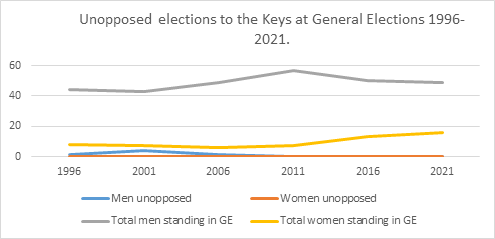
The Tynwald webpage on Women Members of the Legislature notes that Mrs Marion Shimmin, the first woman to be elected to the Keys, “was elected unopposed”, although her Manx Roll of Honour entry and Culture Vannin’s interesting biographical note from her family simply refer to her having been “duly elected”. There is very little reference to unopposed elections to the Keys elsewhere on the Tynwald site. Without some context on unopposed elections to the Keys, some readers might associate her exceptional status as first woman MHK with her unopposed election. So how unusual was it to be elected unopposed – and so without a poll – to the House of Keys?
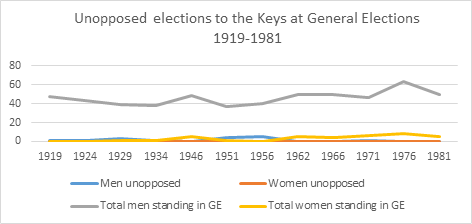
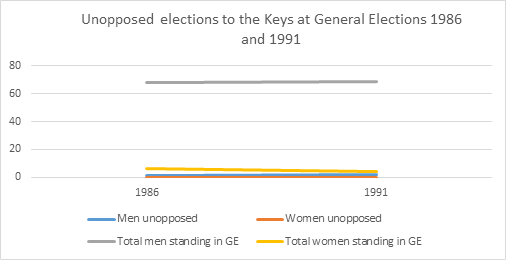
My focus is on General Elections, and I am going to consider these across three periods, the separation driven by the unusual nature of the 1986 and 1991 General Elections, where the voting system within constituencies was briefly changed to a form of single transferable vote. So we have the 12 General Elections from 1919 to 1981, which were dealt with under the first past the post system used today (albeit for a variable number of constituencies and with changes in the number of MHKs elected in some constituencies); the two General Elections of 1986 and 1991, which were dealt with under a single transferable vote system; and then the six General Elections from 1996 to 2021, again dealt with under the first past the post system (again, with variations in the number of constituencies and the number of MHKs in some constituencies).
Up until the end of the 1981 General Election, only one seat in the Keys had been filled by a woman unopposed. Over the same period, 16 seats in the Keys had been filled by a man unopposed. Given 552 men stood for the Keys in General Elections during this period, as opposed to 36 women – that is, 15.3 times as many men than women – that Mrs Marion Shimmin was elected unopposed is not in itself unusual.
The two single transferable vote elections show the continued pattern of unopposed elections being unusual, but not unknown, and men being the beneficiaries. Three seats were taken by men unopposed, none by women; there were a total of 137 men standing, as opposed to 10 women. With so few women standing in just two elections under this system, it is difficult to say much more.
Turning to the most recent set of General Elections, we see six men elected unopposed, and no women. Looking at the period as a whole, we see 292 men standing, and 57 women. With those proportions, it would not have been striking had one of the six people elected unopposed been a woman; but with such small numbers, it is equally not striking that all were men.
Additionally, it is worth noting a feature across the periods since 1919. The decline in the number of seats taken unopposed has occurred alongside an increase in the proportion of candidates who are women. In particular, the three General Elections from 2011 – which had no unopposed candidates – were contested by 36 women: the same number as the twelve General Elections from 1919-1981. At periods when unopposed elections were less uncommon, women candidates for the Keys were more uncommon: so it is unsurprising that only one woman was elected unopposed at a Manx General Election.
To conclude, I think the fact that Mrs Marion Shimmin was elected unopposed to the Keys is not especially worthy of highlighting without the context I have outlined here. More worthy of highlighting is the Keys career of Joseph David Qualtrough. Entering the Keys at a by-election in 1919, he was elected as the member for Castletown at every General Election until his death in 1960. At six of these seven elections he was elected unopposed, and in the only contest (in 1946) he secured a comfortable majority. New Manx Worthies notes, in the third-to-last paragraph of a two and half page entry, that six of his elections were unopposed. The same publication’s entry for Marion Shimmin, on the other hand, begins “Marion Shimmin (nee Fallows) was returned, unopposed, in 1933”.
This blog is authored by Peter Edge, as part of a series on Women in Manx Politics, a larger project funded by Culture Vannin. Click on the icon to go to the project page.
The original version of the Public Health Regulations (no.18) specifically added Peel to the entry points permitted. Details of entry via Peel were to be added by CoMin through a Directive (a GC). This was amended during its approval by Tynwald, with the power to specify any Manx port as an entry point for private vessels, as well as the detailed provisions, given to CoMin under the final reg.7(1).
This power has now been exercised in relation to Peel Harbour, under G.C. 2021/0091. A private vessel may dock at Peel Harbour at specified times published by the Chief Secretary, such specified times not being permitted outside 0500 and 2300. Specified times may change daily. so long as such changes are published.
A substantial number of amendments to the Public Health Regulations through the PHR (Amendment) no.18. coming into effect overnight. One unsurprising change is an extension of the PHRs. These were due to expire on the 26th of October, and will now run until 20 January 2022.
Residents.
The former definition of “registered resident” now becomes “resident” (amended reg.5, amended reg.10, amended reg.12, amended reg.13a, amended Sch.1), defined in Schedule 6, paragraph 1. This is now given a comparatively simple definition. A resident is a person who owns, leases, or occupies a dwelling in the Island as their only or principal home (Sch 1, para.6(2)), or a person aged 12-17 who spends part of their time on the Island living with a parent or guardian (Sch 1, para.6(2A)).
Residents who would otherwise be Category A persons are allowed to enter the Isle of Man without self-isolation or providing a biological sample so long as they have not travelled outside the Common Travel Area in the ten days before returning to the Island (reg. 2A as amended).
Natural immunity exemption.
A new exemption is added to the existing vaccination exemptions, covering persons, including non-residents, with “natural immunity”. As with the vaccination exemptions, a person who qualifies does not need to self-isolate upon entry to the Isle of Man, and does not need to test (new reg.5C(4)). To qualify for this exemption, the person must have had a positive PCR test, taken within the Common Travel Area (CTA), between 11 and 180 days of their arrival in the Isle of Man; and must not have travelled outside of the CTA within ten days of arrival (new reg.5C(2)). There is one unusual difference between the natural immunity exemption and the primary vaccination exemption (i.e. the exemption for a person who has been vaccinated). The latter requires that the person is not infected or reasonably suspected of being infected (reg.5A(c)), the former does not. This would seem to suggest that a person who has been vaccinated, but is reasonably suspected of being infected, cannot take advantage of that exemption; whereas a person who has tested positive 11 days before entering the Isle of Man, who is reasonably suspected of being infected, can take advantage of this one. Perhaps the clause was omitted on the basis that everyone who can take advantage of the natural immunity clause would be excluded, but I think this would miss the distinction between “is infected” and “has been infected”. Allowing persons with a recent positive test who are reasonably suspected of being infected to enter the Isle of Man would be odd.
Airports and Harbors.
The restriction on private aircraft under Reg.8 is removed (and subsequently removed from the list of offences in reg.36).
The PHR is amended to allow private vessels to dock at Peel as well as Douglas, subject to guidance issued by the Chief Secretary (reg.7(1) as amended).
CoMin has released a summary of their approach to “Learning to Live in a World with Covid-19”. The report stresses that “This document does not create new policy, or a new approach, merely confirming the current approach, much of which has already been discussed through other channels” – an appropriate aspiration in the midst of a general election campaign.
One striking aspect of the report is the level and type of harm required before CoMin considers that legal intervention in the form of mandated, legally backed, mitigation requirements are imposed:
Government will not seek to implement Island wide or society level restrictions other than at the borders, unless the level of threat rises to the extent that there is significant threat to the health and care system of being overwhelmed.
This does not rule out specific restrictions, which may themselves be based on the power of IOMG as a delivery of services rather than specific legal rules (such as visiting of health care settings, and use of public transport). Island wide restrictions in the interests of public health are, however, an ancient part of the Manx legal system, and have been imposed in response to threats considerably below that of overwhelming of health and care systems. Two historical examples first.
Deemster Parr’s Abstract, an authoritative summary of Manx law compiled in the 17th century, notes that “the killinge and eating of salmon and salmon frea in kipper time was too obnoxious for the endangereing of breeding leprosie and other noysome diseases: it was therefore ordered … that noe salmon or salmon frea should bee killed in any fresh water or salt water in kipper tyme” (para.86). Violations could be punished by destruction of “nets and engines” for a first offence, 3 months imprisonment for a second offence, and 12 months imprisonment for a third.
“Whosoever will wilfully endanger the public personal safety by any unlawful act, or shall do, cause, occasion, promote, maintain, or continue what is noisome and offensive, or manifestly hurtful to the public; or injure or annoy or tend to injure the public in the enjoyment of any public right or privilege, or cause directly, or manifestly tend to cause, any public calamity, mischief, or disorder, or any common injury or damage to the public in respect to their habitations, personal safety, health, or property, the same being without authority or justification by law, shall be guilty of a misdemeanour; and it shall not be essential that any such unlawful act should be to the general injury of all Her Majesty’s subjects, but it shall be held to be sufficient if it injure or prejudice a class only of such subjects; and no act, being a common nuisance within the meaning of this section, shall be deemed justifiable or excusable on the ground that it is productive of some compensating convenience or advantage to the public.”
There are numerous examples of restrictions on individual choice in the interests of public health in current Manx legislation where the harm being averted is considerably less than overwhelming the health and care system. For instance:
One argument against state intervention in order to protect public health is that it is not practical to enforce every violation of such an intervention. This has not been fatal to the examples noted above. To focus on food safety rules, these are legal rules which can be enforced by the state against food businesses failing to meet the required standard. Two food safety officers investigate complaints about hygiene standards, and carry out food hygiene inspections. They can recommend prosecution or impose prohibitions on a business or equipment, and if there is an imminent risk to consumers, issue an Emergency Prohibition Notice, subject to confirmation by a court. Two food safety officers are clearly not going to be able to check out every shift of every food business on the Island. So, why bother with food safety rules?
Janice Nadler considers the work of law outside of sanctions or direct coercion in this open-access article. She discusses expressive law – “the claim that law influences attitudes and behaviours by what it expresses” – and gives as examples no smoking laws which coordinate expectations (“When law highlights a behavioural choice in a coordination setting, it changes expectations about how others will behave”), and compulsory seat-belt laws which provide additional information (for instance “what legislators collectively know about the risk of not wearing a seat belt”).
Restrictions on individual judgement and choice in the interests of public health are not new to the Isle of Man, and are not restricted to exceptional periods of crisis. What is perhaps exceptional about the use of state sanctions to regulate behaviour during the lockdowns was the severity of the punishment imposed. Mandating mitigations does not, however, necessarily require severe sanctions against individuals. One of my criticisms of the Emergency Powers Regulations, and indeed the Public Health Regulations, was that a single set of maximum penalties was imposed for each type of violation. Failing to obey a mandated mitigation in a vaccinated population would seem closer to established increases of risk to public safety such as a parking violation, than to the pre-vaccination breaches which led to periods of imprisonment. The PHR limits for fixed penalty offences, of £150 rising to £250 if not paid, might serve well.
Living with coronavirus might eventually turn out to be similar to living with dangerous parking, food poisoning, and passive smoking. The next administration might want to begin by looking at the threat of coronavirus in a (thankfully) largely vaccinated population; comparing it with other endemic threats to public health on the Isle of Man, rather than to the level of threat it posed to an entirely unvaccinated population. It may be that the benefits to public health produced by state intervention aimed at this level of harm could justify modest restrictions on behaviour that generates risk, but not prison sentences for breach of these restrictions.
Given that there are, pending the general election, currently no MHKs, it might be a good moment to think about this.
A fundamental challenge for small democracies is striking the balance between democratic legitimacy for all those exercising governance power, avoiding the concentration of power in a small number of hands, and avoiding paying for a disproportionately large number of people to exercise that power.
Sutton has argued that ‘in small societies it is relatively easy for a determined, unscrupulous, individual … to dominate all or most aspects of the country’s life’. With the demise of the plenipotentiary Lieutenant-Governor, the Isle of Man has moved some way from this, but it is clear that constitutional developments have increased the power of the 24 directly elected members of the House of the Keys.
A comparison with other small democracies suggests that over-concentration may be a genuine problem for Manx democracy. In 2012 Johnston and McLean analysed the population per elected representative in the only or lower houses of all independent and semi-independent territories with a population between 50,000 and 150,000.Of the 22 considered, both the Channel Island jurisdictions analysed were amongst the most generous. Guernsey (1328) and Jersey (1920) were in the most generous five, along with Bermuda (1783), Greenland (1829) and the Marshall Islands (1645). The Isle of Man (3521) was at 13th place of the 22, bracketed by American Samoa (3083), the Cayman Islands (3083), the Federated States of Micronesia (3664), and Tonga (3692). The difference between the other Crown Dependencies and the Isle of Man is striking.
So, to answer the question in the title, I don’t think there are too many MHKs, and indeed there *might* be too few.
One possible way to address this would be to increase the size of the House of Keys. If the Keys was to be returned to its pre-twelfth century size of 32 members, the Manx ratio on Johnson and McLean’s figures would move to 2640, 8th most generous of the 22 small democracies, bracketed by Dominica and the Seychelles. The ratio of representation would remain notably less generous than that of the closest comparators to the Isle of Man – the fellow Crown Dependencies of Jersey and Guernsey. A significant concern over such an expansion of the House of Keys would be cost, both in terms of salary and infrastructure. This could be met by increasing resourcing of Tynwald – a politically sensitive argument, particularly as the Isle of Man continues to deal with very significant economic and fiscal challenges. Reconfiguring the MHK role as part-time, remunerated pro rata, risks, as was discussed during the Lisvane debate, reducing diversity in Tynwald. More significant resources could be freed up by the abolition of the Legislative Council, and a move to a unicameral chamber of the kind already found in Jersey and Guernsey. Unicameralism has been discussed in the Isle of Man for some time, but remains contentious.