Emergency Powers Regulations passed on the 19th and 20th of May.

Just two Regulations in this period, but the first is very significant.

The Miscellaneous Amendments Regulations have taken this form, I assume, purely to make it more difficult for me to divide EPRs by different subject matters. The Regulation amends the Prohibition on Movement Regulations, the Closure of Business and Other Premises Regulations, and the Events and Gatherings Regulations.

To start with the last, the definition of “gathering” in the Events and Gatherings Regulations formerly referred to “two or more persons who are not members of the same household” (reg.3). This is amended to “any meeting or assembly of a number of persons who are not members of the same household, which exceeds the number provided for in a direction made under these Regulations” (reg.5, amending reg.3). This allows the DHSC to make directions permitting meetings of a number of persons but may require some care in practice. If the number of persons does not exceed the number in a direction, it does not constitute a gathering, and so a direction does not apply; the EPR does not allow the DHSC to put conditions on non-gatherings. I am not sure this amendment was required. If the DHSC had wanted to allow gatherings of say 5 people, it could have done so under the existing Regulations: two or more persons from two households is a gathering, and the EPR allows the DHSC to put conditions on a gathering – it does not require the DHSC to prohibit a gathering. This power of the DHSC could never have been lost through the DHSC definition of a permitted number.

The amendments to the Prohibitions on Movement Regulations make it clear that members of the same household do not need to observe social distancing with each other when outside (amending reg.3), and add a number of new grounds on which you can leave the house. The first of these is to attend a wedding or to make preparatory activities (new reg.5(1)(g)), which may give law students a chance to use their knowledge of the law of attempt to explore when an activity is preparatory – is a romantic date preparatory to a wedding? More straightforwardly,  the acceptable grounds now include attending a library (new reg.5(1)(w)), a nursery (new reg.5(1)(x)), an auction house (new reg.5(1)(y)), acting as a domestic cleaner for a place of residence (new reg.5(1)(z)), and going to a campsite or caravan park (new reg.5(1)(aa)). While it is not completely patent what is meant by “nursery”, these Miscellaneous Regulations elsewhere make a change to the Closure of Business rules in relation to childcare, which suggests that is what is meant. The regulations allowing an assistant to support a disabled person in an exercise or leisure activity are repeated, in a slightly tidier form, and changing the very specific “distance of at least 2 metres” with the more flexible “appropriate social distancing”, although in the process the assistant must now maintain “appropriate social distancing” from members of their client’s household (amended reg.5(3)(b)).

Finally, the changes to the Closure of Businesses Regulations are primarily about opening up particular types of business. As well as the businesses noted as permitted to leave home to attend, these include domestic cleaning businesses, opticians, private health care clinics, and private dental surgeries (reg.4, amending Part 1 of the Schedule); campsites and caravan parks may now open for any purpose so long as communal facilities remain closed (reg.4, amending Part 2 of the Schedule), and schools and nurseries may now open for the children not only for those providing an essential service, but for any “who may leave his or her residence for the purpose of his office, employment or vocation” (reg. 4, amending Schedule 2).

After this portmanteau EPR, the Births and Deaths Modifications (Amendment) Regulations is narrower. It replaces reg.8 of the earlier Regulations, which deals with death certificates. The original Regulations allowed a very wide range of registered medical practitioners to sign a death certificate, even if they had not attended a final illness, stating their best “knowledge and belief”. The new Regulations take a different approach, with attendance of final illness being satisfied if the medical practitioner attended within 28 days of the person’s death; or where such attendance was not reasonably practicable, they had carried out an effective consultation or assessment by video-link within 14 days of the death (new reg.8). This is a substantial tightening up of the original Regulations, which may indicate either a practical problem, or a sense that the extreme pressure on medical professionals that the earlier Regulations prepared for was now less likely. A new reg.8A allows the Department of Health and Social Care to issues directives to the signing medical practitioner, or any other medical practitioner who becomes aware of the death (new reg.8A(1)). These can include requiring the doctor to provide medical information to the DHSC (new reg.8A(2)). A medical practitioner who fails, without reasonable excuse, to comply is subject to prosecution, with the standard maximum sentence under the EPRs, and no possibility of a fixed penalty alternative (new reg.8A(3)). The Regulation also evens out reg.40(1) and (6) of the 2011 Regulations in this area to remove the need for the presence of an informant in both cases (amended reg.10).

Emergency Power Regulations made between the 16th and 18th of May 2020.

One new, and to me very crisp and clean, Regulation and two more amending Regulations.

The Local Government Regulations make a number of changes to the functioning of local authorities (including local authorities under the Local Government Act 1985, joint boards, joint committees, and associated sub-committees, reg. 3). The Regulations give these authorities the power to determine their meeting schedule without regard to any statutory duty or restriction (reg.5(1),(2)); provides for continuation of appointments otherwise requiring an annual meeting (reg.5(3)), provides for the automatic reappointment of members of joint and committees boards where a vacancy had not been filled before the Regulations came into effect (reg.5(4),(5)), and postpones all compulsory filling of casual vacancies until after the emergency period (reg.9, amending Local Elections Act 1986). All references to local authority meetings are now to be interpreted as allowing “remote attendance” (reg.6(3)), which requires that a member can heard and be heard by members; heard and be heard by members of the public exercising a right to speak at the meeting; and be heard by any other members of the public attending the meeting (reg.6(4)). A local authority may make standing orders and rules governing meetings and remote attendance for meetings in relation to voting, access to documents, and remote access of the public and press (reg.6(7)). Duties on local authorities to make documents available for inspection or copying by the public can be met by publishing electronically (including via social media), physically posting in a conspicuous place, or “in such other manner as the local authority considers appropriate” (reg.7(2)). The reference to social media is interesting – individuals can access the government website through a wide range of proprietorial devices and apps – a sufficient range as to make the connection with those devices and apps insignificant. If, for instance, documents are made available on facebook only, however, that does suggest the public need to engage with that very specific proprietorial infrastructure.

The Prohibition on Movement (amendment no.6) Regulations modify the exceptions to the general prohibition on movement in relation to the property market. Moves to a new residence no longer need to be reasonably necessary (amending reg.5(1)(k)) or for welfare reasons (old reg.5(5A) allowing this now deleted); and viewing a property or visiting a premises (including an estate agents, new reg.5(5D)) preparing for a purchase, lease, remortgage (new reg.5(5E)) or move are now acceptable (new reg. 5(1)(v)), except for business premises required to close under the Closure of Businesses Regulations, so long as the person who does so complies with government guidance, any conditions for a business premises permitted to open only with conditions, and any direction made under the Events and Gatherings Regulations (new rev.5(1)(v)(ii)).

The Closure of Businesses and Other Premises Amendment (no.8) Regulations reopen a number of businesses sectors. The residual category of “any other retail business” (i.e. any retail business not specifically discussed in the Regulations), along with betting shops, car show rooms, and shopping centres, will be allowed to open from the 18th of May (reg.3(3) amending Part 1 of the Schedule). More generally, attending a retail business or premises not required to close is added to the list of acceptable reasons for leaving your house so long as you comply with government guidance, any conditions on the business, and any direction made under the Events and Gatherings Regulations (amending Prohibition on Movement Regulations reg.5(1)(u)). Additionally, all businesses allowed to continue are required to comply with guidance from the Department of Enterprise (new reg.5(3)(d), adding to the specific measures that must be taken to reduce the risk of infection) – this does not only apply to the newly opened businesses. Finally, earlier restrictions on employers requiring them to ensure only the minimum number of staff present necessary for operation of their business has had a subtle, but significant change – by adding “on a sustained basis” (to reg.5(4)(b)), the Regulations allow an employer to require more staff to attend in order to address effective operation in the medium term (the marathon rather than than the sprint); and for staff to travel to work to do so.

Amending Regulations made on the 14th of May 2020.

Continuing the trend of EPRs being amending existing Regulations, the 14th of may saw two amendments to the Closure of Businesses Regulation, and one to the Prohibitions on Movement Regulation.

The Closure of Businesses and Other Premises (Amendment no.6) Regulations introduces an important distinction between businesses and sporting facilities. Sporting facilities are “any premises used for or at which sporting activities are played, held, or otherwise take place and includes facilities which serve such premises” (reg. 3(2) amending reg.3). Rather than continue to treat sporting facilities under the existing scheme of business that must close (reg.4), and those which may continue to operate under conditions for their sector, or without conditions (reg.5), this Amendment adds a new category through a new reg.5A (added by reg.3(3)). This allows the Department of Education, Sport and Culture to give a direction applying to sporting facilities (either generally, specifically, or of a particular kind), as to opening and closure – including for instance taking steps the Department deems reasonable (new reg.5A(3)(a)). A sporting facility which is permitted to open must operate so far as reasonably practicable to “reduce the risk of a person being infected with Coronavirus” – a general duty detailed with specific requirements such as ensuing regular and frequent cleaning (new reg.5A(4)(b)). Contravening an applicable direction is a criminal offence under Reg.7 (as amended), and an operator can be punished under the fixed penalty regime for contravention, without reasonable excuse, of reg.4, 5 or a direction under 5A (Fixed Penalty Regulations 2020 Sch as amended by reg.4). The principal effect of this is to move treatment of sporting facilities out of the explicit scope of a Regulation approved by Tynwald, into the scope of directives issued by the Department on www.gov.im (new Reg.5A(5)). It will be interesting to see if this a trend as the IOMG moves out of the strictest phase of lockdown – suggesting a view that easing temporary restrictions needs less democratic oversight than imposing them.

As IOMG contemplates reducing the stringency of restriction on businesses, the Closure of Businesses and Other Premises (Amendment no7) addresses the issue of a business which has been required to close or restrict its activity, but needs to prepare for reopening. Under a new reg.5B the Chief Minister may formally announce that a type of business currently closed, or subject to conditions, will be permitted to reopen with or without restrictions (new reg.5B(1),(2)). The business may reopen and permit the presence of employees to prepare it for the change (new reg.5B(3), so long as it complies with Department for Enterprise “guidance” issued on www.gov.im (new reg. 5B(5)(b)). A person who does not comply with reg.5B constitutes an offence punishable by a fixed penalty notice, a fine, or imprisonment (reg.3(5) amending reg.7; misnumbered  second reg.3 amending Fixed Penalthy Regulations 2020). I am perhaps being pedantic in querying whether a statement which must be complied with subject to penal sanctions is best described as guidance.

The Prohibitions on Movement (Amendment no.5) Regulations is primarily concerned with leisure activities, extending the definition to activities in a vessel which, in the case of a pleasure craft, comply with Department of Infrastructure Guidance; and to “visiting a friend or family member” providing doing so complies with a direction made under the Events and Gatherings Regulations (reg.3, amending reg.3). It will be recalled that the Chief Minister indicated that the latter was lawful, and that he intended to do so, some time in advance of this Regulation being created. These Regulations also make it clear that necessary travel for a purpose specified in reg.5 of is permitted, but keeping the existing restrictions on car and taxi sharing (reg.3(3) amending reg.5(7)).

How to pass an Emergency Powers Act: The Emergency Powers Act 1936.

In a previous blog I discussed how Emergency Powers Bills based on the UK Emergency Powers Act 1920 failed in Tynwald, either due to rejection by the House of Keys or a failure of the Keys and Council to reach agreement. In this blog I will discuss the successful passage of the Emergency Powers Bill 1935, which became the Emergency Powers Act 1936.

The earlier bills were government bills, not only introduced in the Legislative Council rather than in the Keys, but at the initiative of the Lieutenant-Governor. The 1936 Act had a very different origin.

Between the 3rd and 4th June 1935 there was a substantial, and effective, strike in the Isle of Man by the TGWU, covered in a lucid and engaging podcast by Terry Cringle here. The Speaker introduced a resolution into Tynwald which noted that “during the recent strike the public of the Island were deprived of the essential services, the health of the towns was threatened, and no sufficient police protection was available, and requests his Excellency to take such steps as may prevent a recurrence of such conditions” (TC, 13 June 1935 at 496). The Speaker lamented the lack of an Emergency Powers Act, and called upon MHKs in particular to support a speedy Bill, noting that he wanted to avoid the House “whitt[ling] it away in amendments which would emasculate and nullify it so it would be practically useless” (p503-4). Perhaps the strength of Mr Speaker’s feelings can be seen in his suggestion that, if such a Bill failed, it would be appropriate for the Lieutenant-Governor to dissolve the House of Keys and, if a new House remained opposed to it, call for the extension of Imperial legislation to the Isle of Man (p504). The focus of this debate was primarily the details of the strike, leading to mutual recriminations and personal criticism between members of Tynwald which persisted throughout the debate (for instance by Mr Qualtrough against the Speaker, TC, 14 June 1935 at 728). An amendment to the Speaker’s motion added a request that the Lieutenant-Governor should make provision for setting up an Industrial Council on the lines of the Whitley Council operating in the UK (p514), and the amended motion was passed almost unanimously, with four votes against in the Keys.

The Lieutenant-Governor identified three Bills to give effect to this Tynwald motion – two Bills dealing with trade disputes, and the Emergency Powers Bill. He argued that the procedure by which Acts of Tynwald was created was extremely slow, rendering it unsuitable for responding to an emergency (TC 25 October 1935, at 11). The Bill was particular needed now because of what looking back we would see as globalisation: “since, partly owing to the war, and partly by the development of communications, we have been drawn more and more into the main stream of life, the need for the modernisation of our machinery on the lines in force in Great Britain has become apparent” (ibid, at 12). The provisions of the Bill, as characterised by the Lieutenant-Governor, “are general in character, and cover any emergency, and do not refer specifically to trade disputes” (ibid, at 12). Slightly piquantly, writing in 2020, on the same page of Tynwald Debates the Lieutenant-Governor confirms that the cost of building an isolation hospital would be too much to proceed.

Introducing the Bill into the Legislative Council, the Attorney General took up these themes, noting that the Bill did not “primarily deal with labour disputes, or any particular occasion of emergency”; and suggesting that an Act of Tynwald “cannot be done in less than a couple of months” – the inability of Tynwald to legislate quickly for an emergency was the principal reason why the Emergency Powers Bill was needed (LC, 1 November 1935 at 54). I am not sure this was right in 1935, and it obviously was not the case in 2020. The Act of Tynwald amending the Emergency Powers Act 1935, having been circulating in a number of drafts at the start of the week, was passed in a single day on Friday the 3rd of April, despite requiring the Keys to accept amendments from the Legislative Council, and became law on the 14th of April.

In the first occurrence of an important theme in the debates, Mr Corrin – referring to his earlier time in Tynwald as an MHK – explained that he had opposed earlier Bills because no occasion had  arisen to justify the legislation but “occasion has [now] arisen, to my mind, to justify the introduction of legislation like this” (ibid, at 56). At the second reading in the Legislative Council, repentance was taken up by the Receiver General, who in 1927 had been the only member of Council to vote against the Bill: “recent events have proved that I was entirely wrong” (LC 19 November 1935 at 87). The extent of change of heart by individual legislators was pointed out in the Keys by Mr Crellin not – as can sometimes be found in Tynwald debates – as the basis for an accusation of inconsistency, but rather to show how the events of June 1935 had shown how much the situation in the Isle of Man had changed (HK December 1935 at 139).

Debate in the Legislative Council was limited. There was some discussion of how to draft the protection of the right to strike (LC 19 November 1935 at 89), and of two constitutional issues. Firstly, whether Regulations should be allowed to persist until Tynwald had decided whether to approve them or not: Deemster Farrant favoured this form in case Tynwald wished to avoid responsibility for a Regulation (ibid, at 90), but he was countered by the Attorney General who saw the need for immediate approval by the legislature as “the constitutional thing” (ibid at 90). Secondly, why the power enabling the Lieutenant-Governor to create criminal offences under Emergency Powers Regulations allowed trial not only by the High Baliff but by another person appointed by the Governor. This was intended to cover “the emergency in the event of the High Baliff being away” (ibid, p90-91). The Bill then moved to the House of Keys.

The debates in the Keys are long, but it is striking how little of the time of Tynwald was taken up with the details of, and implications, of the Bill itself. The debates, as in the originating motion of 1935, were primarily about what happened in the strike, the extent of the disruption, and who was to blame for the disruption which followed. The consensus in favour of the Bill, while unsurprising given this 1935 motion, concerned Mr Norris, who noted that the Bill was passing “practically without debate” (HK 3 December 1935, at 140). The minority of MHKs who opposed the Bill had two principal concerns. Firstly, as in the 1920s debates, the extent to which Emergency Powers would empower a Lieutenant-Governor who was not responsible to Tynwald. Mr Norris tabled an amendment requiring the Lieutenant-Governor to take advice from an ad hoc executive including MHKs. Recognising that a general move to responsible government was not on the cards, Mr Norris sought “a little smattering of representative government in the exercise of these very extreme powers” (ibd, at 145). He narrowly failed to convince the Keys, his amendment being lost by two votes (HK 13 January 1936, at 233). Secondly, again as in the 1920 debates, the extent to which the Bill was, as Mr Kneen put it, “class legislation [with] the main object the breaking down of strikes” directed, as Mr Craine thought, “against the trade organisations of the Island” (HK 4 February 1936, at 261). The Bill was passed in the Keys with a significant majority.

This relative disinterest in the detail of a Bill which had significant support in both Branches means that, in contrast to the 1920s debates, there are few insights into the details of the Bill from the legislative debates. Only one point adds to the 1920s discussions. The power of the Governor to appoint judges other than the High Baliff was queried in the Keys, with Mr Cowin suggesting that there were already other judges of summary jurisdiction who could hear such cases (HK 14 January 1936 at 224): an interesting precursor to the 2020 amendment to the Emergency Powers Act which recognised exactly this.

So, given the close similarities of the 1920s Bills and the 1935 Bill what had changed? Sufficient time had passed for there to be a change in the members of Tynwald, but there is substantial evidence from the debates of members of the legislature having changed their view of the necessity for such legislation. This may reflect tighter integration of the Isle of Man with other parts of the British Islands, both economically and politically. On the latter, a number of members of Tynwald raised a contrast between the 1918 Bread Strike, cast as an indigenous response by a significant part of the nation; and the 1935 strike, cast as a response by a small section of the community strongly influenced by union structures which treated Manx labour as part of a broader British Islands organisation. More specifically, it may reflect a reaction to a particular shock – the action of June 1935. The Emergency Powers Act 1936, the basis for the Manx response to the 2020 pandemic, might well not have existed without the strike of 1935.

The 1936 Act as originally passed shows the influence of the context in which the 1920 UK Act, the failed Bills of the 1920s, and the 1936 Act all arose. The 1936 Act, despite a rather broad description by the Lieutenant-Governor as aimed at “any emergency”, had a very specific definition of “emergency”. The powers of the Governor to make a proclamation of an emergency, as in the 1920s Bill could be exercised if:

“it appears to the Governor that any action has been taken or is immediately threatened by any person or body of persons of such a nature and on so extensive a scale as to be calculated, by interfering with the supply and distribution of food, water, fuel or light, or with the means of locomotion, to deprive the community, of the essentials of life” (Emergency Powers Act 1936 s.3(1) as originally passed).

The scope of the Emergency Powers Act 1936 as passed does not seem to lend itself easily to acting against a public health crisis, such as the 2020 pandemic. What is the action “taken or … immediately threatened by any person or body of persons” where the fundamental concern is the spread of an infectious disease? By 2020 the Act had been amended to depersonalise – by which I mean remove the need for human agency – the emergencies to which it applied, with the long definition of emergency instead emphasising “an event or situation” (Emergency Powers Act 1936 s.2A as amended by the Criminal Justice, Police and Courts Act 2007). A future blog post will examine the post-enactment history of the Emergency Powers Act up until the start of the 2020 pandemic.


Emergency Powers Regulations made from the 7th of May to the 11th of May 2020.

Three Regulations were created in this period, all amending other Regulations which have already been amended – so a number 2 (completely replacing an earlier amendment Regulation), an amendment number 3, and an amendment number 5.

The Entry Restrictions (no.2) Regulations completely replace the earlier Entry Restrictions Regulation, although permits etc made under the previous Regulations continue to have effect (reg.15(2)). The Regulation starts from the position that the prohibition on entry into the Isle of Man continues (reg.5). This is subject to five categories of exemption.

Firstly, key workers who have been certified by the relevant Department as vital to critical national infrastructure (Manx or UK), supply of goods or services essential to Manx health or infrastructure, service as a Manx police or fire officer (although interestingly not a prison officer), or a medical expert or professional whose skills are essential to the medical infrastructure and the health of the (Manx or UK) community (reg.6(1)(a)). Where the certification is for UK interests, this allows a Manx resident to return to the Isle of Man after providing services in the UK (reg.6(3), (4)). Certification, although not for police and fire officers, may be for companies as well as individuals (reg.6(5)). The Chief Secretary may also exempt any person (reg.6(1)(b) and reg.6(7)). This allows the Chief Secretary to admit key workers not specified in the Regulation.

There is an interesting distinction between the power of the Chief Secretary and the Departments. The Chief Secretary may only issue an exemption if they consider that failure to issue an exemption “poses a greater risk to public safety and the life of the community, as a direct or indirect result of the incidence or transmission of Coronavirus”; while the Departments may exempt only if they consider that “such measures are put in place as are reasonably practicable to mitigate any risks” (reg.6(8)), which exclude measures which give risk to human life or health, or the environment (reg.3(2)(b)). So the Chief Secretary’s power to make exemptions on a case-by-case basis require a case-by-case risk analysis, while the Department’s power to specify individuals fall within the Regulations categories does not require any consideration of the benefits of allowing an exemption. In either case, allowing entry of a key worker can specify arrangements which must be made in order to minimise the incidence or transmission of Coronavirus (reg.6(10)(e)).

Secondly, returning Manx residents (defined in reg.7(9)). This covers both those returning to the Island after essential medical treatment (reg.7(1)(a)), and those who have an exemption notice from the Chief Secretary (reg.7(1)(b)). The rules around those returning from essential medical treatment are fairly straightforward (see reg.7(2)), but appear to have extended financial liability to those returning from essential medical treatment – which it will be recalled are provided very often in a normal year by the Manx health service contracting for treatment in the UK. A certificate for a person returning from essential medical treatment, as for residents with exemption notices (discussed below) must specify a range of details and conditions (reg.7(12)). The Regulation tells us that an “exempt person” covers individuals who are both covered by medical return rule, and the exemption notice system (reg.7(12)(a)); and that “the conditions on which the exempt individual is permitted to travel to the Island” (reg.7(12)(f)) must include the condition that “the exempt individual” (which but for reg.7(12)(a) might have read as being limited to the exemption regime, but is difficult to limit to that given reg.7(12)(a)), “is liable to pay all the costs incurred and associated with his or her re-entry into the Island including … travel to the Island” (reg.7(13)). On the face of it, as this covers medical returnees, it requires them to pay the very substantial costs which can be involved in medical transfer. To be neither lawyerly nor academic for a moment, this must be wrong.

The main concern of reg.7 is the return to the Island of residents with an exemption issued by the Chief Secretary (the reg.7(1)(b) ground). The Chief Secretary must generally be satisfied that the resident left the Island before 27 March 2020; but this limit does not apply to those who left the Island but remained in the territorial sea for a business or leisure activity (reg.7(4)), or who left the territorial sea but did not enter any other country or territory (note, entering the territorial sea of another country or territory is permitted, see reg.7(8)) for a business activity (reg.7(4)(b)); or who left the Isle of Man but remained within Manx airspace where the flight was necessary to comply with guidelines on the aircraft engine, or licensing requirements or guidelines for the flight crew (reg.7(6)). These Regulations amend the Prohibition on Movement Regulations to explicitly allow pilots or crew members for whom such an exemption has been issued to travel to or from an airport or landing strip (reg.14, creating a new reg.5(1)(t)).

Thirdly, an exemption for individuals employed or engaged in emergency search and rescue services, and air ambulance services (reg.8)). Unlike other exemptions, this does not require any certification by any Manx authority.

Fourthly, those who have left the Island on compassionate grounds (defined to include attending a funeral of an immediate family member, or travelling with their remains to a post-mortem by reg.3). The Regulation contains an exemption in reg.7 for those who had travelled to the UK or Ireland on compassionate grounds before these Regulations came into effect (reg.7(5)). This is a transitional provision. For the future, the Chief Secretary may give written consent to Manx residents to leave and then re-enter the Island “on compassionate grounds”, so long as they travel only to the UK or Republic or Ireland (reg.10). Many of the detailed requirements in reg.7 apply to those with permission to travel for compassionate grounds, as if an exemption notice had been given (reg.10(4) applying reg.7(6)-(16)).

Fifthly, and a shift away from the focus on the individual elsewhere in the Regulation, the Department of Infrastructure may by direction create “an exempt area that is secured for the purpose of transportation”, and an individual who enters an exempt area and remains within it until they leave the Island is not covered by the prohibition (reg.9).

These Regulations are supported by criminal offences, with a fine and/or imprisonment being possible for breaching the general limit on entry to the Isle of Man, or failing to comply with a certificate, exemption, or consent or any conditions contained in it, or knowingly provides false or misleading information (reg.13). The fixed penalty notice regime, which was not applied to the earlier Regulation concerning border control, does not apply to this one.

The Events and Gatherings (Amendment no.3) Regulations addresses enforcement of the Events and Gathering Regulation. It adds the power for a constable to stop and question to determine whether a person or a member of their household is taking part in a gathering, and if so for what purpose (new reg.7(4)), a duty to answer such questions if reasonable (new reg.7(5)), and a power by a constable to require a person to leave any premises if they believe the risk of coming within 2m of a person not in their household is greater than if they do not leave, and that coming into such contact would not be permitted under an EPR (new reg.7(6)). These are identical to the no.2 Regulations which were not laid before Tynwald, and so ceased to take effect. The second set of changes are different from the no.2 Regulations however – the criminal offence under the Events and Gathering Regulation is replaced with an offence committed if a person fails without reasonable excuse to: comply with a direction under the Regulations, answer questions put to them by a constable under their new power, or leave premises when ordered to (replacement reg.8, addressing a concern about criminal offences noted in relation to the no.2 Regulations). The fixed penalty notice regime applies to all of these offences (amendment to Schedule to Fixed Penalty Regulations 2020).  The no.2 Amendment made it a distinct criminal offence to intentionally take part in a gathering which was not permitted under the EPR or for court attendance – this has now been omitted, so that the offence is not intentionally taking part in a gathering, but failing without reasonable excuse to comply with a direction given under this Regulation.

The Closure of Businesses and Other Premises (Amendment no 5) Regulations makes one specific amendment to the closure of businesses regime. Under Part 2 of the Schedule, which specifies businesses that may remain open for restricted purposes, the entry for garden retail shops – garden centres –has been amended. Garden retail shops were formerly able to open only for delivery or collection or pre-ordered goods by the public, but premises could be open for normal sales to businesses. This amendment allows garden retail shops to open for any purpose, so allowing the public to shop on site, but food or drink must not be supplied for consumption on or adjacent to the premises, but may be sold to take away (reg.3(2) amending Schedule Part 2).

How not to pass an Emergency Powers Act: the 1920 and 1926 Emergency Powers Bills.

Mr Teare MHK, speaking in 1927, referred to his introduction of an Emergency Powers Bill in the Keys in 1919 (HK, 15 March 1927 at 539). In 1921, Deemster Moore, introducing the second reading of the 1920 Bill, mentioned that “We had a somewhat similar Bill, last year” (LC, 11 February 1921 at 388). Any Emergency Powers Bill of 1919 has failed to leave its mark in Manx Hansard, but the Bills of the 1920s were the subject of fierce controversy and, ultimately, failed to command sufficient support in the House of Keys.

What “emergency” were the 1920s Bills aimed at?

In introducing the 1920 Bill into the Legislative Council, the Governor noted that it was following up from the Defence of the Realm Act (DORA), which had been the basis for emergency powers during World War One, and that it would “deal with these matters in the same way as they have been dealt with in England”. The Governor was very frank about the mischief the Bill would address “it is really to deal with lightning strikes that interfere with the life or health of the community” (LC 11 February 1921 at 38). The Bill would allow the proclamation of a state of emergency “when action is being taken or contemplated by any person or body of persons to deprive the community of food, water or gas, or the other essentials of life”; an emphasis on human action repeated in the 1926 Bill which refers to the situation when “any action has been taken or is immediately threatened by any persons or body of persons”. The only reference to non-human causes of emergencies is a mocking comment by Mr Corrin in debates over the 1926 Bill, where he queried whether “Hon. Members have in mind tornadoes or earthquakes or that sort of thing” (HK 15 March 1927 at 556).

Given the Bills arose from a concern over lightning strikes, this focus on human action was understood by some in the Keys as a focus on working class militancy, a thread to be found throughout the Keys debates over both Bills. Even a supporter of the 1920 Bill, Mr Norris, justified an emphasis on the role of Tynwald because it included “all the classes”, and that “Labour is so well represented” (HK 3 May 1921 at 718-9). Opponents of the 1920 Bill, on the other hand, saw it as a patent instrument of class warfare. Mr Shimmin described it as “a piece of class legislation” (HK 3 May 1921 at 720), while Mr Bridson was concerned that “the authorities will have the power to arrest all the Labour leaders” (HK 3 May 1921 at 722). This concern was raised even more strongly in relation to the the 1926 Bill, for instance with Mr Clucas seeing the Bill as “a prejudice against the working class” (HK 15 March 1927 at 540), Mr Craine seeing it as “directed solely against the workers” (HK 15 March 1927 at 548), and Mr Corrin describing it as “just one more item in the way of working class progress” (HK 15 March 1927 at 554).

So, the mischief of the 1920s Bills was dealing with emergencies created by persons or groups of persons and, in the views of a substantial group of MHKs, emergencies created by a particular class of persons. This framing of the Emergency Powers Bills was a substantial part of why they failed to pass, particularly for the 1926 Bill which failed to secure a second reading in the Keys because the Keys saw it as wrong in principle.

Who did the 1920s Bills empower?

There were two particularly significant constitutional issues in the 1920s debates, one of which was the sole cause of the failure of the 1920 Bill.

The power of the Secretary of State.

The 1920 Bill as originally introduced required the consent of the UK Secretary of State before the Governor could declare a state of emergency. Supporters of the clause noted that the Governor might need to call on Imperial resources, for instance military force, in an emergency (Governor, LC 11 February 1921 at 389); but principle apart the clause had been proposed by the Home Office itself (Governor, LC 11 February 1921 at 389). There was dissent on this point even in the Legislative Council – which is generally much less robust than the Keys in debating these measures. The Receiver General was very firm:

 We can govern ourselves without the interference of the Secretary of State. We are satisfied with the Governor’s control. As a point of self-determination we must insist upon having our own business done by ourselves, so far as the conducting of our Island is concerned. They cannot govern better than we can govern ourselves. I can tell them that. They want to get a finger in the pie. They want to make another Ireland.” (LC 11 February 1921 at 389).

The role of the Secretary of State was controversial in the Keys too, with Mr Norris for instance noting that the Secretary of State “may prevent [the Governor] from doing things which might be detrimental to interests across the water” (HK 3 May 1921 at 719), and Mr Bridson thinking that the prospect of the Secretary of State as a restraint on the Governor “should [not] carry much weight with this House when we know what the Government allows to go on in Ireland” (ibid, at 722).

By the time of the 1926 Bill, however, formal involvement of the UK Home Secretary was no longer seen as necessary, and Mr Teare noted the change as being a significant difference between the 1920 and 1926 Bills (HK 15 March 1927 at 543). The second Bill was more clearly a nationalisation of the type of emergency envisaged by the Bill, with this vestige of the Imperial role removed.

The power of the Lieutenant-Governor.

A dominant theme of the 1920s debates was concern in the Keys, in particular, that they should either be involved in executive government particularly during a state of emergency; or at the very least that their areas of influence and control over the executive should not be infringed. It must be emphasised that Manx executive government in the 1920s was dominated by the (unelected) Governor, rather than by responsible government. This was a difference from the UK context whose significance was recognised by MHKs in particular (e.g. Mr Norris, HK 7 February 1922 at 415; and HK 16 March at 545).

One issue in the 1920s Bill was a requirement that the Governor should consult with an Executive Council, including in deciding whether to make a proclamation of emergency, including some MHK members. The Governor himself was sanguine about consulting with Exco (LC 24 May 1921 at 770), but the failure of a Bill to create an ExCo including MHKs was seen by Mr Norris as a substantial reduction in the safeguards of the Bill (HK 7 February 1922 at 415-6). He returned to this theme in the 1926 Bill, insisting that emergency powers needed to involve an ExCo including MHKs (15 March 1927 at 544). In both the 1920 and 1926 Bill, an ExCo Bill running alongside the Emergency Powers Bill failed during the passage of the Emergency Powers Bill. In the latter, the decision in the Keys as to  whether to give the Bill a second reading was adjourned in order to determine the fate of the ExCo Bill, and once that Bill was lost, the Emergency Power Bill was rejected (HK 22 March 1927).

The 1920 Bill did not fail on this point, but on a more clearcut issue – the established role of Tynwald to exercise control over Man finances. The 1920 Bill was amended in the Keys to add a clause making it clear that Tynwald would need to authorise any expenditure which had been incurred (HK May 10 1921, 751). This amendment was rejected by the Legislative Council (LC 24 May 1921 at 770). A conference between the two Branches followed, with the Keys arguing that representatives of taxpayers should vote on expenditure, and the Council arguing that requiring a vote could result in the Governor being personally responsible for emergency expenditure (reported in HK 7 February 1922). The House of Keys persisted in supporting the clause, with serious concerns that giving up financial control, put most eloquently by Mr Curphy:

“Ever since I have been in this House, and I am one of the oldest members, and long before I became a member, [members] were fighting for power to expend our own money, but today members are wishful to take that power from us, and take from us all we have gained, and give to the Governor power to spend what he wishes according to his own sweet will. After all these years of fighting, and petitions to get control, so that nothing can be spent without the consent of Tynwald, it is now proposed that we should give up that power. This, if we do it, will be taken as a precedent and we will be told that we did so and so in the Emergency Power Bill, and we ought to do the same again”. (HK 7 February 1922 at 422).

The Legislative Council were unable to accept the upheld clause. The Attorney General described the clause as making the Bill impossible to pass, while the Governor said that no Governor could act “held by a bridle like this” (LC 7 February 1922 at 410). The 1920 Bill failed on this ground, and this ground alone.

So, both Bills were entangled with a broader conflict between Keys and Governor over executive power. The failure of the 1920s Bills show a failure to bring the House of Keys along in giving power to the Governor, as the then centre of gravity of executive government in the Isle of Man.

How did the 1920s Bills square emergency powers with democratic values?

Introducing the 1926 Bill, the Attorney General noted that “every safeguard has been introduced which any democratic government can offer” (LC 7 December 1926 at 265). The Keys efforts to have their – elected – members involved in the emergency powers process can be seen as seeking to add a further democratic safeguard, and was seen in that light by some MHKs. What sort of controls did the 1920s Bill have?

A number of the safeguards made their way into the later Emergency Powers Act 1936 – for instance the limit of each proclamation of emergency to one month; and the confirmation of Emergency Powers Regulations by Tynwald. Some of the details in relation to these safeguards were different, and a small number of additional safeguards made their way into one or other of the Bills.

Firstly, in relation to the Proclamation itself, the 1920s Bills required that Tynwald be called within a certain period of the Proclamation being made. There is a suggestion in the debates that Tynwald would be called upon to approve the Proclamation – and presumably that it would lapse if Tynwald did not so approve it (e.g. Mr Norris, HK 3 May 1921 at 716). This was probably overstating the case, but the debates give considerable political weight to the Governor facing timely scrutiny of his decision to declare an Emergency, with discussion in Legislative Council going so far as to say “at the end of five days the responsibility is shifted to Tynwald” (LC 11 February 1921 at 389 per Mr Southwark).

A recurring issue in the passage of the 1920 Bill was how long the Proclamation could exist before Tynwald sat. The Bill as introduced stated a period of five days. MHKs amended the Bill to two days, but the amendment was rejected by the Legislative Council (LC 24 May 1921), leading to it being discussed in conference. Reporting on the conference, Mr Norris noted that “Seeing the Island is so small, we do not see any occasion for this House being kept out of the Tynwald Court, in an emergency of that character for longer than 48 hours” (HK 7 February 1922, at 414). The Legislative Council had been prepared to compromise on 3 days, as being the minimum required notice for a normal calling of Tynwald, but MHKs persisted in the 2 day limit, with Mr Clucas suggesting “really, in times of emergency people would have to look at things a little differently, and they could gather them together by means of the telephone and motor cars” (HK 7 February 1922 at 415).

A related issue was how long Regulations could persist before being approved by Tynwald. On the first point, the 1920 Bill originally envisaged seven days, but the Keys required a three day limit. This, and the reduction in the period during which Tynwald must be called to consider the Proclamation, would probably have been accepted by the Council if it was the only point at which the Bill would fail (see LC 7 February 1922 at 409).  By the 1926 Bill, these compromises had been forgotten or seen as no longer necessary by the Government, and the time limits on the Bill as it entered Tynwald were restored to five days for the proclamation, and seven days for Regulations (LC 7 December 1926, at 265). The need to supplement the normal powers of Tynwald at all was questioned in Council by Mr Caine, who noted that “in this Island we are in an entirely different position to what they are on the other side, where members of Parliament are scattered all over the country. Here Tynwald can be called together in a very few hours” (LC 7 December 1926 at 266), although the Attorney General countered this by reference to the statutory notice period of 3 days (a slightly odd objection in relation to debating a Bill which could reduce that notice period during an Emergency period). During the initial debate of the 1926 Bill in the Legislative Council, it was agreed to change the proclamation period limit from five days to four days, and for Regulations from seven days to four (LC, 18 January 1927). The Keys rejected the Bill before getting to the level of detail discussed in the 1920 Bill, but given concerns about the danger of any period of emergency before Tynwald sat (for instance HK, 22 March 1927 at 561 per Mr Teare), we might have expected to see pressure to reduce these periods still further.

Concern about the exercise of power before the scrutiny of Tynwald can be seen in three other issues. Firstly, as already discussed, the insistence that proved fatal to the 1920s Bill, that Tynwald approve any expenditure which had been made during the Emergency. Secondly, concerns that the Emergency powers would be used to undermine scrutiny of the powers themselves. Mr Bridson was concerned that “the authorities will have had the power to arrest all the Labour leaders, so that the discussion in Tynwald would happen without the Labour men” (HK 3 May 1921 at 722). On the 1926 Bill, Mr Teare went further: “During [the period before Tynwald sits] it will be dangerous for any member of Tynwald Court – or anyone else – to criticise the action of the Governor” (HK 22 March 1927 at 561). Thirdly, concern that Emergency Powers Regulations could create criminal punishments which would apply to a person who offended against a Regulation in the period before it failed to secure approval by Tynwald. Interestingly, this concern was so powerful in relation to the 1920 Bill that an amendment voiding penalties imposed under Regulations not approved by Tynwald was made by the House of Keys (HK 3 May 1921), and accepted by the Legislative Council without need for a conference (LC 24 May 1921). By the 1926 Bill, however, this specific point was dropped from the Bill as introduced in the Legislative Council, and because of the failure of the Bill as a matter of principle, the point was not debated in the Keys, although Mr Shimmin was concerned that “The penalty will remain in operation even though Tynwald disagrees” (HK 15 March 1927 at 557).

Conclusions.

The 1920s Emergency Powers Bills were aimed at emergencies created by human action, and the prospect of extraordinary powers being used to intervene in communal conflict made passing the Bills a difficult prospect in a Tynwald representing, in their own eyes, different classes. This led to some interesting compromises to address concerns over the powers, including the voiding of any criminal penalties under EPRs which were not endorsed by Tynwald. Most striking, looking back from 2020 is the very tight time limits on Tynwald being called following the Proclamation of an Emergency, and on consideration of Regulations. The short time limits were justified by concern over the democratic legitimacy of action without the endorsement of Tynwald, the undesirability of radical action and criminal punishment which could only be disapproved of by Tynwald retrospectively, and the ability of modern technology – “the telephone and motor cars” – to facilitate the rapid involvement of Tynwald. In the 1920s, a virtual Tynwald made possible by technology would have been literally science fiction – HG Wells’ Men like Gods, with its striking combination of voicemail and email, appeared between the two debates. In the 2020s, such a virtual Tynwald raises the question of whether the tight time limits in the 1920s Bill, as it secured the support of the Keys, merit reconsideration.


Emergency Powers Regulations made on the 5th of May 2020.

The three Regulations created on the 5th of May, as might be expected as we move further into the Emergency period, are all amending existing regulations. Two, making changes to the restrictions on freedom of movement, make substantive changes; the third corrects some minor technical problems.

The most significant of these is the Prohibitions on Movement Amendment no 4 Regulations. It will be recalled that regulation 5 gives a number of specific exceptions to regulation 4, which contains a general prohibition on movement “No person, other than an exempt person, may leave his or her ordinary place of residence except in accordance with these Regulations” (reg.4). Regulation 5 gives a long list of reasons for which a person who is asymptomatic may leave his or her ordinary place of residence. These are tidied up and clarified in some cases, for instance in relation to a disabled person’s exercise with an assistant rather than a family member (new reg.5(4)(a)(ii)), or moving house for welfare reasons (amendment to reg. 5(5A)(a)(i)), but a number of new reasons are added: attending court, complying with bail, attending a police station or attending premises from which court is attended (reg.3(3)(b), adding new reg.5(1)(m)-(p)), taking a dog to or from dog day care or grooming (new reg.5(1)(q)), attending the premises of a person providing education  (new reg.5(1)(s)), and taking your child to and from premises providing education or a family member caring for the child to allow the person to work (new reg.5(1)(r)). The latter is a significant blurring of the separation of households, and may only be done in compliance with guidance from CoMin, and only where the carer and every member of your household is asymptomatic, and you do not enter the carers residence (new reg.5(5C)). Strikingly, although the person transporting the child (who need not live with the child) and their household must be asymptomatic, members of the child’s household, and the carer’s household, need not. This may merit reconsideration.

Taken individually, these additions to the reasons why a person may leave their ordinary place of residence are significant. They are overshadowed, however, by the amendment to the offence in Regulation 7. As originally drafted, this provided that it was an offence to leave or be absent from the ordinary place of residence … otherwise than in accordance with these Regulations” (reg.7). The amended offence is significantly different: “A person commits an offence if, without reasonable excuse or as expressly permitted by these Regulations, he or she leaves or is absent from his ordinary place of residence” (reg3(7), replacing reg.7).

As a result of this change any reasonable excuse will allow a person to leave their normal place of residence without criminal liability. What then is served by the (growing) list of reasons under reg.5? Firstly, reasonable excuse is such a broad term that a citizen may prefer not to take a chance on their explanation being acceptable. The reg.5 list is a set of purposes which can be relied upon, but the change means it is no longer exclusive. If you have a reason for leaving your residence which the court finds to be a reasonable excuse, even if not anticipated by the formers of policy or drafters of legislation, you will not be liable.  Secondly, only some of the reg.5 purposes have reasonableness built in. A move to a new residence must be reasonably necessary, but undertaking shopping does not need to be for essentials, or reasonable. A person who shops in an unreasonable way does not thereby commit a criminal offence: if you prefer to buy your tinned goods individually, necessitating 25 visits to the shop a week, you do not need to make the case for this being reasonable.

Taken as a whole then, this Regulation represents a significant reduction in the restrictions on freedom of movement; shifting the balance still further to the Events and Gatherings Regulation as a way to enforce separation between households.

The Potentially Infectious Persons Amendment no.2 Regulations allows the Department to specify a person to exercise powers conferred in the Regulation (see e.g. new para. 18(g), 7(1)(g) discussed below), rather than specifying the officers who may exercise powers. Subsequently, references to immigration officers as enforcers of the Regulation are removed (reg.3, amending for instance para.14). A requirement or restriction issued by the Department under reg.6(2) may include requirements to “comply with any reasonable instruction given by a person authorised by the Department for the purpose of enforcing any requirement or restriction imposed under regulation 6 and this regulation or incidental to such a requirement or restriction (reg.3(d)(iv) adding reg.7(1)(g)). The reference to “under regulation 6 and this regulation” needs a little gloss.  On the face of it reg.7 does not create a requirement or restriction, which is created under reg.6. The original Regulation did however allow an appeal against a restriction under reg.7, which this Amendment extends to regs.6,7 10 and 10 (reg.3), indicating that restrictions can be based in reg.7.

Turning to the criminal offences under the original Potentially Infectious Person Regulations, reg.3(j) seeks to amend paragraph 18(1) of the original Regulations. It creates a new offence of knowingly or recklessly exposing a child to a person who is a potentially infectious person, except where the child is themself a potentially infectious person, or is in a household with such a person (reg.3(j), amending paragraph 18(1)(f)). The regulation defines potentially infectious person to include both persons who may be infected, and everyone who has been in an infected area within 14 days (para.5(1) of original Regulation). There are already restrictions on what potentially infectious persons can do; this creates liability aimed at those who bring a child into contact with them.

It will be recalled that the Potentially Infectious Person Regulations are covered by the fixed penalty notice regime. That Regulation has now, however, been amended, leaving us with an ambiguity in relation to changes in paragraph 18. The offence under para. 18(1)(f) is covered by the fixed penalty regime, but it no longer matches the description given (“obstructing the Department of Health and Social Care or a constable in the exercise of a power under the Regulations), which is now most closely associated with 18(1)(g): “obstructs a person specified or authorised by the Department in the exercise of a power conferred by these Regulations”. If only one offence is covered, which is it? This ambiguity could be resolved by specifying all offences under paragraph 18 in the schedule to the fixed penalty notice regulation.

Finally, the Provision of Temporary Accommodation (Amendment) Regulations amends the earlier regulations providing for use of the Sefton and Athol House Hotels for temporary accommodation by persons without a right to occupy any premises. As noted the Regulation is very specific, with a detailed letter laying out the terms of accommodation being incorporated into the Regulation. This Regulation corrects one typographical error (reg.3(2)(a)), and switches responsibility for PAT testing of electrical items the resident brings with them from the resident, to the Department of Health and Social Care (reg.3(2)(b)).


The Emergency Powers Regulations in numbers, as of week commencing 26 April.

Last week in Tynwald, Mr Robertshaw observed: “I am becoming more and more uneasy now as these Regulations reach further and further into detail and complexity. I think actually we are seeing this afternoon the limit of the reach or the ability of emergency regulations to make sense. I think if this continues my degree of unease will grow significantly to the point that I will actually start saying no, and I will no longer support these sorts of regulations. They are getting too complex, we have to think again”. This may be a good point to reflect on the shape of the Emergency Powers Regulations.

Using numbers as a way of understanding laws can be eye catching, but should be approached with serious caution. Not all laws are equally important, and the length of a law is no guide to importance either. A purely numerical approach might take an Act introducing the election of MHKs as being as important as an Act removing the voting rights of the Attorney General in Tynwald. If we reach below the level of Acts to particular sections, a detailed Act amending say the Companies Acts may seem vastly more significant than a short act abolishing capital punishment for murder. With that caveat, some numbers as a way of understanding the EPRs!

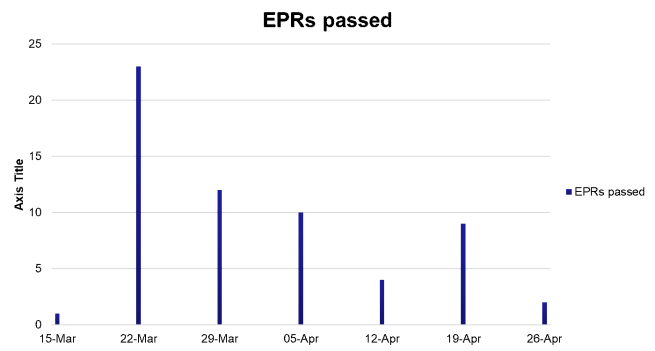
fig 1

The number of Regulations created each week ramped up rapidly at the start of the crisis, and then fairly consistently drop.

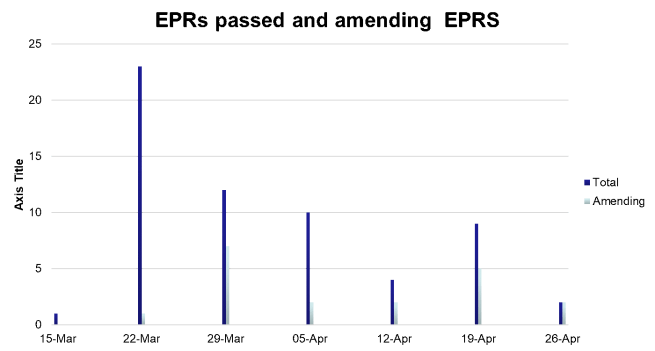
fig 2


Regulations amending earlier Regulations begin to pick up after the peak of new Regulations has passed. Some of this is substantive change to policy, but a significant amount of it is fixing problems that had become apparent after the Regulations were drafted and came into effect – notably identified by members of Tynwald during approval of the Regulation.

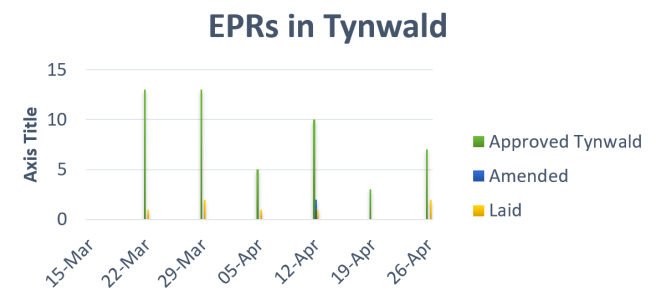
fig 3

Unsurprisingly, given the rules for approval of EPRs, we see approval by Tynwald off-set by a week from the creation of the EPRs. The vast majority of EPRs were put to Tynwald for approval. A small number were allowed to lapse, and in one week (12 April) we have Tynwald exercising its powers to approve subject to amendments for two EPRs.

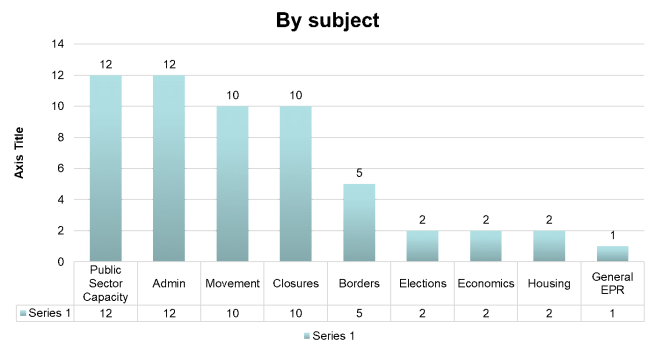
Finally, turning to subject matter, my categories are inevitably subjective, and I have treated each EPR as only falling into one category. I am likely to revise these subjects once the state of emergency has ceased; and, given what the Chief Minister has said about how EPRs are generated, mapping EPRs onto Departmental portfolios may also be useful. For the moment, it does give a sense of the centre of gravity of the EPR response.

fig 4

Emergency Power Regulations, 29 April to 1 May.

Two Regulations amending the Closure of Businesses Regime were created in rapid succession.

The Closure of Businesses and Other Premises (no.3) Regulations adds recycling facilities to civic amenity sites as premises that may remain open for restricted purposes (reg.3(3)(a), amending Sch.1), discussed further below; and makes it clear that the premises identified for provision of temporary accommodation in the early Regulation noted here are permitted to open for that purpose (reg.3(3)(b)).  The more significant changes are to the rules concerning continuation of operation of businesses, added to the new detail added by Closure of Businesses and Other Premises (Amendment no.2) Regulations, discussed here.  The duty on employers to ensure that premises are regularly cleaned is amended to “regularly and frequently cleaned” (reg. 3(2)(a) amending reg.5(3)(b)). The power of an employer to require the presence at the business premises of employees, limited by the no.2 Amendments is clarified to include a power to require presence at “such other premises as the employee would ordinarily be expected to attend” (reg.3(2)(b) amending reg.5(4)(a)). This covers the case of a business whose employees deliver services outside of their own premises – for instance an electrical goods repair service, or provider of temporary office workers.

The Closure of Businesses and Other Premises (no.4) Regulations makes two amendments to Part 1 of the Schedule, that is businesses which must close. Original entry 20 simply closed “golf courses”; this has been amended to close clubhouses serving golf courses, except that if the clubhouse includes a point where members must report prior to playing golf “that part of the clubhouse may remain open for that purpose only” (reg. 3(2)(a), amending Sch.1). Original entry 21 similarly closed “any premises that provide recreational fishing activities”. The amendment reduces the scope of that restriction to fishing from any unmoored vessel, or from premises charging a fee other than a fishing license fee (reg.3(2)(b), amending Sch.1). This amendment continues the trend of blurring an initially clear distinction between Part 1 of the Schedule (“Businesses and Premises that must close”), Part 2 (“Businesses and premises that may remain open for Restricted purposes”), and Part 3 (“Businesses that may remain in operation”).

The question of recycling facilities appears in both of these amending Regulations. The no 3 Regulations added “other facilities for the collection of recyclable” to the permission to open for civic amenity sites (reg.3(3)(a)), amending Sch.1). The no 4 Regulations correct the no.3 Regulations by adding “products” after the word “recyclable” (reg 3(3)) – correcting a purely typographical error, as the guidance to the no.3 Regulations refer explicitly to “recyclable products”.

The Manx legal response to the 1919 pandemic.

Parallels are often drawn between the 2020 coronavirus pandemic and the “Spanish Flu” pandemic of 1918-1920. The Isle of Man was affected by this earlier pandemic, with the Isle of Man Examiner reporting from the latter part of 1918 to the end of March 1919 a total of 84 deaths (“Influenza Mortality”, Isle of Man Examiner 29 March 1919), against a population of around 55,000 at the turn of the century.

The legal response to this threat was not under a general Emergency Powers Act (no such Act existed), or Imperial statutes or emergency Acts of Tynwald such as those which had played such a role in the wartime regime, but rather a very specific provision which allowed the creation of Regulations with a view to preventing, mitigating, and guarding against the spreading of epidemic disease.  (Local Government Consolidation Act 1916 s.195). These powers were seen as broad enough to allow more substantial restrictions on individuals than English law did, and in particular to be able to encompass controls of gatherings of people, including private parties (Isle of Man Times 25 January 1919) – a speculation which as we will see bore legal fruit a little later. Unusually for such significant powers in this era, these were not exercised by the Lieutenant-Governor, but by the Local Government Board, a Board of Tynwald (see the discussion of this by the Vicar General in Tynwald April 15th 1919). The Board was able to make regulations which took effect immediately, and would be proclaimed by the Lieutenant-Governor, but if not confirmed by Tynwald would cease to have effect.

The Isle of Man responded to the early wave of the pandemic with school closures, restrictions on cinemas and theatres, and cleaning requirements for cinemas, theatres, and public conveyances (Proclamation of 29th October 1918).; but on the 11th of  January 1919 the government updated this regulation, adding a duty to disinfect daily for “all factories, workshops and shops” (Proclamation of the Lieutenant-Governor of 11 January 1919). These formal regulations, violation of which could be punished by a fine, were – in a precursor of 2020 – supplemented by guidance. At the same time as publicising these regulations, the Government Secretary added that “The general public is required to cooperate with the authorities in preventing the spread of the epidemic” (B.E. Sargeaunt, 11 January 1919):

“The following instructions should be carefully observed by members of the general public –

  1. Avoid crowded places, especially dances, parties, and similar forms of amuseument.
  2. Keep doors and windows open, and sleep in well-ventilated bedrooms.
  3. Brush teeth frequently, and use antiseptic gargles.
  4. If headache, shivering, or joint pains are felt, go to bed immediately, and consult a doctor.
  5. Strict isolation should be enforced in every affected case”.

These restrictions were shortly amended, to clarify that the ban included night schools, to reduce the permitted opening hours for cinemas and theatres, and to extend these limited hours to “all dances, theatres, or other public entertainment in any public hall, boarding-house, or any other place where a charge is made for admission, or a subscription is paid” (reproduced in “The Influenza Epidemic”, Isle of Man Times 25 January 1919). Peel continued to pose particular concerns, however, and on the 22nd of February a further Regulation limited to Peel prohibited all performances in cinemas and theatres; closed all churches, chapels, and schools; and prohibited gatherings – even in private houses – of more than twelve people (Peel District Influenza Epidemic Regulation, 22 February 1919, approved by Tynwald 15 April 1919). The restriction on places of worship was removed on the 7th of March (Peel Destrict Influenza Epidemic Regulation, 7 March 1919), the remaining restrictions expiring as planned later in the month.

The 1916 Act saw regular use through a long lifetime. Regulations to deal with influenza were completely routine during the 1920s and 1930s, albeit much less intrusive than the 1919 set, and rarely subject to scrutiny or query in Tynwald. Mr Crellin, moving approval of one set in 1933, constituted the entire discussion of the motion: “This is rather important, and it won’t take a minute. I beg to move this resolution. The regulations are the usual regulations issued when there is an influenza epidemic in the Island” (Tynwald Court, 27 January 1933). They were not replaced by the Emergency Powers Act 1936 – for instance influenza regulations being issued in January 1937.  Regulations under this provision of the Act were made 23 times between 1918 and 1973, principally concerning influenza but also on occasion measles, psittacosis, and scarlet fever.

It may be tempting to see the powers under the 1916 Act as the precursor to the Emergency Powers Act 1936. It is better, however, to see them as the precursors to the Public Health Act 1990, which repealed and replaced the 1916 powers. The Public Health Act 1990 was the legal basis for the first emergency regulations in the current crisis, the Health Protection (Coronavirus) Regulations 2020, created on the 26th of February, and laid before Tynwald on the 24th of March, but as it was not approved by Tynwald at that point, ceasing to have effect on that day (Public Health Act 1990 s.51Q(3)-(5)). Since the 24th of March, Regulations under the Emergency Powers Act 1936 have instead been the primary tool for dealing with the pandemic.

Comparison of the legal structures used to respond to the 1919 and 2020 pandemics raise some interesting lines of inquiry. The 1919 response, in a context where Tynwald was incomparably weaker in relation to the Lieutenant-Governor than today, was by a Board of Tynwald, not the Lieutenant-Governor. Changes in executive government in the Isle of Man have been so profound, however, that this may not be a useful comparison. Perhaps more illuminating will be the possibilities the 1919 experience shows for regulating public behaviour under specific measures aimed at addressing epidemics, rather than emergency powers drafted to deal with a range of possible crises. In this light, the decision made between the 26th of February and the 24th of March 2020 to step away from the powers in the Public Health Act, and instead rely on the Emergency Powers Act even on issues directly related to reducing the spread of the disease, may be particularly significant. The geographical granularity of the 1919 response, with strict special rules for Peel during the broader crisis, does not feel like it would travel well into the 21st century context.