The threshold for intervention with society level restrictions to deal with the pandemic.

CoMin has released a summary of their approach to “Learning to Live in a World with Covid-19”. The report stresses that “This document does not create new policy, or a new approach, merely confirming the current approach, much of which has already been discussed through other channels” – an appropriate aspiration in the midst of a general election campaign.

One striking aspect of the report is the level and type of harm required before CoMin considers that legal intervention in the form of mandated, legally backed, mitigation requirements are imposed:

Government will not seek to implement Island wide or society level restrictions other than at the borders, unless the level of threat rises to the extent that there is significant threat to the health and care system of being overwhelmed.

This does not rule out specific restrictions, which may themselves be based on the power of IOMG as a delivery of services rather than specific legal rules (such as visiting of health care settings, and use of public transport). Island wide restrictions in the interests of public health are, however, an ancient part of the Manx legal system, and have been imposed in response to threats considerably below that of overwhelming of health and care systems. Two historical examples first.

Deemster Parr’s Abstract, an authoritative summary of Manx law compiled in the 17th century, notes that “the killinge and eating of salmon and salmon frea in kipper time was too obnoxious for the endangereing of breeding leprosie and other noysome diseases: it was therefore ordered … that noe salmon or salmon frea should bee killed in any fresh water or salt water in kipper tyme” (para.86). Violations could be punished by destruction of “nets and engines” for a first offence, 3 months imprisonment for a second offence, and 12 months imprisonment for a third.

The Criminal Code 1872 s.342, a section which is still in force, provides:

“Whosoever will wilfully endanger the public personal safety by any unlawful act, or shall do, cause, occasion, promote, maintain, or continue what is noisome and offensive, or manifestly hurtful to the public; or injure or annoy or tend to injure the public in the enjoyment of any public right or privilege, or cause directly, or manifestly tend to cause, any public calamity, mischief, or disorder, or any common injury or damage to the public in respect to their habitations, personal safety, health, or property, the same being without authority or justification by law, shall be guilty of a misdemeanour; and it shall not be essential that any such unlawful act should be to the general injury of all Her Majesty’s subjects, but it shall be held to be sufficient if it injure or prejudice a class only of such subjects; and no act, being a common nuisance within the meaning of this section, shall be deemed justifiable or excusable on the ground that it is productive of some compensating convenience or advantage to the public.”

There are numerous examples of restrictions on individual choice in the interests of public health in current Manx legislation where the harm being averted is considerably less than overwhelming the health and care system. For instance:

One argument against state intervention in order to protect public health is that it is not practical to enforce every violation of such an intervention. This has not been fatal to the examples noted above. To focus on food safety rules, these are legal rules which can be enforced by the state against food businesses failing to meet the required standard. Two food safety officers investigate complaints about hygiene standards, and carry out food hygiene inspections. They can recommend prosecution or impose prohibitions on a business or equipment, and if there is an imminent risk to consumers, issue an Emergency Prohibition Notice, subject to confirmation by a court. Two food safety officers are clearly not going to be able to check out every shift of every food business on the Island. So, why bother with food safety rules?

Janice Nadler considers the work of law outside of sanctions or direct coercion in this open-access article. She discusses expressive law – “the claim that law influences attitudes and behaviours by what it expresses” – and gives as examples no smoking laws which coordinate expectations (“When law highlights a behavioural choice in a coordination setting, it changes expectations about how others will behave”), and compulsory seat-belt laws which provide additional information (for instance “what legislators collectively know about the risk of not wearing a seat belt”).

Restrictions on individual judgement and choice in the interests of public health are not new to the Isle of Man, and are not restricted to exceptional periods of crisis. What is perhaps exceptional about the use of state sanctions to regulate behaviour during the lockdowns was the severity of the punishment imposed. Mandating mitigations does not, however, necessarily require severe sanctions against individuals. One of my criticisms of the Emergency Powers Regulations, and indeed the Public Health Regulations, was that a single set of maximum penalties was imposed for each type of violation. Failing to obey a mandated mitigation in a vaccinated population would seem closer to established increases of risk to public safety such as a parking violation, than to the pre-vaccination breaches which led to periods of imprisonment. The PHR limits for fixed penalty offences, of £150 rising to £250 if not paid, might serve well.

Living with coronavirus might eventually turn out to be similar to living with dangerous parking, food poisoning, and passive smoking. The next administration might want to begin by looking at the threat of coronavirus in a (thankfully) largely vaccinated population; comparing it with other endemic threats to public health on the Isle of Man, rather than to the level of threat it posed to an entirely unvaccinated population. It may be that the benefits to public health produced by state intervention aimed at this level of harm could justify modest restrictions on behaviour that generates risk, but not prison sentences for breach of these restrictions.

Are there too many MHKs?

Given that there are, pending the general election, currently no MHKs, it might be a good moment to think about this.

A fundamental challenge for small democracies is striking the balance between democratic legitimacy for all those exercising governance power, avoiding the concentration of power in a small number of hands, and avoiding paying for a disproportionately large number of people to exercise that power.

Sutton has argued that ‘in small societies it is relatively easy for a determined, unscrupulous, individual … to dominate all or most aspects of the country’s life’. With the demise of the plenipotentiary Lieutenant-Governor, the Isle of Man has moved some way from this, but it is clear that constitutional developments have increased the power of the 24 directly
elected members of the House of the Keys.

A comparison with other small democracies suggests that over-concentration may be a genuine problem for Manx democracy. In 2012 Johnston and McLean analysed the population per elected representative in the only or lower houses of all independent and semi-independent territories with a population between 50,000 and 150,000.Of the 22 considered, both the Channel Island jurisdictions analysed were amongst the most generous. Guernsey (1328) and Jersey (1920) were in the most generous five, along with Bermuda (1783), Greenland (1829) and the Marshall Islands (1645). The Isle of Man (3521) was at 13th place of the 22, bracketed by American Samoa (3083), the Cayman Islands (3083), the Federated States of Micronesia (3664), and Tonga (3692). The difference between the other Crown Dependencies and the Isle of Man is striking.

So, to answer the question in the title, I don’t think there are too many MHKs, and indeed there *might* be too few.

One possible way to address this would be to increase the size of the House of Keys. If the Keys was to be returned to its pre-twelfth century size of 32 members, the Manx ratio on Johnson and McLean’s figures would move to 2640, 8th most generous of the 22 small democracies, bracketed by Dominica and the Seychelles. The ratio of representation would remain notably less generous than that of the closest comparators to the Isle of Man – the fellow Crown Dependencies of Jersey and Guernsey. A significant concern over such an expansion of the House of Keys would be cost, both in terms of salary and infrastructure. This could be met by increasing resourcing of Tynwald – a politically sensitive argument, particularly as the Isle of Man continues to deal with very significant economic and fiscal challenges. Reconfiguring the MHK role as part-time, remunerated pro rata, risks, as was discussed during the Lisvane debate, reducing diversity in Tynwald. More significant resources could be freed up by the abolition of the Legislative Council, and a move to a unicameral chamber of the kind already found in Jersey and Guernsey. Unicameralism has been discussed in the Isle of Man for some time, but remains contentious.

Law and religion materials on Box of Broadcasts?

Inspired by some great use of Box of Broadcasts in legal teaching, I’ve been looking at suitable “further viewing” for my third year LLB option in Religion and Law. I’ve added a number to this year’s module, but thought it was something that UK law and religion teachers based in the UK (where most of us have access to Box of Broadcasts), might want to share suggestions on!

So my current materials below, by category. Please email me at pwedge@brookes.ac.uk with your suggestions, either in these categories or under new categories, and I will update. If you could keep the same format (so include hyperlink at bob) that would be handy.

Defining Religion.

“Around the World in 80 Faiths” (2019). A TV series exploring a wide range of religious systems around the world. The episodes on the US and Europe are most relevant to the focus of my course.

Freedom of conscience.

“A Man for All Seasons” (1966) Excellent full-length movie around the final years of Thomas More. One of my favourite films, but raises issues of faith in the law, the forum internum, and law and politics.

Equality and inequality.

“Young, Welsh and Pretty Religious” (2019). A 2019 documentary looking at nine young Welsh people of a wide variety of faiths, in this episode looking at their experiences of intolerance. A really thought provoking succession of people talking about a range of inequalities in their lives including a substantial discussion of being LGBT+ Christian; niqab wearing women;  becoming a Hare Krishna monk; and antisemitism (with an interesting point about vegan food and religion). Part of a series of three episodes available on bob.

Marriage.

“The Big Questions”, Episode 8 (2017). A studio discussion show, which at 42 mins in turns to civil partnerships, with an interesting contribution by Peter Tatchell on “Is marriage what you make it?”.  The series covers a lot of religion/society/politics questions.

Notice of Poll for the General Election 2021 – some stats around gender.

The formal notice of poll has now been issued for each constituency. I’ve done a quick gender breakdown, and comparison with the notice of poll for the last General Election in 2016.

ConstituencyTotal 2021M/W 2021Total 2016M/W 2016
Arbory44/076/1
Ayre86/265/1
Douglas Cent42/263/3
Douglas East73/485/3
Douglas Nor44/053/2
Douglas Sou42/243/1
Garff54/154/1
Glenfaba76/133/0
Middle53/244/0
Onchan54/154/1
Ramsey87/155/0
Rushen43/155/0
TOTALS6548/176350/13

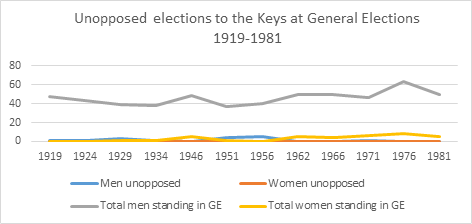
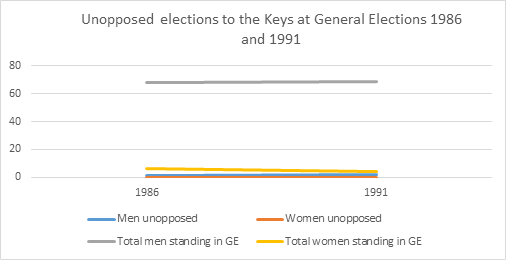
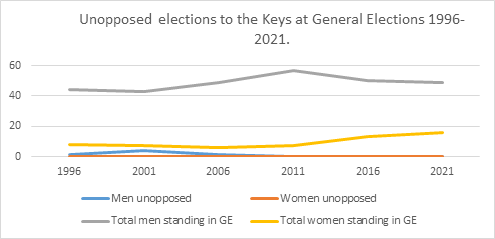
Compared with the last General Election, nationally, a very similar number of candidates for the 24 seats, with a modestly higher proportion of women candidates (26% as opposed to 21%). Considering conversion from candidates to MHKs, the numbers are very small, and small changes in particular constituencies can have a big effect – for instance, if there had been a 42 vote swing in one constituency in  2011, 12.5% of the Keys would have been women, as opposed to the 8.33% who were elected (against 11% of candidates in that election being women). Nonetheless, the 2016 and 2011 elections had women candidates elected at very much the same rate as men. It will be interesting to see if something similar happens in September.

The elections are resolved in constituencies, rather than nationally, and so it is worth breaking those national figures down a little. The number of constituencies with no women standing has reduced substantially, from 4 to 2. In one constituency (Douglas East) there are more women than men standing. This is, perhaps surprisingly, not the first time this has happened in an election to the Keys. Marion Shimmin, the first woman MHK, was elected unopposed at a by-election in 1933 (so would be 0/1 on my table). In 2001 both candidates for the single seat in Peel were women (so would be 0/2 on my table). In two other Douglas constituencies there are the same number of men and women standing – Douglas Central (which was in this position in 2011) being joined by Douglas South. In both elections, there are 5 constituencies with only one woman on the ballot for the two seats.

Prosecution, conviction, and imprisonment for Coronavirus offences.

The response to a useful Freedom of Information Request has now been published by the Isle of Man Government, on the freedom of information site. This link should lead to the response from the Department of Home Affairs.

The data provided covers March 2020 through to March 2021. In that period there were 215 arrests for coronavirus offences (which from the question asked, means offences under the EPR and PHR), 35 being arrests of juveniles. Seventy-one persons received a custodial sentence for breach of the EPR/PHR. Thirty-seven fixed penalty notices were issued.

The report by the Chief Constable, referred to in the FOI response, provides useful additional data.

  • The 215 arrests were clustered, unsurprisingly, around the three lockdowns, with 84 in the first lockdown, 42 in the second, and 27 in the third, for a total of 153, or 70% of the total.
  •  Coronavirus arrests outside of lockdowns never reached 9% of the total arrests in non-lockdown months. During lockdown one, nearly 50% of arrests were coronavirus arrests, dropping to under 30% in both lockdown two and lockdown three.
  • The 215 arrests represent arrests of 190 different individuals (overwhelmingly, male adults). Seventeen were arrested twice, and four arrested three times (including three juveniles).
  • The report includes data on convictions, which puts the seventy-one custodial sentences in context. At the time of the report, 87 offences had resulted in conviction. Although this isn’t broken down into multiple offences prosecuted against the same person, 20 of the 134 offences were part of “multiple cases brought against … 9 individuals”. If we are conservative, and assume that the 87 convictions were all in relation to different individuals, 81% of coronavirus prosecutions resulted in a custodial sentence.
  • A total of 2361 reports were made from the public relating to coronavirus incidents. In the lockdown only (which is the focus of the report), there were 1968 reports. In the three lockdowns, 767 individuals were warned for breaching the coronavirus regulations.

A couple of final comments.

Firstly, fixed penalty notices were not available until late in April 2020. The biggest month for coronavirus arrests (April 2020, with 54 of 131 arrests equalling more than 40% of all arrests) had already been and gone. Nonetheless, it is striking how many more people were imprisoned for breaches of the PHR than received fixed penalty notices for these breaches. Not every PHR offence could be dealt with by a fixed penalty notice, but I would still have expected to see them having a bigger role. It may be, however, that the police chose to give warnings rather than fixed penalty notices wherever possible; so that a situation which was viewed as too serious for a warning was often also too serious for a fixed penalty notice. I think fixed penalty notices have an important role to play if we return to more legal intervention in the transmission of coronavirus in the Manx community, but it would be worth reflecting on why did not receive much more significant use in the past.

Secondly, 81% of convictions for a broad category of offences resulting in custodial sentences is striking. If someone has access to the Manx custodial sentences breakdown I would be very grateful for it, and will update the blog accordingly. In the meantime, a comparison with 2020 in England and Wales might be useful. A custody rate of 34% across all indictable offences (i.e. the more serious criminal offences) was noted as “the highest in a decade”. A useful public access overview from 2017, by Civitas, breaks down the percentage of offenders who received a custodial sentence by broad category of offence. The Manx EPR/PHR custodial sentence rate is higher every offence in Graph 2 of the report, which includes robbery (described in the report as having the highest custody rate, but other lawyers, like me, would want to finesse that to take account of the mandatory life sentence for murder), sexual offences, and violence against the person.

That the custody rate for EPR/PHR violations was extraordinarily high will not come as any surprise, and may spark another round of international interest in Manx sentencing policy. One of my ongoing criticisms of the EPR/PHR is that the power to create criminal offences under the Regulations was used too bluntly. Those creating offences under the Regulations invariably set the maximum sentence at the maximum allowed by law. Setting a different range of maximum sentences would have allowed communication to the judiciary of different degrees of seriousness for different violations. If there is a return to more legal intervention to deal with coronavirus, it would be useful for any criminal offences created as part of that intervention to reflect differing degrees of seriousness by differing maximum sentences. Knowingly violating a self-isolation direction following a positive test, for instance, feels to me a different order of magnitude of seriousness from failing to require customers to wear face masks in your shop.

GCs relevant to the vaccination exemption at the end of July 2021.

At the end of July CoMin issued four directions under the new powers under the PHR to specify details for the vaccination exemption.

GC 2021/0084 adds Johnson and Johnson’s Janssen to the list of qualifying vaccination, with a two week period required following the full completion of the course of vaccination.

GC 2021/0086 departs from the English categories 1-3 by classing France as a category 3 country for the purposes of regulation 5A (so making travellers from France unable to use the vaccination exemption; but perhaps not invalidating vaccinations received in France – in any  case see below), and category 2 for the purposes of 5B (allowing children travelling with adults to whom the vaccination exemption applies). My reading of this is that a child who has been in France within ten days of entering the Isle of Man can make use of the secondary vaccination exemption so long as the fully vaccinated parent or guardian with who they travel has not been in France within ten days. So a fully vaccinated parent could travel to the UK to collect a child who has been, say, on a school trip in France; but could not collect them directly from France without losing the vaccination exemption.

GC 2021/0087 adds four clinical trials to the vaccination exemption, allowing those who have completed vaccination with Valneva, Novovax, Com-COV and Com-COV 2 more than 14 days before entering the Isle of Man to make use of the vaccination exemption.

 GC 2021/0088 deals with the issue of where a qualifying vaccination is received. The Regulations limit the vaccination exemption to vaccinations received in “relevant countries”. This direction defines relevant country as “any country”. So, so long as the other requirements for the vaccination exemption are met, the location in which the vaccine was received is no longer significant. This seems sensible, but does mean that vaccinations received in any of the more than 190 countries of the world will satisfy the exemption, which may pose administrative problems. Bhutan for instance, has been very active in providing its population with complete courses of vaccinations accepted by the PHRs. I have no idea what Bhutan’s proof of vaccination looks like.

PHR Amendment no.17.

The PHR (Amendment) no.16 makes significant changes to a number of aspects of the PHR. Unusually for PHRs, it was put before Tynwald before it was planned to come into effect on the 24th of July. The July Tynwald was tremendously busy, however, and this item was placed as the only substantive item on a supplementary order paper. A vote to suspend standing orders to allow this supplementary order paper, and so voting on this PHR, failed. Tynwald returned to it – for technical reasons as PHR no.17 – on the 23rd of July. After a long debate, the amendment passed.

A number of minor drafting errors are corrected, for instance replacing “in accordance” with the better “in accordance with”. A number of substantial changes are made however.

One criticised element of the initial version of the vaccination exemption for entry into the Isle of Man was that it was based on an unnecessarily narrow idea of what fully vaccinated could be, assuming as it did 2 doses of a vaccine being required. The Amendment changes the “2+2 vaccination exemption” to the “vaccination exemption”, making substantial changes in the process.

Formerly, the “2+2 vaccination exemption”, did not recognise single dose vaccines. The vaccination exemption now requires completing “the full course of a qualifying vaccination” (reg.5A(2)(a)), followed by the passing of “the relevant period” (formerly a set two weeks). Additionally, the vaccination exemption now applies to those participating in a qualifying clinical trial (reg.5A(2)(a), to be recognised by CoMin under reg.5A(3)(c)). The vaccination or trial must have taken place in a “relevant country” (formerly qualifying country). This continues to include the Common Travel Area, but is extended to Category 1 or 2 territories (which I discuss in a moment), and any other country specified by CoMin. There is no power for CoMin to declare a country that meets these requirements is not a relevant country – so CoMin could expand the list, but not restrict it. In fact, a different feature of the PHR means this is not a problem.

Formerly, the exemption was only available to those who had not travelled outside the common travel area in the 10 days preceding their arrival in the Island. This has been expanded beyond the Common Travel Area to the CTA “or a category 1 or Category 2 country or territory” (reg.5A(2)(c)). The list of Category 1-3 territories is tied to the relevant English Regulations, but CoMin can by direction vary these categories, for instance deciding that a territory in Category 3 in the English Regulations is to be treated as Category 2 (new reg.5(10)). This means, obliquely, that CoMin can remove a territory from being a relevant country for vaccinations, by moving it out of Category 1 or 2. The power to vary category can apply to “any part” of the PHR as well as the PHR as a whole. So if, for instance, CoMin wished to allow travel from Malta, but not recognise Maltese vaccinations for some reason, the power could be exercised only for the relevant country element.

The exemption still requires that a person not have travelled outside this expanded area in the ten days before they entered the Isle of Man, regardless of when that was. I still think it would be useful to think about how to deal with non-travelling vaccination exemptions.

In relation to children travelling with parents and guardians entitled to the vaccination exemption, changes bring it in line with the changes to the vaccination exemption (for instance the expansion beyond the Common Travel Area). The most significant change, however, is in relation to age, with the upper limit for a child to take advantage of this exception without any testing being raised from 5 to 12 (the exclusion of Category A persons under 5 years from Schedule 2 is similarly moved to 12 year olds). A child of 12 or over could take advantage of this exception only with testing within 48 hours of arrival and then again on the sixth day following arrival. The problem I pointed out earlier, that there was no discussion of the situation of a child who refused to test, has been dealt with: a child who does not provide a biological sample “must self-isolate as directed by the Director of Public Health” (new reg.5B(5)).

A change of age is also to be found in relation to contact tracing. Under the Amendment, the Director of Public Health can no longer require a person under 12 to self-isolate under reg.15 (reg.15(1)(b) as amended). In giving a direction notice requiring self-isolation, the Director of Public Health would now insert the relevant information from Schedule 2 into that direction notice (reg.15(12)). Once a direction notice has been issued, the Director of Public Health is able to revoke or amend it – a power I think implicit in this section already, but as it appears to have been one that has been exercised as a result of the policy shift in relation to self-isolation under track and trace, one whose explicit inclusion is understandable (new reg.15(4)). Similar changes can be found in the requirement to isolate when suspected to be infected, a power which the Director retains for those under 12 (reg.16); and to the power to require a Category C person to self-isolate, which however, no longer extends to those under 12 years of age (reg.18(2) as amended).

The House of Keys election.

Two points discussed in the July Tynwald, only one under this PHR.

It will be recalled that the last amendment to the PHR specifically dealt with the amendment of the PHR while the House of Keys was dissolved, and so Tynwald could not necessarily approve amendments of a PHR. This power was initially limited to self-isolation requirements and periods, and samples and analysis. This has been expanded to allow a direction to “vary the application of any part of these Regulations” (new reg.9A(3A)). It remains limited to the period during which the Keys is dissolved, and subject to consideration at the first sitting of Tynwald following the day on which the House of Keys is first assembled.

In the same sitting, Tynwald approved the Elections (Keys) (Amendment) Regulations 2021. Existing regulations meant that an application for a proxy vote justified by a medical emergency had to be received by Friday 17 September. Mid-pandemic, however, a medical emergency might arise for a number of electors after this date, but before polling day. These Regulation would allow a person to appoint a proxy to vote on his or her behalf up until 22 September – the day before the elections.

Schedule 2.

During the Tynwald debate, there was some discussion of the detailed changes to Schedule 2, so I have added this (detailed) discussion here.

A number of changes were made in Schedule 2. A common theme is the removal of restrictions in the Schedule on non-emergency access to health and social care settings – this is not to say, of course, that individual direction notices may not include restrictions effectively recreating this limit.

Category A persons (residents of the Isle of Man returning from the Common Travel Area), are expanded to include those returning from Category 1 countries or territories. Category B persons are similarly redefined to exclude residents who have not travelled outside the CTA or Category 1 territories. Both types of returning residents would no longer be restricted in attending health or social care premises within ten days of their return.

Category C persons (non-residents permitted to enter who have not travelled outside the Common Travel Area), are expanded to include those returning from Category 1 countries or territories. Category D persons are similarly redefined to exclude those who who had travelled only in Category 1 countries or territories. In both cases, the person would no longer be restricted in attending health or social care premises within ten days of their return.

Category I persons – that is persons who are reasonably suspected of being infected – have the default self-isolation period dropped from 21 days to 10 days, and may test on the day of being given a direction notice to self-isolate, rather than on or after the ninth day of being given the direction notice. A Category I person who tests negative is no longer required to self-isolate.

Category J persons (contact traced persons who share a household with an infected person) similarly have the default self-isolation dropped to 10 days, and may test on the day of being given a direction notice, rather than on or after the ninth day. Where the sample is negative, the person may exercise, but otherwise must self-isolate as directed by the Director of Public Health. The explicit restriction on attending health or social care premises within ten days of their test would no longer apply. A Category J person, and their household, who has tested positive must self-isolate as directed by the Director of Public Health.

Category K persons (contact traced persons who do not share a household with an infected person) similarly have the default self-isolation dropped to 10 days, and need only test once. If they test negative, they may exercise, but otherwise must self-isolate as directed by the Director of Public Health. There was formerly a reference to the consequences of a positive test, but this has now been deleted.

PHR Amendment no.16 – planned for Tynwald 22 July.

The PHR (Amendment) no.16 makes significant changes to a number of aspects of the PHR. Unusually for PHRs, it was put before Tynwald before it was planned to come into effect on the 24th of July. The July Tynwald was tremendously busy, however, and this item was placed as the only substantive item on a supplementary order paper. A vote to suspend standing orders to allow this supplementary order paper, and so voting on this PHR, failed.

So what would this PHR do if successful in Tynwald at some point? A number of minor drafting errors are corrected, for instance replacing “in accordance” with the better “in accordance with”. A number of substantial changes would, however, be made.

One criticised element of the initial version of the vaccination exemption for entry into the Isle of Man was that it was based on an unnecessarily narrow idea of what fully vaccinated could be, assuming as it did 2 doses of a vaccine being required. The Amendment would change the “2+2 vaccination exemption” to the “vaccination exemption”, making substantial changes in the process.

Formerly, the “2+2 vaccination exemption”, did not recognise single dose vaccines. The vaccination exemption would now require completing “the full course of a qualifying vaccination” (reg.5A(2)(a)), followed by the passing of “the relevant period” (formerly a set two weeks). Additionally, the vaccination exemption would now apply to those participating in a qualifying clinical trial (reg.5A(2)(a), to be recognised by CoMin under reg.5A(3)(c)). The vaccination or trial must have taken place in a “relevant country” (formerly qualifying country). This would remain including the Common Travel Area, but would be extended to Category 1 or 2 territories (which I discuss in a moment), and any other country specified by CoMin. There is no power for CoMin to declare a country that meets these requirements is not a relevant country – so CoMin could expand the list, but not restrict it. In fact, a different feature of the PHR would mean this was not a problem.

Formerly, the exemption was only available to those who had not travelled outside the common travel area in the 10 days preceding their arrival in the Island. This would be expanded beyond the Common Travel Area to the CTA “or a category 1 or Category 2 country or territory” (reg.5A(2)(c)). The list of Category 1-3 territories is tied to the relevant English Regulations, but CoMin could by direction vary these categories, for instance deciding that a territory in Category 3 in the English Regulations is to be treated as Category 2 (new reg.5(10)). This would mean, obliquely, that CoMin could remove a territory from being a relevant country for vaccinations, by moving it out of Category 1 or 2. The power to vary category can apply to “any part” of the PHR as well as the PHR as a whole. So if, for instance, CoMin wished to allow travel from Malta, but not recognise Maltese vaccinations for some reason, the power could be exercised only for the relevant country element.

The exemption would still require that a person not have travelled outside this expanded area in the ten days before they entered the Isle of Man, regardless of when that was. I still think it would be useful to think about how to deal with non-travelling vaccination exemptions.

In relation to children travelling with parents and guardians entitled to the vaccination exemption, changes would be made to bring it in line with the changes to the vaccination exemption (for instance the expansion beyond the Common Travel Area). The most significant change, however, is in relation to age, with the upper limit for a child to take advantage of this exception without any testing being raised from 5 to 12 (the exclusion of Category A persons under 5 years from Schedule 2 is similarly moved to 12 year olds). A child of 12 or over could take advantage of this exception only with testing within 48 hours of arrival and then again on the sixth day following arrival. The problem I pointed out earlier, that there was no discussion of the situation of a child who refused to test, would now be dealt with: a child who does not provide a biological sample “must self-isolate as directed by the Director of Public Health” (new reg.5B(5)).

A change of age is also to be found in relation to contact tracing. Under the proposed PHR, the Director of Public Health could no longer require a person under 12 to self-isolate (reg.15(1)(b) as amended). In giving a direction notice requiring self-isolation, the Director of Public Health would now insert the relevant information from Schedule 2 into that direction notice (reg.15(12)). Once a direction notice has been issued, the Director of Public Health would be able to revoke or amend it – a power I think implicit in this section already, but as it appears to have been one that has been exercised as a result of the policy shift in relation to self-isolation under track and trace, one whose explicit inclusion is understandable (new reg.15(4)). Similar changes can be found in the requirement to isolate when suspected to be infected, a power which the Director would retain for those under 12 (reg.16); and to the power to require a Category C person to self-isolate, which however, would no longer extend to those under 12 years of age (reg.18(2) as amended).

The House of Keys election.

Two points discussed in the July Tynwald, only one under this PHR.

It will be recalled that the last amendment to the PHR specifically dealt with the amendment of the PHR while the House of Keys was dissolved, and so Tynwald could not necessarily approve amendments of a PHR. This power was initially limited to self-isolation requirements and periods, and samples and analysis. This would be expanded to allow a direction to “vary the application of any part of these Regulations” (new reg.9A(3A)). It would remain limited to the period during which the Keys is dissolved, and subject to consideration at the first sitting of Tynwald following the day on which the House of Keys is first assembled.

In the same sitting, Tynwald approved the Elections (Keys) (Amendment) Regulations 2021. Existing regulations meant that an application for a proxy vote justified by a medical emergency had to be received by Friday 17 September. Mid-pandemic, however, a medical emergency might arise for a number of electors after this date, but before polling day. These Regulation would allow a person to appoint a proxy to vote on his or her behalf up until 22 September – the day before the elections.

Schedule 2.

A number of changes were made in Schedule 2. A common theme is the removal of restrictions in the Schedule on non-emergency access to health and social care settings – this is not to say, of course, that individual direction notices may not include restrictions.

Category A persons (residents of the Isle of Man returning from the Common Travel Area), are expanded to include those returning from Category 1 countries or territories. Category B persons are similarly redefined to exclude residents who have not travelled outside the CTA or Category 1 territories. Both types of returning residents would no longer be restricted in attending health or social care premises within ten days of their return.

Category C persons (non-residents permitted to enter who have not travelled outside the Common Travel Area), are expanded to include those returning from Category 1 countries or territories. Category D persons are similarly redefined to exclude those who who had travelled only in Category 1 countries or territories. In both cases, the person would no longer be restricted in attending health or social care premises within ten days of their return.

Category I persons – that is persons who are reasonably suspected of being infected – have the default self-isolation period dropped from 21 days to 10 days, and may test on the day of being given a direction notice to self-isolate, rather than on or after the ninth day of being given the direction notice. A Category I person who tests negative is no longer required to self-isolate.

Category J persons (contact traced persons who share a household with an infected person) similarly have the default self-isolation dropped to 10 days, and may test on the day of being given a direction notice, rather than on or after the ninth day. Where the sample is negative, the person may exercise, but otherwise must self-isolate as directed by the Director of Public Health. The explicit restriction on attending health or social care premises within ten days of their test would no longer apply. A Category J person, and their household, who has tested positive must self-isolate as directed by the Director of Public Health.

Category K persons (contact traced persons who do not share a household with an infected person) similarly have the default self-isolation dropped to 10 days, and need only test once. If they test negative, they may exercise, but otherwise must self-isolate as directed by the Director of Public Health. There was formerly a reference to the consequences of a positive test, but this has now been deleted.

Vaccination as the basis for differential treatment beyond the Public Health Regulations.

In earlier blogs I’ve suggested that the Public Health Regulations definition of fully vaccinated (2+2) has been written for border control, but has an element of internal regulation (around self-isolation); and also that we might expect to see differential treatment between vaccinated and non-vaccinated people beyond the PHRs themselves.

Thanks to Trish McDonough (@trish1400) for sharing this from the Heritage Railways

There is no distinction between fully vaccinated and other Manx residents, but there is between fully vaccinated visitors, and other visitors. It is possible for adult visitors to the Isle of Man who fall under one of the Category A groups to enter the Isle of Man without being fully vaccinated – for instance a non-resident who was allowed to enter the Isle of Man on compassionate grounds. Such a visitor’s quickest route out of self-isolation is to give a negative biological sample within 48 hours of arrival, followed up by a second negative sample on the sixth day after their arrival. Such a visitor could be moving freely, but not on the Heritage Railways, after the negative results of their first sample. It is also possible for child visitors to the Isle of Man accompanying vaccinated parents or guardians to move freely on the same basis – again, not on the Heritage Railways.

I’ve suggested earlier some of the factors relevant to whether treating a non-vaccinated person differently is proportionate. I think a restriction like this on Heritage Railways is more likely to be justified than if the restriction were expanded to Manx public transport more broadly.