GCs relevant to the vaccination exemption at the end of July 2021.

At the end of July CoMin issued four directions under the new powers under the PHR to specify details for the vaccination exemption.

GC 2021/0084 adds Johnson and Johnson’s Janssen to the list of qualifying vaccination, with a two week period required following the full completion of the course of vaccination.

GC 2021/0086 departs from the English categories 1-3 by classing France as a category 3 country for the purposes of regulation 5A (so making travellers from France unable to use the vaccination exemption; but perhaps not invalidating vaccinations received in France – in any  case see below), and category 2 for the purposes of 5B (allowing children travelling with adults to whom the vaccination exemption applies). My reading of this is that a child who has been in France within ten days of entering the Isle of Man can make use of the secondary vaccination exemption so long as the fully vaccinated parent or guardian with who they travel has not been in France within ten days. So a fully vaccinated parent could travel to the UK to collect a child who has been, say, on a school trip in France; but could not collect them directly from France without losing the vaccination exemption.

GC 2021/0087 adds four clinical trials to the vaccination exemption, allowing those who have completed vaccination with Valneva, Novovax, Com-COV and Com-COV 2 more than 14 days before entering the Isle of Man to make use of the vaccination exemption.

 GC 2021/0088 deals with the issue of where a qualifying vaccination is received. The Regulations limit the vaccination exemption to vaccinations received in “relevant countries”. This direction defines relevant country as “any country”. So, so long as the other requirements for the vaccination exemption are met, the location in which the vaccine was received is no longer significant. This seems sensible, but does mean that vaccinations received in any of the more than 190 countries of the world will satisfy the exemption, which may pose administrative problems. Bhutan for instance, has been very active in providing its population with complete courses of vaccinations accepted by the PHRs. I have no idea what Bhutan’s proof of vaccination looks like.

PHR Amendment no.17.

The PHR (Amendment) no.16 makes significant changes to a number of aspects of the PHR. Unusually for PHRs, it was put before Tynwald before it was planned to come into effect on the 24th of July. The July Tynwald was tremendously busy, however, and this item was placed as the only substantive item on a supplementary order paper. A vote to suspend standing orders to allow this supplementary order paper, and so voting on this PHR, failed. Tynwald returned to it – for technical reasons as PHR no.17 – on the 23rd of July. After a long debate, the amendment passed.

A number of minor drafting errors are corrected, for instance replacing “in accordance” with the better “in accordance with”. A number of substantial changes are made however.

One criticised element of the initial version of the vaccination exemption for entry into the Isle of Man was that it was based on an unnecessarily narrow idea of what fully vaccinated could be, assuming as it did 2 doses of a vaccine being required. The Amendment changes the “2+2 vaccination exemption” to the “vaccination exemption”, making substantial changes in the process.

Formerly, the “2+2 vaccination exemption”, did not recognise single dose vaccines. The vaccination exemption now requires completing “the full course of a qualifying vaccination” (reg.5A(2)(a)), followed by the passing of “the relevant period” (formerly a set two weeks). Additionally, the vaccination exemption now applies to those participating in a qualifying clinical trial (reg.5A(2)(a), to be recognised by CoMin under reg.5A(3)(c)). The vaccination or trial must have taken place in a “relevant country” (formerly qualifying country). This continues to include the Common Travel Area, but is extended to Category 1 or 2 territories (which I discuss in a moment), and any other country specified by CoMin. There is no power for CoMin to declare a country that meets these requirements is not a relevant country – so CoMin could expand the list, but not restrict it. In fact, a different feature of the PHR means this is not a problem.

Formerly, the exemption was only available to those who had not travelled outside the common travel area in the 10 days preceding their arrival in the Island. This has been expanded beyond the Common Travel Area to the CTA “or a category 1 or Category 2 country or territory” (reg.5A(2)(c)). The list of Category 1-3 territories is tied to the relevant English Regulations, but CoMin can by direction vary these categories, for instance deciding that a territory in Category 3 in the English Regulations is to be treated as Category 2 (new reg.5(10)). This means, obliquely, that CoMin can remove a territory from being a relevant country for vaccinations, by moving it out of Category 1 or 2. The power to vary category can apply to “any part” of the PHR as well as the PHR as a whole. So if, for instance, CoMin wished to allow travel from Malta, but not recognise Maltese vaccinations for some reason, the power could be exercised only for the relevant country element.

The exemption still requires that a person not have travelled outside this expanded area in the ten days before they entered the Isle of Man, regardless of when that was. I still think it would be useful to think about how to deal with non-travelling vaccination exemptions.

In relation to children travelling with parents and guardians entitled to the vaccination exemption, changes bring it in line with the changes to the vaccination exemption (for instance the expansion beyond the Common Travel Area). The most significant change, however, is in relation to age, with the upper limit for a child to take advantage of this exception without any testing being raised from 5 to 12 (the exclusion of Category A persons under 5 years from Schedule 2 is similarly moved to 12 year olds). A child of 12 or over could take advantage of this exception only with testing within 48 hours of arrival and then again on the sixth day following arrival. The problem I pointed out earlier, that there was no discussion of the situation of a child who refused to test, has been dealt with: a child who does not provide a biological sample “must self-isolate as directed by the Director of Public Health” (new reg.5B(5)).

A change of age is also to be found in relation to contact tracing. Under the Amendment, the Director of Public Health can no longer require a person under 12 to self-isolate under reg.15 (reg.15(1)(b) as amended). In giving a direction notice requiring self-isolation, the Director of Public Health would now insert the relevant information from Schedule 2 into that direction notice (reg.15(12)). Once a direction notice has been issued, the Director of Public Health is able to revoke or amend it – a power I think implicit in this section already, but as it appears to have been one that has been exercised as a result of the policy shift in relation to self-isolation under track and trace, one whose explicit inclusion is understandable (new reg.15(4)). Similar changes can be found in the requirement to isolate when suspected to be infected, a power which the Director retains for those under 12 (reg.16); and to the power to require a Category C person to self-isolate, which however, no longer extends to those under 12 years of age (reg.18(2) as amended).

The House of Keys election.

Two points discussed in the July Tynwald, only one under this PHR.

It will be recalled that the last amendment to the PHR specifically dealt with the amendment of the PHR while the House of Keys was dissolved, and so Tynwald could not necessarily approve amendments of a PHR. This power was initially limited to self-isolation requirements and periods, and samples and analysis. This has been expanded to allow a direction to “vary the application of any part of these Regulations” (new reg.9A(3A)). It remains limited to the period during which the Keys is dissolved, and subject to consideration at the first sitting of Tynwald following the day on which the House of Keys is first assembled.

In the same sitting, Tynwald approved the Elections (Keys) (Amendment) Regulations 2021. Existing regulations meant that an application for a proxy vote justified by a medical emergency had to be received by Friday 17 September. Mid-pandemic, however, a medical emergency might arise for a number of electors after this date, but before polling day. These Regulation would allow a person to appoint a proxy to vote on his or her behalf up until 22 September – the day before the elections.

Schedule 2.

During the Tynwald debate, there was some discussion of the detailed changes to Schedule 2, so I have added this (detailed) discussion here.

A number of changes were made in Schedule 2. A common theme is the removal of restrictions in the Schedule on non-emergency access to health and social care settings – this is not to say, of course, that individual direction notices may not include restrictions effectively recreating this limit.

Category A persons (residents of the Isle of Man returning from the Common Travel Area), are expanded to include those returning from Category 1 countries or territories. Category B persons are similarly redefined to exclude residents who have not travelled outside the CTA or Category 1 territories. Both types of returning residents would no longer be restricted in attending health or social care premises within ten days of their return.

Category C persons (non-residents permitted to enter who have not travelled outside the Common Travel Area), are expanded to include those returning from Category 1 countries or territories. Category D persons are similarly redefined to exclude those who who had travelled only in Category 1 countries or territories. In both cases, the person would no longer be restricted in attending health or social care premises within ten days of their return.

Category I persons – that is persons who are reasonably suspected of being infected – have the default self-isolation period dropped from 21 days to 10 days, and may test on the day of being given a direction notice to self-isolate, rather than on or after the ninth day of being given the direction notice. A Category I person who tests negative is no longer required to self-isolate.

Category J persons (contact traced persons who share a household with an infected person) similarly have the default self-isolation dropped to 10 days, and may test on the day of being given a direction notice, rather than on or after the ninth day. Where the sample is negative, the person may exercise, but otherwise must self-isolate as directed by the Director of Public Health. The explicit restriction on attending health or social care premises within ten days of their test would no longer apply. A Category J person, and their household, who has tested positive must self-isolate as directed by the Director of Public Health.

Category K persons (contact traced persons who do not share a household with an infected person) similarly have the default self-isolation dropped to 10 days, and need only test once. If they test negative, they may exercise, but otherwise must self-isolate as directed by the Director of Public Health. There was formerly a reference to the consequences of a positive test, but this has now been deleted.

PHR Amendment no.16 – planned for Tynwald 22 July.

The PHR (Amendment) no.16 makes significant changes to a number of aspects of the PHR. Unusually for PHRs, it was put before Tynwald before it was planned to come into effect on the 24th of July. The July Tynwald was tremendously busy, however, and this item was placed as the only substantive item on a supplementary order paper. A vote to suspend standing orders to allow this supplementary order paper, and so voting on this PHR, failed.

So what would this PHR do if successful in Tynwald at some point? A number of minor drafting errors are corrected, for instance replacing “in accordance” with the better “in accordance with”. A number of substantial changes would, however, be made.

One criticised element of the initial version of the vaccination exemption for entry into the Isle of Man was that it was based on an unnecessarily narrow idea of what fully vaccinated could be, assuming as it did 2 doses of a vaccine being required. The Amendment would change the “2+2 vaccination exemption” to the “vaccination exemption”, making substantial changes in the process.

Formerly, the “2+2 vaccination exemption”, did not recognise single dose vaccines. The vaccination exemption would now require completing “the full course of a qualifying vaccination” (reg.5A(2)(a)), followed by the passing of “the relevant period” (formerly a set two weeks). Additionally, the vaccination exemption would now apply to those participating in a qualifying clinical trial (reg.5A(2)(a), to be recognised by CoMin under reg.5A(3)(c)). The vaccination or trial must have taken place in a “relevant country” (formerly qualifying country). This would remain including the Common Travel Area, but would be extended to Category 1 or 2 territories (which I discuss in a moment), and any other country specified by CoMin. There is no power for CoMin to declare a country that meets these requirements is not a relevant country – so CoMin could expand the list, but not restrict it. In fact, a different feature of the PHR would mean this was not a problem.

Formerly, the exemption was only available to those who had not travelled outside the common travel area in the 10 days preceding their arrival in the Island. This would be expanded beyond the Common Travel Area to the CTA “or a category 1 or Category 2 country or territory” (reg.5A(2)(c)). The list of Category 1-3 territories is tied to the relevant English Regulations, but CoMin could by direction vary these categories, for instance deciding that a territory in Category 3 in the English Regulations is to be treated as Category 2 (new reg.5(10)). This would mean, obliquely, that CoMin could remove a territory from being a relevant country for vaccinations, by moving it out of Category 1 or 2. The power to vary category can apply to “any part” of the PHR as well as the PHR as a whole. So if, for instance, CoMin wished to allow travel from Malta, but not recognise Maltese vaccinations for some reason, the power could be exercised only for the relevant country element.

The exemption would still require that a person not have travelled outside this expanded area in the ten days before they entered the Isle of Man, regardless of when that was. I still think it would be useful to think about how to deal with non-travelling vaccination exemptions.

In relation to children travelling with parents and guardians entitled to the vaccination exemption, changes would be made to bring it in line with the changes to the vaccination exemption (for instance the expansion beyond the Common Travel Area). The most significant change, however, is in relation to age, with the upper limit for a child to take advantage of this exception without any testing being raised from 5 to 12 (the exclusion of Category A persons under 5 years from Schedule 2 is similarly moved to 12 year olds). A child of 12 or over could take advantage of this exception only with testing within 48 hours of arrival and then again on the sixth day following arrival. The problem I pointed out earlier, that there was no discussion of the situation of a child who refused to test, would now be dealt with: a child who does not provide a biological sample “must self-isolate as directed by the Director of Public Health” (new reg.5B(5)).

A change of age is also to be found in relation to contact tracing. Under the proposed PHR, the Director of Public Health could no longer require a person under 12 to self-isolate (reg.15(1)(b) as amended). In giving a direction notice requiring self-isolation, the Director of Public Health would now insert the relevant information from Schedule 2 into that direction notice (reg.15(12)). Once a direction notice has been issued, the Director of Public Health would be able to revoke or amend it – a power I think implicit in this section already, but as it appears to have been one that has been exercised as a result of the policy shift in relation to self-isolation under track and trace, one whose explicit inclusion is understandable (new reg.15(4)). Similar changes can be found in the requirement to isolate when suspected to be infected, a power which the Director would retain for those under 12 (reg.16); and to the power to require a Category C person to self-isolate, which however, would no longer extend to those under 12 years of age (reg.18(2) as amended).

The House of Keys election.

Two points discussed in the July Tynwald, only one under this PHR.

It will be recalled that the last amendment to the PHR specifically dealt with the amendment of the PHR while the House of Keys was dissolved, and so Tynwald could not necessarily approve amendments of a PHR. This power was initially limited to self-isolation requirements and periods, and samples and analysis. This would be expanded to allow a direction to “vary the application of any part of these Regulations” (new reg.9A(3A)). It would remain limited to the period during which the Keys is dissolved, and subject to consideration at the first sitting of Tynwald following the day on which the House of Keys is first assembled.

In the same sitting, Tynwald approved the Elections (Keys) (Amendment) Regulations 2021. Existing regulations meant that an application for a proxy vote justified by a medical emergency had to be received by Friday 17 September. Mid-pandemic, however, a medical emergency might arise for a number of electors after this date, but before polling day. These Regulation would allow a person to appoint a proxy to vote on his or her behalf up until 22 September – the day before the elections.

Schedule 2.

A number of changes were made in Schedule 2. A common theme is the removal of restrictions in the Schedule on non-emergency access to health and social care settings – this is not to say, of course, that individual direction notices may not include restrictions.

Category A persons (residents of the Isle of Man returning from the Common Travel Area), are expanded to include those returning from Category 1 countries or territories. Category B persons are similarly redefined to exclude residents who have not travelled outside the CTA or Category 1 territories. Both types of returning residents would no longer be restricted in attending health or social care premises within ten days of their return.

Category C persons (non-residents permitted to enter who have not travelled outside the Common Travel Area), are expanded to include those returning from Category 1 countries or territories. Category D persons are similarly redefined to exclude those who who had travelled only in Category 1 countries or territories. In both cases, the person would no longer be restricted in attending health or social care premises within ten days of their return.

Category I persons – that is persons who are reasonably suspected of being infected – have the default self-isolation period dropped from 21 days to 10 days, and may test on the day of being given a direction notice to self-isolate, rather than on or after the ninth day of being given the direction notice. A Category I person who tests negative is no longer required to self-isolate.

Category J persons (contact traced persons who share a household with an infected person) similarly have the default self-isolation dropped to 10 days, and may test on the day of being given a direction notice, rather than on or after the ninth day. Where the sample is negative, the person may exercise, but otherwise must self-isolate as directed by the Director of Public Health. The explicit restriction on attending health or social care premises within ten days of their test would no longer apply. A Category J person, and their household, who has tested positive must self-isolate as directed by the Director of Public Health.

Category K persons (contact traced persons who do not share a household with an infected person) similarly have the default self-isolation dropped to 10 days, and need only test once. If they test negative, they may exercise, but otherwise must self-isolate as directed by the Director of Public Health. There was formerly a reference to the consequences of a positive test, but this has now been deleted.

Vaccination as the basis for differential treatment beyond the Public Health Regulations.

In earlier blogs I’ve suggested that the Public Health Regulations definition of fully vaccinated (2+2) has been written for border control, but has an element of internal regulation (around self-isolation); and also that we might expect to see differential treatment between vaccinated and non-vaccinated people beyond the PHRs themselves.

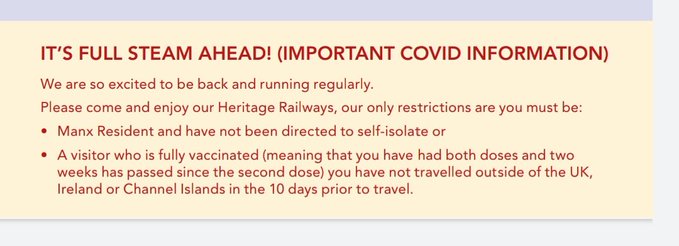
Thanks to Trish McDonough (@trish1400) for sharing this from the Heritage Railways

There is no distinction between fully vaccinated and other Manx residents, but there is between fully vaccinated visitors, and other visitors. It is possible for adult visitors to the Isle of Man who fall under one of the Category A groups to enter the Isle of Man without being fully vaccinated – for instance a non-resident who was allowed to enter the Isle of Man on compassionate grounds. Such a visitor’s quickest route out of self-isolation is to give a negative biological sample within 48 hours of arrival, followed up by a second negative sample on the sixth day after their arrival. Such a visitor could be moving freely, but not on the Heritage Railways, after the negative results of their first sample. It is also possible for child visitors to the Isle of Man accompanying vaccinated parents or guardians to move freely on the same basis – again, not on the Heritage Railways.

I’ve suggested earlier some of the factors relevant to whether treating a non-vaccinated person differently is proportionate. I think a restriction like this on Heritage Railways is more likely to be justified than if the restriction were expanded to Manx public transport more broadly.

2+2 vaccinated persons and contact tracing.

The big news in the Chief Minister’s statement of the 17th of June was the change to border controls, and in particular the change to access for non-residents, and the testing regime for residents, who met the 2+2 vaccination criteria. The Chief Minister also commented on contact tracing:

“The protection offered by 2 + 2 means that we can now also take vaccination status into account as part of contact tracing where we have cases of the virus on-Island. If someone is fully vaccinated then, from 28 June they will no longer be required to isolate if they are identified as a close contact of someone with the virus. This will significantly reduce the impact on our society during an outbreak.”

The PHR (Amendment) (no.15), commented on earlier in this blog, comes into effect on the 28th of June. It clearly gives effect to the border changes announced by the Chief Minister, but it is less clear how it impacts on contact tracing.

The principal section on the 2+2 vaccine exemption is the new reg.5A. For those covered by reg.5A, there is a good argument for saying that self-isolation requirements do not apply. Reg 5A(6) states: “A person to whom the 2 + 2 vaccination exemption applies — (a) is not required to self-isolate and need not provide a biological sample (and accordingly Schedule 2 does not apply to such a person where that person would otherwise be a Category A person and subject to that Schedule)”. Schedule 2 deals with border control, but there is a good case for arguing that this section applies to self-isolation requirements in general. It does not, however, apply to a person who is infected or reasonably suspected of being infected (reg.5A(2)(c)(i)).

Unfortunately, reg.5A has been drafted very much to address border control, and not as a free-standing section on vaccination status in the abstract, which can easily be applied to other contexts. In particular the definition of this regulation excludes a person who has “travelled outside the common travel area in the 10 days preceding their arrival in the Island” (reg.5A(2)(c)(ii)). A fully vaccinated person whose last journey outside the Isle of Man was outside the Common Travel Area (for instance to Spain in 2019) and did not spend 10 days in the CTA before they continued back to the Isle of Man does not fall within the definition of a 2+2 vaccinated person under reg.5A. Accordingly, if reg.5A is being relied upon to remove self-isolation requirements on 2+2 vaccinated persons, it will not cover every Manx resident who has had two qualifying vaccinations more than two weeks earlier.

It may be that other routes are intended to give effect to this policy, for instance by individual decisions on persons who would otherwise be required to self-isolate (reg.15(1)). Dealing with 2+2 vaccinated persons under two quite different parts of the PHRs based on whether they had travelled outside the CTA within ten days of their (perhaps historic) last entry to the Isle of Man would not be ideal.  In any case, if 2+2 status becomes more important for activities other than leaving and returning to the Island, an amendment of reg.5A to deal with the person whose last journey outside the Isle of Man was some time ago would be worth considering.

A National Emergency or a Public Health Crisis? Reflecting on the 2020 and 2021 Manx responses to the global pandemic.

The full academic article with this title will be appearing in Amicus Curiae later in 2021. This is an open access academic journal, which means that the full text will be freely available here once it appears. In the meantime, here is the abstract of the paper – which except for the incorrigible law nerds, may be more than enough!

The Isle of Man, a self-governing Crown Dependency, developed its own response to the global pandemic, including strict border controls and periods of lockdown. In 2020, this was given legal effect through the declaration of a formal state of emergency, while in 2021 similar measures were implemented under public health legislation without a state of emergency. Framing the 2021 lockdowns as a public health crisis led to a more tightly focussed response than the 2020 framing as a national emergency. Within this narrower range, however, the structure of the public health legislation as implemented provided less democratic accountability than the emergency powers legislation, and reduced the emphasis given to the rules as laws, leading to a decrease in formality in relation to both creation and publication of these legal rules, and exacerbating a blurring between law and advice. These disadvantages were not, however, intrinsic to the public health legislation itself, and if corrected the public health response is to be preferred.

Distinguishing between vaccinated and non-vaccinated people during the pandemic.

With the introduction of a distinction between those who are fully vaccinated and those who are not, the latest iteration of the Public Health Regulations marks a significant shift. One concern expressed, including in Tynwald, was that such a distinction is discrimination; another was concern over an element of compulsion. In this slightly more abstract blog, I will discuss some of the issues raised by this shift.

Mandatory vaccination policies are, globally, extremely common. A 2020 survey identified more than 100 countries with a nationwide mandatory vaccination policy, with 59% of those backed by penalties against those who do not comply, with financial and educational penalties (typically refusal of school enrolment, for instance in France) the most common. A number of countries distinguish between vaccinated and non-vaccinated travellers either by requiring vaccination to enter from a high risk country (for instance in Spain), or by altering isolation periods for fully vaccinated persons (for instance in Canada).

What limits are there on incorporating vaccination status into the Manx legal response to the pandemic?

The absolute limit on requiring vaccination under the PHA.

The Public Health Act 1990 s.51(E) prohibits PHRs made under s.51B (which allows PHRs regulating  international travel including quarantine and prohibiting the entry of persons) and s.51C (which allows PHRs creating other restrictions on persons, things or premises) from “requiring a person to undergo medical treatment”. Medical treatment “includes vaccination and other prophylactic treatment”. This provision is closely modelled on the UKs Public Health (Control of Disease) Act 1984 s.45E. Neither have been the subject of judicial consideration, which makes interpretation more difficult.

I think there is a distinction for this section between “required to” and “required in order to”. A PHR which required particular classes of person to undertake vaccination, and imposed criminal sanctions for persons who refuse, would be prohibited under s.51(E) – even if proportionate to the public health challenges. A PHR which required persons to undertake vaccination in order to do something, however, would not fall under this absolute requirement, although as discussed below it might fall foul of other, qualified, requirements.

If this view of the scope of s.51(E) is right, then distinguishing clearly in the PHRs between a requirement to, and a requirement in order to, would reduce the risk of a challenge under this provision of Manx law. As noted, however, neither this provision nor the UK equivalent has been explored by the courts, even in passing. If there is significant doubt about the correct interpretation of s.51(E), it may be worth a clarifying amendment to the section.

Limits on requiring vaccination in order to do something else: Fundamental rights.

It is still possible, however, for a “requirement in order to” to constitute a breach of fundamental rights protected by law. The WHO has recently recognised that “threats of imposing restrictions in cases of non compliance … [limiting] individual choice in non-trivial ways by making vaccination a condition of, for example, attending school or working in particular industries or settings” can constitute mandatory vaccination. This type of mandatory vaccination can raise issues when it imposes a burden on a fundamental right.

The Human Rights Act 2001, and the European Convention on Human Rights to which it refers, could be the basis for a number of arguments around for instance Article 8 (the right to privacy) and Article 11 (the right to association). In relation to compulsory childhood vaccination, failure resulting in exclusion from school, the European Court of Human Rights has very recently shown considerable deference to the decisions of the state. A requirement for vaccination in order to do something would be likely to survive ECHR challenge if it could be viewed as proportionate. I return to proportionality below.

Limits on requiring vaccination in order to do something else: Discrimination.

The PHRs now clearly distinguish between vaccinated and non-vaccinated persons, but not every distinction is discrimination. The same PHRs, and their predecessor EPRs, distinguish between people who are infected with coronavirus and those who are not for instance; and in the penal sections between those who have been found guilty of an offence and those who have not. Concerns about discrimination are not so much about the drawing of a distinction per se, but that it is either not lawful, or not just, to do so.

An important point to make here is that we find guarantees against these sorts of distinction across the Manx legal order. Equality norms pervade the legal order, and manifest in particular laws such as the Equality Act 2017, and the Human Rights Act 2001, and can have a subtler impact through the influence of international law. When someone suggests that a particular piece of policy is against the Equality Act 2017 they do not necessarily mean that the Equality Act prevents that policy making; rather they mean that the policy is incompatible with the equality norms it exemplifies (and which are to a large extent also exemplified in the Human Rights Act).

That said, groups protected by the Equality Act, and understandings of discrimination based on the Equality Act, are particularly potent. They also usefully illustrate the importance of proportionality in considering these issues.

Arguments that the unvaccinated per se legally constitute a group capable of being discriminated against are likely to be explored globally. The importance of this is that discriminating against someone because they are a member of a group sharing a protected characteristic is normally characterised as “direct discrimination”. Direct discrimination is very difficult to justify, and the Equality Act only allows justification of most direct discrimination in very narrow circumstances. If vaccinated people are not characterised as a group, however, the idea of “indirect discrimination” is much more important.

Under the Equality Act, indirect discrimination is when a generally applied policy puts those sharing a protected characteristic “at a particular disadvantage” and it is not shown “to be a proportionate means of achieving a legitimate aim” (Equality Act 2017 s.20(2)). To dodge a distraction into the reach of the Equality Act into the PHRs, let us imagine that a restaurant adopts a policy of only allowing 2+2 vaccinated persons access to a confined dining area. Could that be indirect discrimination?

One line of argument would be that the restaurant is indirectly discriminating on grounds of age and of disability. If it is impossible for almost any 18 year old to secure a vaccine , and an 18 year old is refused entry because they are not vaccinated, this could be indirect age discrimination. If a person who is unable because of their disability safely to be vaccinated is similarly refused, this could raise issues of indirect disability discrimination. In both cases, however, the restaurant could seek to “show it to be a proportionate means of achieving a legitimate aim”.

So whether our concern is the impact of distinguishing between vaccinated and non-vaccinated persons in their exercise of fundamental rights, or on indirect discrimination, the central issue is likely to be whether the impact is proportionate.

Proportionality.

This emphasis on proportionality means that accepting a distinction between vaccinated and non-vaccinated persons is not a single decision. Every time the distinction is drawn, consideration needs to be given to whether it is a disproportionate burden on the exercise of fundamental rights, or on a group sharing a protected characteristic. How should this consideration proceed?

The Council of Europe Committee on Bioethics has suggested:

“One should also take into account those individuals who, for medical or other reasons, cannot be vaccinated, and keep in mind that test results (and in the case of travel also quarantine) provide alternative means to vaccination certificates when withdrawal of some public health measures is considered. Furthermore, as underlined in our statement on “COVID-19 and vaccine”, referring to the principle of equitable access to healthcare laid down in Article 3 of the Oviedo Convention, particular attention must be paid to individuals in vulnerable situations and to the exacerbation of inequalities within such groups due to the public health crisis, including in their access to vaccination.”

Every “requirement in order to” laid down in the pandemic laws should be scrutinised carefully with these principles in mind, particularly in relation to the protected characteristics under the Equality Act 2017. Scrutiny should be particularly close where the impact on the non-vaccinated individual is more serious – so to my mind requiring vaccination to go to a nightclub is easier to justify than requiring vaccination to practise a particular profession. It should also be particularly close where there is no alternative route to the same end – so to my mind a requirement that all persons entering the Island be fully-vaccinated would require stronger justification than one which imposes differing isolation.

PHRs before Tynwald, 17 June 2021.

Two PHRs are to be laid before Tynwald today, both requiring approval by Tynwald before coming into effect. The first, PHR (Amendment) (no.14) changes the expiry date of the Regulations from 25 June 2021 to 26 October 2021. The second, PHR (Amendment) (no.15) makes very substantial changes to a number of areas of the PHR regime, most significantly introducing a new exemption for vaccinated travellers..

Cross-border travel without isolation for vaccinated persons.

A new category of 2+2 vaccine exemption is created under reg. 5A. To be covered by this exemption, the uninfected person must have:

  • received two qualifying vaccinations (currently Pfizer, Moderna and AZ, but with the power for CoMin to add to, or remove from, the list),
  • received the second vaccination at least two weeks before;
  • had both administered in a qualifying country (currently every country in the CTA, but again with the power for CoMin to add to, or remove from, the list);
  • not travelled outside of the common travel area in the ten days before their travel to the Isle of Man.

A person who meets the 2+2 criteria “is not required to self-isolate and need not provide a biological sample”, but “must not until the tenth day after their arrival, attend at any health or social care premises except to receive emergency treatment”.

Although the new reg.5A refers to persons, rather than adults, there is accommodation for the difficulty of a child complying with the 2+2 criteria. On balance, despite residents ceasing to be children for one part of the regs at 16 (reg.6(17)), a child is a person under 18 years (PHR reg.5(1)). The child must not have travelled outside the CTA within ten days, must not be a Category A person, must not be covered by reg.5A, and must have travelled “to the Island with an adult parent or guardian to whom the vaccination exemption does apply” (note the specificity – the adult must be parent or guardian). In such circumstances, a child under the age of 5 is not required to self-isolate or provide a biological sample, but a child of 5 and over must self-isolate (as suggested by reg.5B(3)(a)) and provide a sample within 48 hours of their arrival and a second on the sixth day following their arrival. If the first sample is negative, such a child is not required to continue to self-isolate. They may not, however, attend any health or social care premises except to receive emergency treatment until the tenth day after their arrival, and must provide the second sample on the sixth day.

To fall under either of these exceptions, the vaccinated person or child must not have travelled outside the CTA within ten days. There is, however, an additional, wider,  restriction in relation to travel from “red list” (Category 3) areas. Reg.11 as amended provides a prohibition on persons entering the Island unless they are a Category A person, they are passing through a secure exempt area under reg.10(5), or they are covered by one of these two new vaccination related exemptions. None of these persons, however, may enter the Isle of Man unless at least ten days have passed since they were in a Category 3 country or territory, and “they have complied with any self-isolation or equivalent requirements (however expressed) of that country or territory or any other country or territory they have or intend to transit through, or embark from in travelling to the Island” (reg.11(2(b)).  There is not a freestanding Manx definition of Category 3 – red list – countries or territories. Instead, the term is to have the same meaning “as it has from time to time” in the relevant English Regulations Tying into the changing judgment of the English executive on this point is likely to be controversial.

This is potentially a significant amount of information being provided to gain the exemption, particularly if the person has at any time been in a Category 3 country or territory. Remember, they must show that at least 10 days have passed since they were in a Category 3 country or territory, and they have complied with a range of foreign law requirements. For instance, if three months ago they had been in Greece, and then travelled one month ago to Bangladesh (Greece being a 14 day hotel quarantine country for Bangladesh), and then onto a CTA country such as Ireland (Bangladesh being a Category 2 country with mandatory hotel quarantine), they would need to show that they had complied with the relevant legal restrictions in Greek, Bangladeshi, and Irish, law. An outer timelimit beyond which information was not needed to be provided on historic presence in a Category 3 country may have been useful; particular as the time in which countries have had border controls and self-isolation rules in relation to coronavirus lengthens.

In any case, even a much simpler case is going to require a substantial amount of information to consider. This is covered by the Reg itself, requiring not only the completion of a landing card “fully and truthfully” answered, at least 48 hours before their scheduled arrival in the Island (made standard for any Manx resident arriving in the Island by a different part of the Reg), but also providing the Chief Secretary or Director of Public Health “with such information as they may reasonably require for the purposes of this Regulation”.

Other changes to isolation rules.

As in the last change to the isolation rules, Schedule 2 has been replaced in its entirety. It should be remembered that persons who fall under the 2+2 exemption (meaning both the vaccinated person, and their eligible child travelling with them), do not need to comply with Schedule 2. The 2+2 vaccinated person has no testing or self-isolation requirements; the testing and self-isolation requirements for the associated child over 5 years is contained in the body of reg.5B. The Schedule has been made clearer and more usable. The key thing to use it is to identify what “Category of Person” in column 1 applies to you – this then gives information on how consent to enter the Island has been granted, where isolation can be carried out, default isolation period, and the voluntary testing regime and its consequences.

The Schedule provides a default isolation period (frequently 21 days), and the opportunity to reduce this by voluntarily choosing to be tested. Adults under the 2+2 exemption cannot alter their position by testing: they do not need to self-isolate for any period. Children accompanying them under 5 are not subject to Schedule 2 (reg.12(2A) as amended). Children over 5 under reg.5B, however, are detailed only if they take tests. There is no consideration in reg.5B for a child, accompanying a vaccinated person, who refuses to take a test; but neither do they have their own default period of self-isolation if they refuse to take test (some of the categories may be applicable to a particular child, but not every instance a child could enter the Island under reg.5B is covered). It is not at all clear to me what the position of an unvaccinated child over 5 years of age, accompanying a vaccinated parent, is, should they refuse to comply with the testing regime. 

Changes to isolation rules during the House of Keys election period.

As noted frequently in this blog, the PHR lockdowns were implemented almost entirely by Government Circulars rather than changes to the PHR through amending PHRs made by CoMin. Border control and related self-isolation was, however, primarily dealt with by amending PHRs – this has been one of the most controversial topics throughout the pandemic, and perhaps one which was therefore best dealt with at PHR level. A new section of the PHR, reg.9A, provides for CoMin to issue directions (which I assume will be GCs) covering very substantial variations to self-isolation requirements. This is not, however, completely adopting GCs for this aspect of the pandemic response. Reg.9A may “only be issued where the House of Keys stands dissolved”, and lasts only “until the first sitting of Tynwald following the day on which the House of Keys is first assembled after its preceding dissolution”, unless that Tynwald resolves to continue it in operation.

Strictly speaking this provision was not necessary. PHRs do not require approval by Tynwald within a set time, and ministers remain ministers even when they are no longer in Tynwald, until their successor is appointed (Council of Ministers Act 1990 s.4). PHRs can come into effect immediately, subject to approval by Tynwald within 14 days of being made (s.51Q(5)). If the President is not able to summon Tynwald within 14 days, the PHR remains in effect until a sitting is possible (s.51Q(5B, 5C)). So the ability of CoMin to implement urgent policy changes seems clear even over the Election Period, so long as the policy change can be implemented by a PHR. If the policy change could not be made by a PHR this provision, made under a PHR, would not make it possible to do so.

Voluntary Community Testing.

A new regulation, reg.16A, provides that the Director of Public Health may request that a particular Category B person, two or more persons, or a particular group of such persons “or all such persons” voluntarily provide a biological sample. On my reading, such a request under this section can only be made to Category B persons; but it is not clear why the section is needed at all, unless there is a general limit to the ability of the Director of Public Health to ask for people to voluntarily provide a biological sample. It is not, in any case, unlawful for such persons to choose not to voluntarily provide a biological sample.

Changes to the Public Health Regulations, April and May 2021.

Two PHRs were made in April 2021.

PHR (Amendment) (no.11) was made on the 26th of April. It amended the Regulations to apply the voluntary samples rules under reg.17 to be applied to Category B, as well as Category A, persons. This had a brief existence however, with reg.17 itself being removed by PHR (Amendment) (no.12) on 30th of April.

The latter amendment made significant changes around border control. Some of these were backward looking, for instance providing for refund of testing fees for a person who had travelled to the Island sufficiently recently as to be in self-isolation (reg.2A). The principal amendments to the main PHR, however, introduced a regime where a person subject to a default period of self-isolation (reg.12) may elect to provide biological samples (reg.13A) and in doing so may satisfy the requirements of their direction notice or entry certificate allowing them or their household more freedom of action during the remainder of their isolation. This is laid out clearly in Schedule 2, which is not simply a (good) communication of the legal position, but rather the legal position itself (referred to as it is in reg.12 for Category A persons; reg.15 and reg.16 for Category B persons; and reg.18 for Category  persons). Given the nuances in the border control introduced by the changes – which had the general effect of reducing burdens on residents – this is particularly welcome.

 A further PHR was made on the 18th of May 2021. The PHR (Amendment) (no.13) modified Schedule 2 to amend the requirements imposed on Category A persons in relation to self-isolation, and the provision and effects of a biological sample. Perhaps taking a leaf from the GC good practice of replicating an entire set of rules, rather than making textual amendments, an entirely new Schedule 2 is provided. The most important changes were that PHR (12) allowed exercise by a Manx resident if they tested negative within on arrival, while PHR (13) allowed a Manx resident who had only travelled to the UK to be released from isolation upon their negative test, except “no attendance at health or social care premises except to receive emergency medical treatment until day 10”; subject to a further test on day 6 to remain exempt from isolation.  A similar relaxation for Manx residents who travelled outside of the UK could only happen after a negative day six test.