

In February 2026, Baroness Finlay of Llandaff tabled an amendment to the Crime and Policing Bill then going through the Lords which referred to the Crown Dependencies. In particular it would have restricted liability for assisting suicide in Scotland or the Crown Dependencies. It would have excluded actions under assisted dying laws in those jurisdictions from being capable of amounting to assisting suicide; and in addition have created a defence where a person “(a) reasonably believed they were acting in accordance with relevant legislation in those jurisdictions and (b) took all reasonable precautions and exercised all due diligence to avoid the commission of the offence”.
Baroness Finlay did not move the tabled amendment, on the basis that “I was contacted by the Chief Minister of the Isle of Man, who felt that it was premature: they had not been consulted, their Bill has not received Royal Assent, and they felt that a considerable number of parliamentary colleagues would be greatly concerned if this was to pass as an amendment without formal consultation”.
Correspondence between Baroness Finlay and the Chief Minister has been released under a Freedom of Information Request. It is worth embedding the image of the key email.
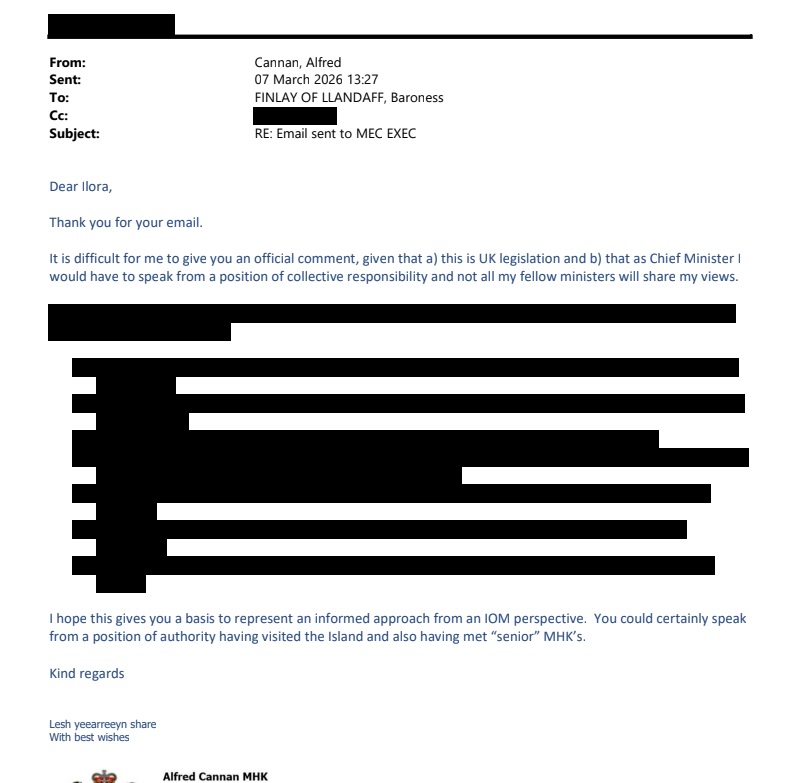
The Chief Minister gives two reasons why it is difficult to give an official comment, before sharing 15 lines of redacted text. The second is his position as one member of the Council of Ministers, who do not share the same view on assisted dying in the Isle of Man; leading to a concern that the Chief Minister was being accused of having “personally intervened in the process inside a Westminster piece of legislation”. The first is that “this is UK legislation”. What does he mean?
The UK Parliament retains the legal authority to legislate for the Isle of Man by Act of Parliament. The modern constitutional position is that only in exceptional circumstances should this be exercised without the consent of Manx authorities. So in some instances it is not only permissible, but expected, that Manx views on UK legislation will be expressed. This is, however, UK legislation which is intended to extend to, or provide for the later extension to, the Isle of Man.
The Finlay amendment, despite the reference to the Crown Dependencies, would not have changed Manx law. It is worth unpacking this a little.
In some cases, criminal liability can attach to a UK resident for actions committed outside of the jurisdiction. Generally, however, criminal liability does not attach for acts committed outside the jurisdiction, although the courts can be flexible in how they interpret where an act is committed – for instance, a letter sent to a person in Germany which constituted a demand with menaces resulted in prosecution of the English poster, on the basis that the demand was made as soon as the letter was posted. The location of the offence was grounded in where the criminal act began (England, with the posting of the letter), as opposed to only where the final act occurs (Germany, with the reading of the letter).
The Suicide Act 1961 created specific offences of aiding and abetting suicide. In Purdy the House of Lords considered whether these offences applied to deaths which were intended to occur outside of the jurisdiction, in this case Switzerland. There were significant differences of opinion in the House of Lords (perhaps most clearly between Lord Phillips and Lord Hope), but the majority considered it was not necessary to resolve the issue if it was in doubt – that is, if it was not impossible that the offence would be committed if the death occurred abroad, then the arguments for clarity put forward by Purdy would apply.
As a result of Purdy, the CPS published detailed guidance on prosecutorial policy in related to encouraging or assisting suicide. This includes the specific statement that:
“This policy applies when the act that constitutes the encouragement or assistance is committed in England and Wales; any suicide or attempted suicide as a result of that encouragement or assistance may take place anywhere in the world, including in England and Wales.”
If it was not impossible that an English resident could be prosecuted for aiding and abetting a suicide which lawfully occurred in Switzerland, it was not impossible that they could be prosecuted for aiding and abetting a suicide which lawfully occurred in the Isle of Man. It was this rule of English law – enforced in the English courts for acts which occurred in England – that would have been changed by the amendment, rather than any rule of Manx law enforceable in Manx courts.
In that sense, this was UK legislation for the UK.

